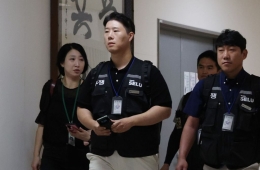
Minister Choi Gyojin: "Supporting Basic AI Education for Every Stage of Life"
Ministry of Education Announces Universal AI Education Plan for All Stages of Life
In response to the era of a major artificial intelligence (AI) transformation, the Ministry of Education will expand "customized basic AI education for every stage of life" to ensure that no one in the country is left behind from the benefits of AI. The number of hours dedicated to AI education in the current curriculum will be significantly increased, and the number of "AI-focused schools," which offer more hours in information subjects (computing systems, artificial intelligence, data, etc.) than regular schools, will be expanded from the current 730 schools to 2,000 schools by 2028, thereby strengthening the AI capabilities of elementary, middle, and high school students. Basic AI education will also be reinforced at leading national universities, and starting in 2026, 30 universities will be supported to offer a variety of interdisciplinary courses that combine AI with other academic fields. In addition, adults who are already employed or wish to enhance their AI skills will be able to receive AI education at a level suited to their needs through initiatives such as the activation of in-house AI graduate schools and the expansion of AI online open courses via K-MOOC, thereby strengthening lifelong and vocational education.

Early AI Talent Development... Doctorate in 5.5 Years, Expanded AI Admissions at Science and Gifted Schools
On November 10, the Ministry of Education announced the "AI for All: Artificial Intelligence Talent Development Plan for Everyone," which contains these measures. The ministry, recognizing the risk of falling behind in the global competition for dominance if the country fails to prepare for the AI era in time, has chosen to focus on nurturing "talent" as its core strategy. With this announcement, the Ministry of Education plans to accelerate the implementation of national policy tasks to support South Korea's goal of becoming one of the world's top three AI powers.
The ministry's key objectives are: ▲expanding universal AI education across all stages of life; and ▲developing multi-layered AI talent, including innovative and interdisciplinary professionals, to drive the country's leap into the global top three in AI.
To achieve these goals, support will be provided to foster AI literacy from elementary and secondary education, and the government will concretely support the cultivation and securing of outstanding talent in line with the "Science and Technology Talent Acquisition Strategy."
Within the current curriculum, teachers will be able to restructure courses to increase AI education hours within information subjects, and teacher training colleges will develop new AI curricula to strengthen the AI capabilities of future educators from the pre-service stage.
Furthermore, the number of AI-focused schools will be gradually increased to 2,000 by 2028. These schools will be able to offer more hours in information subjects than regular schools and will operate various AI clubs and career/experience programs. Through this, the ministry aims to support diverse efforts for AI transformation in the field, while ensuring that teachers, students, and parents can adequately prepare for the major AI transition without confusion caused by rapid policy changes. In collaboration with the National Education Commission, revisions to the elementary and secondary education curriculum will also be pursued to systematize AI education.

In addition, to ensure that even non-major university students can acquire basic AI literacy, basic AI education will be strengthened at leading national universities, and excellent courses and instructors will be shared with neighboring universities. Starting in 2026, 30 universities will be supported to develop interdisciplinary courses that combine various academic fields and AI, as well as general education courses on topics such as ethical AI use. Considering that university students are already widely using generative AI for assignments and other tasks, the curriculum will include AI literacy skills to ensure students do not become overly dependent on AI and can use it ethically.
Measures for adult learners are also being prepared. The number of intensive AI+Digital (AID) courses for employees to enhance job-related AI skills will be expanded from 30 institutions in 2025 to 38 in 2026, and support for AI education via online platforms such as K-MOOC, cyber universities, and the Korea National Open University will be strengthened to allow anyone to acquire basic AI literacy anytime, anywhere. In addition, digital lifelong education vouchers will be expanded so that adult learners aged 30 and over can develop AI and digital skills without financial burden.
To ensure that the AI transformation is balanced across regions, regional AI education will also be strengthened. First, AI Education Support Centers will be established in three provincial education offices by 2026 and expanded to all 17 metropolitan and provincial education offices nationwide by 2028. In addition, leading national universities will be intensively developed as regional AI hubs (three universities by 2026, with a budget of 30 billion won). Support will also be provided for the establishment of colleges focused on strong academic fields and AI-related departments linked to local industries, as well as for infrastructure such as GPUs. Furthermore, the 37 AI bootcamps to be selected next year will focus on regional institutions. Through these measures, the ministry aims to strengthen the foundation for outstanding talent to grow within their local regions.

The number of science high schools and gifted schools supported for AI and software (SW) specialized curricula and program operation will be increased from 14 schools this year to all 27 science and gifted schools next year. This is part of the effort to foster AI talent from an early stage. In addition, a new fast-track system will be introduced to allow integrated bachelor's, master's, and doctoral programs, enabling outstanding students to earn a doctorate 5.5 years after entering university and move into industry or research in their early to mid-20s. The ministry will also consider introducing a "National Distinguished Professorship System" (tentative name) to allow excellent teachers to continue participating in education and research after retirement, and will clarify standards for joint appointments between academia and industry to help mitigate the problem of talent outflow overseas. Support will also be provided for entrepreneurship, such as operating startup funds, so that university research achievements can be commercialized through startups.
AI Education for Adults and Non-Major University Students... Fostering Interdisciplinary AI Talent Across Industry and Academia
The Ministry of Education will also strengthen support for fostering interdisciplinary talent required by various industries. To lay the foundation for interdisciplinary AI talent development from the elementary and secondary levels, STEAM (Science, Technology, Engineering, Arts, and Mathematics) education will be reinforced so that students can use knowledge from various subjects to solve complex problems. Students' AI data skills will be enhanced, focusing on foundational subjects such as mathematics and science, and intelligent science labs will be expanded to all elementary, middle, and high schools by 2027.
In addition, the ministry will support the development and operation of curricula that link advanced fields such as secondary batteries and biotechnology with AI through AX bootcamps, and will launch a new project to promote the use of AID at vocational colleges by designating specialized vocational colleges for AID transformation.
To foster critical thinking and the ability to reason, which are essential for future society, the number of "Questioning School Leading Schools," where students create their own questions and expand their thinking through discussion, will be increased from 104 this year to 200 by 2027.
Efforts to design curricula and foster talent in collaboration with industry, vocational high schools, and universities have been diverse to date. However, due to the rapid development of AI technology, companies are increasingly facing talent shortages. The government plans to expand industry participation in AI talent development programs and to train talent that can be quickly utilized in the field through various methods.
The designation of AI-specialized Meister high schools will continue, and the number of schools participating in the re-jump support project, which encourages the use of AI in Meister high school major subjects, will be increased by seven per year, with 35 new schools to be selected by 2030. The restructuring of vocational high school departments to focus on AI will be expanded, and active support will be provided to strengthen AI literacy and application skills in all specialized high schools by 2030.
Furthermore, the system of contract departments and contract quotas, in which companies and universities sign agreements to train AI talent tailored to industry demand, will be continuously expanded. Internship programs will also be supported so that graduating students can gain work experience in companies. The ministry will revise the system related to the establishment of in-house graduate schools where companies directly train AI talent, and will introduce the "Industrial Degree System" (tentative name) to allow degrees to be awarded for research and development outcomes achieved through industry-academia cooperation.
Hot Picks Today
 "Samsung and Hynix Were Once for the Underachievers"... Hyundai Motor Employee's Lament
- "Was This Delicious Treat Enjoyed Only by Koreans?"... The K-Dessert Captivating Japan
- "Iran Considers Usage Fees From Surface to Seabed, Eyes $15 Billion Annual Revenue"
- U.S. Treasury Yields Surge Amid Iran War Uncertainty... Warning Signs for AI Tech Stock Rally
- "That? It's Already Stashed" Nightlife Scene Crosses the Line [ChwiYak Nation] ③
Minister of Education Choi Gyojin stated, "Fostering AI talent is a national survival strategy that everyone must consider and address together," adding, "The Ministry of Education will support basic AI education for every stage of life so that all citizens can easily utilize AI in their daily lives, and will foster talent capable of leading the AX era." He also emphasized, "Since the AI transformation and talent development require the combined efforts of all government ministries, we will strengthen cooperation with related ministries."
© The Asia Business Daily(www.asiae.co.kr). All rights reserved.