Prosecutors' Office to Be Dissolved in a Year... Three Key Issues as Constitutional Complaint Looms
The amendment to the Government Organization Act, which centers on abolishing the Prosecutors' Office, passed the Cabinet meeting on September 30. The revised Government Organization Act will be promulgated on October 1, 2026, and the Prosecutors' Office will be dissolved the following day, on October 2. The Prosecutors' Alumni Association, as well as former Ministers of Justice and former Prosecutors General, have already announced their intention to immediately file a constitutional complaint upon promulgation. As a result, attention is focused on how the Constitutional Court will rule when a constitutional complaint is filed regarding this legislation. The key issues are: whether a constitutional complaint can be filed before the law is enforced; whether the petitioners are eligible; and whether an injunction to suspend the law's effect will be granted.

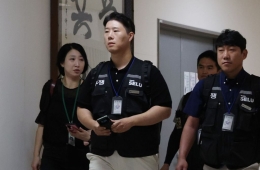
The Supreme Prosecutors' Office in Seocho-gu, Seoul. Photo by Yonhap News Agency
View original image① Constitutional complaint before the law is enforced?
The first issue is the timing of the petition. Since the law will take effect in a year, some may argue that no violation of fundamental rights has yet occurred.
Constitutional scholars believe that it will be possible to file a constitutional complaint even before the law is enforced. Although a constitutional complaint generally requires the 'actuality' of a fundamental rights violation, the Constitutional Court has exceptionally recognized this requirement if a future violation is clearly predictable. Professor A, a constitutional law expert at a law school in Seoul, stated, "Even before a law is promulgated or enforced, if a violation of fundamental rights can be clearly predicted after enforcement, a constitutional complaint can be filed in advance," adding, "In this case, the actuality of the fundamental rights violation is unlikely to be a significant issue."
The Prosecutors' Alumni Association, along with some former Ministers of Justice and former Prosecutors General, issued a statement on September 28, declaring, "The amendment to the Government Organization Act abolishing the Prosecutors' Office is unconstitutional," and, "If promulgated, we will immediately file a constitutional complaint."
② Petitioners: Prosecutors or the public?
The second issue concerns the eligibility of petitioners. In a constitutional complaint for relief, the petitioner must prove that they are the party whose fundamental rights have been violated.
In legal circles, it is believed that the Prosecutors' Alumni Association-composed of former Ministers of Justice, former Prosecutors General, and former prosecutors-may not qualify as petitioners, as it would be difficult for them to claim a direct violation of their fundamental rights. In contrast, current prosecutors are seen as having a stronger case for standing. Professor B, a constitutional law expert at another law school, noted, "It would be much more convincing for current prosecutors to claim that their right to hold public office has been violated," adding, "While former prosecutors may feel aggrieved, it is difficult for them to argue that their right to hold public office is being violated at this moment."
Some argue that all citizens could qualify as petitioners. This argument is based on the premise that abolishing the Prosecutors' Office is not merely a legislative amendment, but a constitutional amendment. Article 130, Paragraph 2 of the Constitution stipulates that constitutional amendments must be put to a national referendum. Therefore, handling the abolition of the Prosecutors' Office as a simple legislative amendment could be seen as violating the right to a national referendum, and this logic was actually cited in the past case regarding the relocation of the administrative capital (2004Hun-Ma554). The key is whether the Prosecutors' Office is recognized as a constitutional institution.
There are differing academic views on whether the Prosecutors' Office can be considered a constitutional institution. Professor A explained, "The existence of the Prosecutor General, as specified in the Constitution, presupposes the Prosecutors' Office," and, "If the Prosecutors' Office is interpreted as a constitutional institution, its abolition would require a constitutional amendment, and handling it solely through legislation without a national referendum could be seen as a violation of the right to a national referendum."
On the other hand, Professor C, another constitutional law expert, stated, "The Constitution only stipulates the appointment of the Prosecutor General and the right of prosecutors to request warrants; it is difficult to interpret this as an inseparable, organic entity with the Prosecutors' Office," adding, "Since the Prosecutors' Office itself is not a constitutional institution, the logic of violating the right to a national referendum does not hold."
Professor D, a constitutional law expert at a law school in Seoul, commented, "The argument regarding violation of the right to a national referendum draws on the 2004 precedent about the relocation of the administrative capital, but that case directly affected all citizens," and, "The abolition of the Prosecutors' Office is an issue affecting a specific professional group, so the argument may not be robust." He added, "However, given the significant impact of the issue, the Constitutional Court may opt for a substantive ruling rather than simply dismissing the case."
③ Is an injunction to suspend the law's effect possible?
There is also the possibility that a request for an injunction to suspend the law's effect will be filed simultaneously with the constitutional complaint. If the Constitutional Court grants the injunction, the law's enforcement will be suspended and the dissolution of the Prosecutors' Office will be halted until a substantive ruling is made.
There are questions as to whether suspending the law's effect before it is enforced would be effective. Some believe that it is possible to request an injunction to preemptively halt the law's enforcement, timed for the enactment date one year after promulgation.
However, opinions are divided on the likelihood of the injunction being granted. While a rational conclusion is expected, some believe that the political inclinations of the justices may influence the decision.
Hot Picks Today
 "Samsung and Hynix Were Once for the Underachievers"... Hyundai Motor Employee's Lament
- Samsung Enterprise Labor Union: "We Respect Court’s Injunction Decision... General Strike to Proceed on the 21st as Planned"
- "Was This Delicious Treat Enjoyed Only by Koreans?"... The K-Dessert Captivating Japan
- Special Counsel on Insurrection Urges Swift Decision on 'Recusal Requests' by Yoon Seok-yeol and Others, Citing 'Clear Intent to Delay'
- "That? It's Already Stashed" Nightlife Scene Crosses the Line [ChwiYak Nation] ③
Lim Hyunkyung, Legal Times Reporter
※This article is based on content supplied by Law Times.
© The Asia Business Daily(www.asiae.co.kr). All rights reserved.