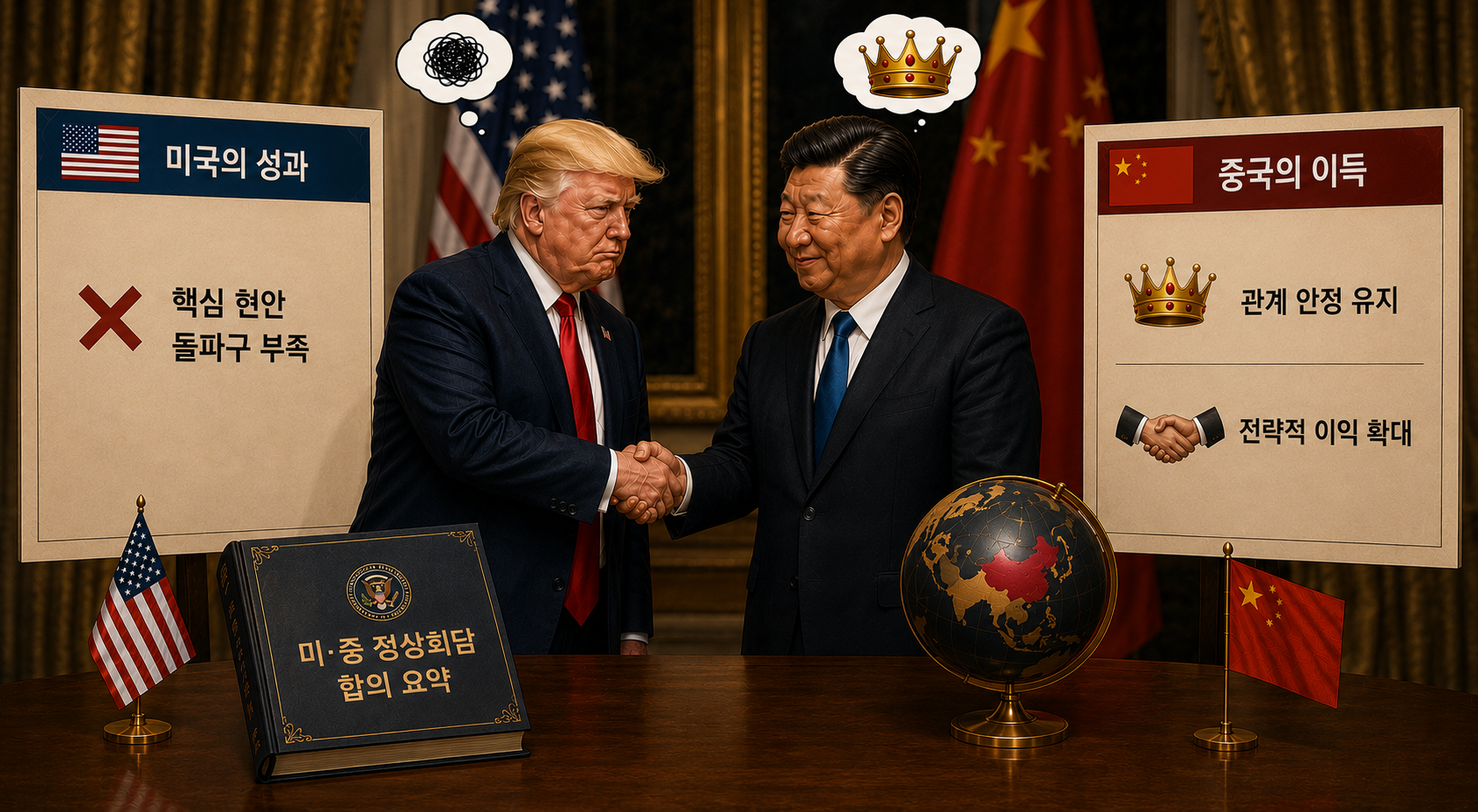

On May 17 (local time), the White House released a fact sheet outlining the results of the U.S.-China summit, including China’s commitment to purchase at least $1.7 billion (approximately 25.5 trillion won) worth of U.S. agricultural products annually through 2028. The two countries also agreed to establish a trade commission that will oversee future discussions on trade-related matters. However, experts noted that there was a lack of breakthroughs on core issues, such as a concrete Chinese guarantee on rare earth supply chains and specific agreements regarding tariff reductions.
White House Calls It a "Historic Achievement," but...
According to the fact sheet released under the title “President Donald J. Trump Secures Historic Deals with China,” China has pledged to purchase at least $1.7 billion worth of U.S. agricultural products annually from 2026 to 2028. This is in addition to the previously promised purchase of U.S. soybeans agreed at the summit in Busan in October of the previous year. The year 2028 effectively marks the final year of President Trump’s second term in office.

The two countries also agreed to establish both a U.S.-China Trade Commission and an Investment Commission. According to the White House, the Trade Commission will be responsible for managing trade in “non-sensitive goods.” According to China's Ministry of Commerce, the Trade Commission will oversee mutual tariff reductions on certain products and will be in charge of broad negotiations on tariff reductions for agricultural products and other items. Earlier, foreign media had reported that both countries had been discussing tariff reductions on non-sensitive items, each worth about $3 billion (about 4.5 trillion won). However, neither the U.S. nor China released detailed information on specific items, amounts, or quantities in their announcements.
Another achievement highlighted by the White House is the easing of export restrictions on U.S. beef. China has agreed to renew export licenses for more than 400 U.S. beef facilities whose registrations had expired and to add new registrations. The agreement also includes efforts, in cooperation with U.S. regulatory authorities, to lift all restrictions on U.S. beef facilities. Additionally, imports of poultry from certain U.S. states, designated as highly pathogenic avian influenza (HPAI)-free by the U.S. Department of Agriculture (USDA), will resume.
China has also agreed to purchase 200 Boeing aircraft. However, this figure falls short of the market’s expectations of 500 aircraft. In fact, Boeing’s stock price fell by 4.73% and 3.80% respectively on May 14 and 15 compared to the previous trading day. Nevertheless, President Trump stated on his return trip that China could increase its purchases to as many as 750 aircraft. The White House also mentioned that, regarding rare earths and critical minerals that China used as leverage during last year's trade war, “China will address U.S. concerns about supply chain shortages for yttrium, scandium, neodymium, indium, and others.”

Both Countries: "Cannot Allow Iran to Possess Nuclear Weapons, Keep Strait of Hormuz Open"
In the area of security, the White House said the two countries agreed that Iran must not be allowed to possess nuclear weapons and called for the reopening of the Strait of Hormuz. They also agreed on the principle that no passage fees should be imposed for transit through the Strait of Hormuz. Regarding North Korea, the White House stated that the two leaders reaffirmed their “shared goal” of denuclearization of North Korea. Previously, China’s state-run Xinhua News Agency briefly reported that the two leaders exchanged views on the situation in the Middle East, the Ukraine crisis, and issues related to the Korean Peninsula.
The White House emphasized, “President Trump and Chinese President Xi Jinping agreed that the United States and China should build a constructive relationship of strategic stability based on fairness and reciprocity.” The phrase “constructive relationship of strategic stability” was first mentioned by President Xi during the summit and was adopted as-is by the United States. The White House also highlighted President Xi’s promise to visit Washington in September as a major achievement.

U.S. President Donald Trump (right) and Chinese President Xi Jinping are attending the schedule on the second day of the summit at the garden of Zhongnanhai in Beijing on the 15th. Photo by AP
원본보기 아이콘Experts: "Limited Achievements"... "Described as Ordinary"
While the Trump administration has portrayed the outcome of the summit as “historic,” U.S. experts have commented that the summit contributed to stabilizing relations but resulted in only limited substantive economic achievements. Other than agreements on agricultural and Boeing purchases, there were few solutions presented to resolve structural trade conflicts. Furthermore, specific results regarding U.S. energy sales, which had been promoted by senior Trump administration officials, were not included in the fact sheet.
Kurt M. Campbell, chairman and co-founder of The Asia Group (TAG) and a leading U.S. Asia and foreign policy expert, stated in a foreign press briefing, “The outcome of this summit was relatively modest,” though he noted that “there is some potential for progress in the agricultural sector and some other areas.” He added, “Now, attention turns to President Xi’s visit to Washington, D.C. on September 24—a rare move by China to set a specific date for such a distant event.”
Christopher Johnson, chairman of the China Strategies Group and former lead China analyst at the Central Intelligence Agency (CIA), told the Financial Times (FT) that the economic results for the United States were “much more ordinary.” He went on to say that “the minimal purchase outcomes suggest that the Trump team did not easily allow China to extend the long-term truce it wanted and sought to maintain pressure on China regarding rare earths.” The two countries had agreed to a one-year truce in October of the previous year, and while China wanted to extend it through the end of Trump’s term, the United States was reluctant to make a long-term commitment in order to retain its negotiating leverage, according to FT’s analysis.

"China Gains More Economic Benefits"... Concerns Raised over Taiwan Comments
There is analysis that China gained more economic benefits, including maintaining the tariff war truce. Scott Kennedy, a senior adviser and China economy expert at the Center for Strategic and International Studies (CSIS), also said in a discussion, “Overall, from China’s perspective, this is a ‘grand bargain,’ and China did quite well in the economic sector.” He added, “China gave up very little and, in particular, obtained the important extension of the Busan truce. On the other hand, sensitive issues such as industrial policy, global imbalances, or China’s ‘economic red lines’ were hardly discussed.”
Meanwhile, President Trump’s remarks regarding the Taiwan issue during the summit raised concerns among experts. Campbell commented, “From the perspective of U.S. allies, there was somewhat of a ‘G2’ feeling, giving the impression that the two great powers are making decisions that shape Asia. While allies may think they have avoided the worst, they are also likely feeling uneasy.” Ryan Hass, a China expert at the Brookings Institution in Washington, D.C., pointed out that “by raising questions about the continuation of the U.S.’s existing cross-strait policy, President Trump is opening the door for Beijing (China) to simultaneously put pressure on both Washington (the U.S.) and Taipei (Taiwan).”
!["Please Help Us": How Much Do Those Bowing 90 Degrees These Days Actually Earn? [Data Pick]](https://cwcontent.asiae.co.kr/asiaresize/323/2026052010120870131_1779239528.png)