DGIST Develops 'Smart Adhesive Electrode' Without Worry of Nerve Damage
Expectations for the Use of Various Soft Bioelectronic Devices, Including Electronic Medicines, for Peripheral Nerve Treatment
The Daegu Gyeongbuk Institute of Science and Technology (DGIST) announced on the 20th that a research team led by Professor Kim Sohee from the Department of Robotics and Mechanical-Electronic Engineering has developed an electrode that can safely wrap around nerves without causing damage.
The newly developed electrode features the ability to transform from a flat 2D shape into a 3D structure using soft actuation technology. It is expected to be utilized in various next-generation soft bioelectronic devices, such as electronic medicines targeting peripheral nerves.

Nerve electrodes are devices that measure electrical signals transmitted through nerves or stimulate nerves by sending tiny currents. They are used to help patients with nerve damage regain movement or to reduce pain by stimulating specific nerves.
However, if the nerve and electrode do not make proper contact, it is difficult to accurately measure signals or deliver the desired stimulation. Conventional cuff electrodes fix the nerve by wrapping around it, but since nerves have a smooth, wire-like structure, the electrode can slip or rotate. To prevent this, the electrode is tightened strongly, but this can compress the nerve, reducing blood flow or causing damage.
To overcome the limitations of conventional cuff electrodes, the research team developed a 'soft-actuated cuff electrode' that can bend by itself to wrap around the nerve.
This electrode operates by gently bending to envelop the nerve, allowing it to be stably fixed without sutures. It maintains adhesion without excessively tightening the nerve, making it safer than existing electrodes.
The team applied a structure where part of the electrode protrudes three-dimensionally. This reduces the contact area with the nerve while increasing adhesion, enabling clearer nerve signal measurement without damaging the nerve.

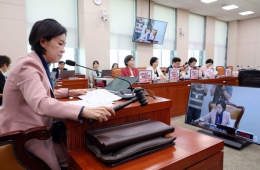
Professor Sohee Kim, Department of Robotics and Mechanical Engineering, DGIST (left), Hyunmin Moon, Postdoctoral Researcher, Department of Mechanical Engineering, MIT. Provided by DGIST
View original imageLong-term experiments applying the electrode to peripheral nerves showed that it could measure accurate nerve signals without causing nerve damage and selectively stimulate the desired nerves. In particular, thanks to the 3D structure that minimizes pressure while maintaining close contact with the nerve, nerve tissue was not damaged, and nerve function remained intact.
Professor Kim said, "This research presents a new concept of cuff-type electrodes that wrap around peripheral nerves and the vagus nerve," adding, "As it enables long-term high-quality nerve signal monitoring and minimal current stimulation, it is expected to be utilized in various bioelectronic devices such as implantable electronic medicines in the future."
Hot Picks Today
 "Now Our Salaries Are 10 Million Won a Month" Record High... Semiconductor Boom Drives Performance Bonuses at Major Electronic Component Firms
- Wallets Open Wide on Big News...300 Trillion Won Heads to the U.S., "Tax Breaks" Fail to Keep Funds at Home
- "Hope You Enjoy the 'Welfare' for Bereavement of Children"... Ridicule of Strike Non-Participants Intensifies Union Conflict at Samsung Electronics
- "Realizing How Fast Money Disappears: Should You Try Only the Essentials for 5,000 Won? [The Basics of Benefits]"
- Experts Already Watching Closely..."Target Price Set at 970,000 Won" Only Upward Momentum Remains [Weekend Money]
This study was led by corresponding author Professor Kim Sohee, with Dr. Moon Hyunmin, a postdoctoral researcher in the Department of Mechanical Engineering at MIT, as the first author. Senior Researcher Chu Namseon from the Korea Brain Research Institute and Neurosurgery Professor Park Kisu from Kyungpook National University Hospital also participated. The research results were selected as a Back Cover paper in the international journal Advanced Materials.
© The Asia Business Daily(www.asiae.co.kr). All rights reserved.