Forgotten 2024 Heatwave in the US... What About Trump's Withdrawal Declaration from the 'Paris Climate Change Agreement'?
Trump Withdraws U.S. from Climate Pact on First Day in Office
Signs Executive Order on Paris Agreement Involving Over 200 Countries
Concerns Rise Over Global Warming After U.S. Withdrawal

On the 20th (local time), U.S. President Donald Trump signed an executive order to withdraw the United States from the Paris Climate Agreement. The photo shows local firefighters watching a wildfire in Riverside County, California, last September. (AP·Yonhap News)
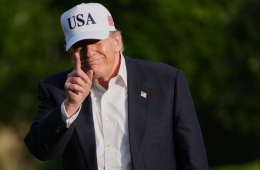
View original imageOn the 20th (local time), U.S. President Donald Trump signed an executive order withdrawing the United States from the Paris Agreement on climate change, which involves over 200 countries, on the first day of his term as the 47th president. Given that 2024 was recorded as the 'hottest year in history,' concerns have arisen that this U.S. decision could act as a catalyst accelerating global warming.
What is the Paris Agreement?
According to CNN on the 20th (local time), ten years ago in 2015, more than 190 countries gathered at the UN Climate Summit held in Paris and signed the Paris Agreement on climate change, aiming to limit global warming to below 2 degrees Celsius, preferably to 1.5 degrees.
There was disagreement among countries about whether to target 1.5 degrees or 2 degrees. The 1.5-degree target was a standard strongly advocated by climate scientists. Ultimately, this target was added as an ideal standard rather than the official goal of the agreement.
The agreement is not legally binding. Countries have no obligation under international law to reduce climate pollution. Each country must set its own pollution reduction targets and methods to achieve them. The limitations of the agreement were revealed. While it had monumental significance in leading the world in the direction supported by scientists, it lacked detailed plans for countries to achieve their goals.
In fact, in 2024, the Earth's temperature rose by an average of 1.6 degrees compared to pre-industrial times, marking the hottest year in climate observation history. This level exceeded the 1.5-degree increase limit set by the agreement for the first time. Last year, an area more than 100 times the size of Yeouido in southern California burned. The combination of heatwaves and dry climate led to disaster-level fires. Rapid growth of weeds and shrubs due to climate change was also cited as one of the causes.
U.S. Climate Goals and Impact
The Biden administration submitted a new target representing the United States in December 2024. This included a plan to reduce climate pollution by up to 66% from 2005 levels by 2035.
Former President Joe Biden was already aware that Trump intended to withdraw the U.S. from the agreement. This target itself was a symbolic declaration of the path that could be set if the U.S. elected a climate-friendly president.
Climate advocates agreed that this target was ambitious. Kate Larson, head of international energy and climate research at the private research institute Rhodium, said, "Considering this new and ambitious target aiming for 2035, we are already off track," adding, "Under the Trump administration, it is even more likely that we will deviate further from the plan."
U.S. Paris Agreement: Joining → Withdrawal → Rejoining → Withdrawal
U.S. representatives have played a leading role in the agreement. The agreement was adopted by about 200 countries during the Obama administration in 2015.
Trump announced the U.S. intention to withdraw from the agreement in 2017, which was officially formalized on November 4, 2020, the day after Biden won the presidential election.
Biden announced his intention to rejoin the agreement on the first day of his term.
Hot Picks Today
 "Buy on Black Monday"... Japan's Nomura Forecasts 590,000 for Samsung, 4 Million for SK hynix
- "Plunged During the War, Now Surging Again"... The Real Reason Behind the 6% One-Day Silver Market Rally [Weekend Money]
- "We're Now Earning 10 Million Won a Month"... Semiconductor Boom Drives Performance Bonuses at Major Electronic Component Firms
- [PE Now] F&B Companies Making a Second Attempt at Sale: The Formula for a Successful Deal
- Experts Are Already Watching Closely..."Target Stock Price 970,000 Won" Now Only the Uptrend Remains [Weekend Money]
On the first day of Trump's second term in January 2025, Trump once again ordered the U.S. withdrawal from the agreement and announced plans to increase U.S. fossil fuel production.
© The Asia Business Daily(www.asiae.co.kr). All rights reserved.