"Contract Work Also Goes Electronic~"…Seocho-gu to Reduce Paper Usage by 200,000 Sheets
'Seocho Smart Contract Administration' to be Implemented from Next Month
Reducing Visits to Contract Companies, Streamlining Procedures to Enhance Efficiency

Seocho-gu, Seoul (Mayor Jeon Seong-su) announced on the 21st that starting next month, it will transition contract work, which currently involves paper document approval, printing, and storage, to an electronic document-based system, promoting a paperless and visit-free ‘Seocho Smart Contract Administration.’
Currently, during the contract process, stamps and handwritten approvals are applied on paper documents at each stage, resulting in about 250,000 sheets of paper annually being compiled and stored in archives.
To improve this, the district plans to replace stamps and approvals with administrative electronic signatures, unifying the process into an electronic document system without paper printing. The method of compiling documents and storing them in archives will be improved to electronic storage within the work management system.
The contract department will also refrain from unnecessary printing of contract documents at each stage and use the electronic system for electronic storage, reducing the use of printing paper and office supplies, which is expected to reduce carbon emissions and save budget.
It is anticipated that this policy will reduce about 200,000 sheets of paper annually, which accounts for 80% of the current usage. According to the Ministry of Environment’s ‘Carbon Neutral Lifestyle Practice Guide,’ the amount of paper saved is equivalent to planting 140 thirty-year-old pine trees. Assuming a carbon absorption of 8kg per pine tree, a total reduction of 1,120kg of carbon dioxide is expected.
Additionally, contract companies have had the inconvenience of having to visit the district office’s ordering and contract departments directly from as few as twice to as many as 7 to 8 times to submit contract documents. To address this, the district plans to allow contract documents that can be electronically submitted through the Public Procurement Service’s Nara Marketplace to be received electronically without visits, reducing the number of visits by contract companies to the district office.
Furthermore, when individual departments request contracts, instead of submitting documents manually, they will send them electronically through the work management system, eliminating the inconvenience of employees visiting the district contract department (Finance Division) and simplifying the work process.
In addition, the district will promote contracts that coexist with local small businesses by preparing improvement measures regarding the current limit on the number of direct contracts with the same company. The limit on direct contracts is a standard to prevent concentration of contracts with specific companies, restricting to 5 cases per department annually and 7 cases district-wide.
The district has established an exception clause that relaxes the direct contract limit to 7 cases per department annually and 9 cases district-wide for local companies, aiming to improve contract fulfillment rates with local companies and contribute to revitalizing the local economy.
The district is also pursuing various win-win measures for small and medium contract companies. Through the ‘Introducing Our Companies’ system on the district website, which is a local company promotion system, it facilitates easy searching of company information and actively utilizes it to discover local companies. Additionally, an ‘Easy-to-Understand Public Contract Guide’ has been produced and distributed to contract companies, allowing them to easily find major procedures and required documents at each contract stage.
Hot Picks Today
!["Rather Than Endure a 1.5 Million KRW Stipend, I'd Rather Earn 500 Million in the U.S." Top Talent from SNU and KAIST Are Leaving [Scientists Are Disappearing] ①](https://cwcontent.asiae.co.kr/asiaresize/93/2026051914165468840_1779167814.png) "Rather Than Endure a 1.5 Million KRW Stipend, I'd Rather Earn 500 Million in the U.S." Top Talent from SNU and KAIST Are Leaving [Scientists Are Disappearing] ①
"Rather Than Endure a 1.5 Million KRW Stipend, I'd Rather Earn 500 Million in the U.S." Top Talent from SNU and KAIST Are Leaving [Scientists Are Disappearing] ①
- Brilliant Korean Technology Flows Overseas... Subsidies Granted, but "No Product Launch Allowed"
- "If That's the Case, Why Not Just Buy Stocks?" ETFs in Name Only, Now 'Semiconductor-Heavy' and a Playground for Short-Term Traders
- Singer Kim Minjong Responds to MC Mong's Gambling Allegations: "Clearly False... Legal Action to Follow"
- "No Cure Available, Spread Accelerates... Already 105 Dead, American Infected"
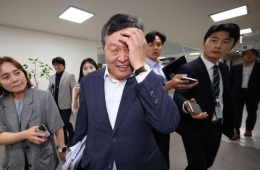
Mayor Jeon Seong-su said, “Through this ‘Seocho Smart Contract Administration,’ we will take the lead in practicing global carbon neutrality by digitizing contract work, and furthermore, by coexisting with local small businesses and revitalizing the local economy, we will create a more transparent, fair, eco-friendly, and clean city Seocho-gu.”
© The Asia Business Daily(www.asiae.co.kr). All rights reserved.
![Cheaper Than Candy, Yet Impossible to Find... Fears of a 'Pediatric Medical Crisis' as Pharmaceutical Companies Halt Production [Why&Next]](https://cwcontent.asiae.co.kr/asiaresize/307/2026051910065268365_1779152813.jpg)