Bank with 'Seungseung Janggu' Performance... Ending Good Times with a Pivot?
As domestic banks are expected to achieve record-high performance this year, attention is focused on the aftermath of the Bank of Korea's decision to cut the base interest rate for the first time in 38 months. The industry expects that, although there will be little immediate change due to loan regulations, once a full-fledged interest rate cut cycle begins, the net interest margin (NIM), a key indicator of bank management, will naturally decline, making mid- to long-term profitability deterioration inevitable.

Since 2018 until June of this year, a total of 14,426 ATMs have been removed from banks over approximately six years. On the 24th, ATMs from commercial banks are installed on a street in Seoul. Banks are rapidly withdrawing ATMs, citing maintenance costs such as ATM management and heating and cooling expenses. Photo by Yongjun Cho jun21@
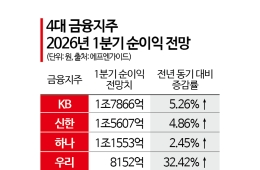
View original imageAccording to FnGuide, a financial information analysis firm, the consensus net income attributable to controlling shareholders for the four major domestic financial holding companies (KB, Shinhan, Hana, Woori) this year is estimated at 16.6427 trillion KRW. This represents a 6.34% (9.924 trillion KRW) increase compared to the record-high combined net income of 15.6503 trillion KRW in 2022.
In the third quarter alone, the four major banks are estimated to have posted a combined net income of 4.6504 trillion KRW, approaching 5 trillion KRW. The net income of the four major banks has exceeded 15 trillion KRW for three consecutive years due to the impact of high interest rates: 15.6503 trillion KRW in 2022, 15.1367 trillion KRW in 2023, and an estimated 16.6427 trillion KRW in 2024.

Despite the decline in market interest rates driven by expectations of interest rate cuts, the banking sector has maintained strong performance thanks to explosive loan growth and artificial interest rate adjustments to curb it. As expectations for interest rate cuts by the U.S. Federal Reserve (Fed) increased, the 5-year bank bond rate, which serves as the benchmark for fixed-rate mortgage loans, fell to 3.145% in mid-last month, marking the lowest level in about two years.
However, from July to September, bank loans increased by more than 20 trillion KRW due to the housing market recovery, and to prevent a surge in household debt, authorities and banks raised household loan interest rates about 30 times by adjusting the spread rate. This allowed banks to defend profitability despite falling market interest rates. For example, the average loan-to-deposit interest rate spread for household loans (excluding policy-based low-income finance) at the four major banks, which had been narrowing, rose by 0.11 percentage points to 0.44 percentage points in August compared to the previous month.
Although banks continue their strong performance, the Bank of Korea's 0.25 percentage point base rate cut at the Monetary Policy Committee meeting on the 11th has led to observations that the banks' prosperous period is entering its final stage in the mid- to long term. With market interest rates already declining, many banks' NIMs in the second quarter failed to avoid a downward trend compared to the previous quarter. Mirae Asset Securities estimated in a report released the day before that some banks that rapidly increased mortgage loans in July and August likely experienced a 3-4 basis points (1 bp = 0.01%) decline in NIM.
Lee Byung-yoon, senior research fellow at the Korea Institute of Finance, stated in a recent report titled "Status and Outlook of Domestic Banks' Profitability and Soundness in the First Half of 2024" that "Domestic banks generally have interest-bearing assets that generate interest income larger than interest-bearing liabilities that incur interest expenses, so when interest rates rise, interest income increases, and when they fall, it decreases." He added, "The NIM of domestic banks tends to move similarly to market interest rates, so if the global trend of interest rate cuts continues and domestic policy rates fall along with market rates, downward pressure is expected."
A representative from a commercial bank said, "Looking at the trends over the past one to two years, each bank has steadily increased assets such as corporate and household loans, but market interest rates have continuously declined amid expectations of base rate cuts. Moreover, since the disclosure of the loan-to-deposit interest rate spread, the narrowing trend has continued, causing NIM to decline. While quantitative indicators may look good in year-end results, qualitative indicators likely deteriorated, and this trend is expected to continue next year."
Hot Picks Today
![Even With a 900 Million Won Deposit and 2.5 Million Won Monthly Living Expenses, Residents Say "It's Good to Be Taken Care Of"... Inside a Luxury Silver Town [Opening Silver Housing]](https://cwcontent.asiae.co.kr/asiaresize/93/2026042010015932171_1776646918.gif) Even With a 900 Million Won Deposit and 2.5 Mil...
Even With a 900 Million Won Deposit and 2.5 Mil...
- "When the Middle East War Ends, This Stock Will Lead"... Target Price Raised 71%...
- Apple's Foldable Phones, Production Expansion, and Robotics... All Signs Point t...
- "Please Launch It in Korea!" After All the Hype... This Coffee Finally Arrives i...
- Controversy Over Chinese Character Name Resembling "Ching Chong"... "The Devil W...
The financial sector expects the downward trend in NIM to continue until the base rate cut cycle ends. Jeong Tae-jun, a researcher at Mirae Asset Securities, said, "Bank NIMs will rebound sharply after the economy fully recovers and the base rate cut cycle ends, and loan growth rates will also surge at that time, leading to substantial growth in interest income. Since interest income still accounts for an absolute majority of net operating income in banking, it is necessary to focus on banks with a smaller proportion of interest income or those whose NIMs are less sensitive to interest rates during this period."
© The Asia Business Daily(www.asiae.co.kr). All rights reserved.