Seoul Mayor Oh Se-hoon Says He Will Not Insist on '100m Taegukgi' Display, Will Fully Consider Citizens' Opinions (Summary)
Controversy Over Large Taegeukgi at Gwanghwamun Calmed
Discussion on Expanding Beyond Taegeukgi to Other Korean National Symbols
Plan for National Symbol Space to Proceed as Scheduled
'Unextinguishable Flame' Also Usable with LED
"It is not the Taegeukgi. If it is judged that using the Taegeukgi as a symbol is not necessary, we may create a sculpture using the Mugunghwa flower as the motif."
As controversy continued over the announcement to install a giant 100m-high Taegeukgi flag at Gwanghwamun Square, Seoul Mayor Oh Se-hoon eventually took a step back. However, he did not withdraw the plan to create a national symbol space. Moving forward, discussions are expected to focus on revising the existing plan to actively utilize national symbols designated by the government and to allow height adjustments when installing flagpoles.

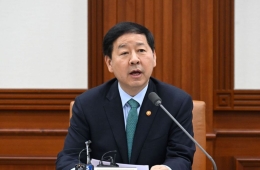
Seoul Mayor Oh Se-hoon is holding a press briefing on the 11th at Seoul City Hall in Jung-gu, Seoul, regarding the controversy over the construction of a 100m high Taegeukgi flagpole at Gwanghwamun Square. Photo by Jo Yong-jun jun21@
View original imageOn the morning of the 11th, Mayor Oh held a press briefing at Seoul City Hall and stated regarding the recent controversy, "We will keep all possibilities open and sufficiently gather opinions from citizens, experts, and various fields to create a meaningful place that reflects the wishes and intentions of the people."
Earlier, on the 25th of last month, marking the 74th anniversary of the June 25th Korean War, Mayor Oh announced a project to create a national symbol space at Gwanghwamun Square as part of which approximately 11 billion KRW would be spent to build a 'giant Taegeukgi' and an 'eternal flame.' The flagpole will feature a specially made Taegeukgi measuring 21m wide and 14m high, the largest in the country. The 'eternal flame' will be created either as an actual flame similar to an Olympic torch or as a lighting installation, to be decided in consultation with the Ministry of Patriots and Veterans Affairs.
However, immediately after the announcement, controversy arose over excessive patriotism. There was backlash against adding another nationalist sculpture to Gwanghwamun Square, which already has statues of Admiral Yi Sun-sin and King Sejong the Great. Some civic groups even called it a "retrogressive measure." The Ministry of Land, Infrastructure and Transport, which is also involved in creating the national symbol space, opposed the plan, stating that Gwanghwamun Square had never been designated as a national symbol space and that there was no prior consultation.
In response, Mayor Oh emphasized the intention behind the project, saying, "Gwanghwamun Square is the heart of downtown Seoul and a genuine national symbol space of the Republic of Korea where history, culture, and civic spirit coexist." He added, "This project started from the desire to create a place that represents the identity of the Republic of Korea as a free democracy alongside the statues of Admiral Yi Sun-sin and King Sejong the Great, which symbolize our nation's unique identity." He also previewed, "We will create a space to commemorate various historical events and figures that laid the foundation for today's Korea, including the June 25th War, the March 1st Independence Movement, and the April 19th Revolution, which have been the bedrock of Korea's freedom and prosperity."
Regarding the recent controversy, he said a separate channel for collecting opinions would be created on the city’s website. In particular, the form of the national symbol sculpture will include not only the Taegeukgi but also other national symbols designated by the government such as the national anthem, Mugunghwa, the national emblem, and the national seal. The existing plan to erect a 100m-high Taegeukgi flagpole and the 'eternal flame' symbol at Gwanghwamun Square will be reconsidered from scratch, but the project to create a national symbol space there will continue.
He also expressed a willingness not to insist on the Taegeukgi. While the Taegeukgi is a representative national symbol and was naturally proposed, given the differing opinions that it could be seen as nationalist, the plan will not be limited to the Taegeukgi. He said all possibilities would be kept open regarding the form and height of the national symbol sculpture and the historical events and figures to be commemorated.
If a flagpole is installed, a variable-height structure will be considered, adjustable from 10m up to a maximum of 70m. Mayor Oh said, "We will start a process to receive ideas from the entire nation," adding, "It does not have to be the Taegeukgi, and there is no need to insist on exactly 100m."
On the same day, Mayor Oh gave examples such as a media wall or media pole displaying the flags of the 22 countries that participated in the Korean War and the names of fallen soldiers surrounding the flagpole, with pine trees from all over the country standing on the outskirts. He also explained that the 'eternal flame' symbol could use LED lighting instead of an actual flame.
Going forward, the plan is to use an advisory body composed of civic groups and experts to add ideas to the overall concept, from the scale to the design of the national symbol space and sculptures, to produce the best outcome. They will also consider establishing a close cooperation system through consultations with the National Architecture Policy Committee, the Ministry of Patriots and Veterans Affairs, and the Ministry of Land, Infrastructure and Transport.
According to Seoul City's plan, the creation of the national symbol facility within Gwanghwamun Square will proceed with a design competition from August to November, complete basic and detailed designs by April next year, start construction in May, and finish by December of the same year. An integrated design competition will be promoted to harmonize the national symbol space with Sejongno Park, and through this process, the design and scale will be finalized. Additionally, Sejongno Park, which will be developed as the only hub-type convenience facility around the square in connection with Gwanghwamun Square, will be reborn as an essential urban space in the Gwanghwamun area.
Hot Picks Today
 "How Do Six People Sleep in a 44㎡ Apartment?" ...
- "Why Are the Same Shares Priced Differently?" Will SK hynix Also See a 'U.S. Lis...
- Local Companies to Gain Advantage in Public Procurement Bids: "Additional Points...
- "Never Hike Alone as a Woman" "Even Two Are at Risk"... Growing Fear of Crime on...
- "You Can Only Have This in Korea": Which National Museum Cafe Menu Is Captivatin...

Seoul Mayor Oh Se-hoon is holding a press briefing on the 11th at Seoul City Hall in Jung-gu, Seoul, regarding the controversy over the construction of a 100m high Taegeukgi flagpole at Gwanghwamun Square. Photo by Jo Yong-jun jun21@
View original image© The Asia Business Daily(www.asiae.co.kr). All rights reserved.
![Epic "1,500 Trillion Won Bill"... In the End, the Poor Pay the Price [Data Pick]](https://cwcontent.asiae.co.kr/asiaresize/307/2026042310001637425_1776906017.jpg)