Will the KOSPI Long Position Soar in June After a Strong May?
Rebound with Over 1% Increase on June 1st
Poor Performance in May with Negative Returns Compared to Early Year
Stock Price Recovery Expected in June
June FOMC as a Turning Point Amid Continued Significant Interest Rate Impact
On the first day of June, the KOSPI rose more than 1%, raising expectations for a rebound. Although it showed the weakest performance compared to major stock markets last month due to a sluggish trend, attention is focused on whether it can escape this downturn in June. With interest rates cited as a factor behind the relative underperformance of the KOSPI, the market flow this month is also expected to be influenced by the interest rate trajectory, and the June Federal Open Market Committee (FOMC) meeting scheduled for mid-June is anticipated to be a turning point.

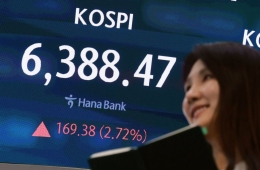
According to the Korea Exchange on the 4th, the KOSPI closed at 2,682.52, up 1.74% from the previous session. Starting June with a significant rebound has increased expectations for breaking through the previous high and recovering the 2,800 level this month.
Last month, the KOSPI fell by 2.06%. Compared to the beginning of the year, it dropped 0.71%, marking the only negative return among major global stock markets, showing signs of being sidelined. Lee Kyung-min, a researcher at Daishin Securities, analyzed, "As of the closing price on the 30th of last month, the KOSPI's return since the beginning of the year turned negative," adding, "While major markets such as Taiwan, Japan, the U.S., and Germany are recording double-digit gains, and the Chinese and Hong Kong markets are also showing positive returns, the KOSPI was thoroughly sidelined."
The biggest reason for the KOSPI's underperformance is attributed to interest rates. The weakening expectation of U.S. interest rate cuts negatively affected the stock market last month. Structurally, the KOSPI has a high proportion of growth stocks, making it highly sensitive to interest rates. The researcher explained, "The main reason for the KOSPI's underperformance is its increased sensitivity to bond interest rate fluctuations," adding, "Among the top 20 KOSPI market capitalization stocks (excluding Samsung Electronics and SK Hynix), growth stocks account for 14.6%, and value stocks account for 11.8%, indicating a high proportion of growth stocks. This year, bond interest rates have risen from the low point in early January, maintaining a high level." He continued, "The secondary battery and internet sectors are recording the lowest returns this year, so even if value stocks show strength, it has been difficult for the KOSPI index level to rise."
The significant rebound in the KOSPI the previous day is also interpreted as being influenced by the U.S. April Personal Consumption Expenditures (PCE) price index meeting market expectations, which eased concerns about interest rates. As the PCE price index met market expectations, the 10-year U.S. Treasury yield fell below 4.5%.
The KOSPI is expected to begin stock price recovery this month. Kim Yong-gu, a researcher at Sangsangin Securities, predicted, "In June, the start of relay interest rate cuts by major reserve currency countries such as the European Central Bank (ECB), Bank of England (BOE), and Bank of Canada (BOC), along with strengthened expectations for a simultaneous recovery in the global manufacturing sector and economies outside the U.S., additional slowdown in U.S. economic and inflation indicators in May, restoration of expectations for two Fed rate cuts this year, and stabilization of market interest rates will combine with internal factors such as the possibility of smooth Korean exports and corporate performance in Q2 and the domestic stock market's valuation attractiveness to gradually lead the market's recovery." He also forecasted, "Until mid-June, as U.S. monetary policy anxiety subsides and the economic and export momentum of Korea and China recovers, attempts at a rebound will unfold."
Since the KOSPI is sensitive to interest rates, the June FOMC scheduled for mid-month is expected to be an important turning point for the KOSPI's trend. The June FOMC is scheduled for June 11-12 (local time), and on the 12th, the U.S. May Consumer Price Index (CPI) will also be announced. The researcher said, "It is necessary to confirm the results of the June FOMC and May CPI," adding, "Depending on the results, it could be a turning point leading to further rises and an overshooting phase or a reversal to a decline."
Hot Picks Today
 "Over 20 Times More Than Overseas": 104.5 Milli...
- "Only the Top 1% Winning Big in Stocks Smile... '300 Million Won Splurges' or '1...
- Applied Just for Skin Soothing...Study Finds It Suppresses Antibiotic Resistance
- "If an Accident Happens, Teachers Go to Jail"... The Real Reason Behind Fewer Sc...
- "Please Launch It in Korea!" After All the Hype... This Coffee Finally Arrives i...
As the market is expected to experience fluctuations due to interest rates in June, there is an opinion that responses should focus on sectors with earnings improvements. Roh Dong-gil, a researcher at Shinhan Investment Corp., said, "The KOSPI band in June is expected to be between 2,600 and 2,800. Although market interest rates cause fluctuations, they do not reverse the expectation of disinflation (slowing inflation)," adding, "I prefer sectors with strong earnings momentum such as semiconductors, displays, shipbuilding, non-ferrous metals, machinery, automobiles, and IT hardware."
© The Asia Business Daily(www.asiae.co.kr). All rights reserved.