Complete Novel 'Munsin' by Yun Heung-gil: "Expressing Homing Instinct and Imitating Pansori Rhythm"
"I made great efforts to express the unique homing instinct of the Korean people. The sentences imitate the rhythm of pansori to convey a local sentiment."
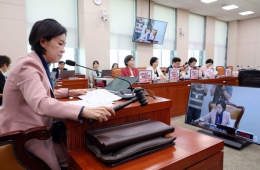
Novelist Yun Heung-gil, famous for 'Jangma' and 'Wanjang,' has completed the five-volume novel series Munshin. At a press conference held on the 27th at the Francisco Education Center in Jung-gu, Seoul, the author explained the work in detail. Munshin is scheduled to be published on March 1.
Munshin is set during the Japanese colonial period, when the policy of Japanization and forced labor were in full swing. It depicts conflicting beliefs, desires, and conflicts centered around the fictional wealthy landowner family of Choi Myeong-bae in the Sanseo region.
Serialization began in a literary magazine in 1989, and it was finally completed after 35 years. The literary magazine that first serialized the work was discontinued twice during serialization, and there were times when the author could not write due to health reasons. In particular, after publishing volumes 1 to 3 in 2018, volumes 4 and 5 were scheduled for release in the first half of 2019, but poor health delayed completion by another five years.
![[Photo by Munhakdongne]](http://www.asiae.co.kr/news/img_view.htm?img=2024022720360777792_1709033767.jpg)
Yun Heung-gil explained the theme as the homing instinct and said that the customs of 'Bubyeongjaja (赴兵刺字)' and the song 'Balbado Arirang' served as motifs for the work.
Bubyeongjaja refers to the custom of tattooing characters on the backs of husbands, fathers, or sons who were to be sent as soldiers by pricking the skin with a needle.
"During the Korean War, I often saw young men in the village receiving draft notices and tattooing their upper arms or shoulders. After getting the tattoo, they would drink with friends and make noise in the village for several days before going to the army. When I was young, I wondered why those guys acted that way, but later I learned it was part of the Bubyeongjaja custom. This custom expressed the hope that if they survived the war and returned, it was fortunate, and if they died, their families could identify their bodies by the tattoo and bury them in their ancestral graves back home."
Regarding 'Balbado Arirang,' the author shared a story from an acquaintance. A PD from a broadcasting company went to Palau Island in the Pacific to shoot a documentary and heard 'Balbado Arirang' from a mixed-race woman there. The woman’s father was a Korean who had been conscripted. Palau was a Japanese naval base during the Pacific War. The mixed-race woman said her father endured hard labor while singing 'Balbado Arirang' during the Japanese colonial period and hoped to return home alive and be buried there.
The author said, "I was deeply shocked and moved by the story of the mixed-race woman." He then recited the lyrics of 'Balbado Arirang': "Arirang, Arirang, Arariyo, crossing over Arirang Pass. Even if you tread on me, tread on me, just don’t kill me, for spring will come again with blooming flowers."
Now 82 years old and marking 56 years since his literary debut, the author still contemplates his writing. He said he omitted many particles while writing Munshin to imitate the rhythm of pansori.
"I wanted to express a certain local sentiment through pansori. Because I imitated the rhythm of pansori in the sentences, the writing became somewhat unfamiliar to readers."
Hot Picks Today
 "Now Our Salaries Are 10 Million Won a Month" Record High... Semiconductor Boom Drives Performance Bonuses at Major Electronic Component Firms
- Wallets Open Wide on Big News...300 Trillion Won Heads to the U.S., "Tax Breaks" Fail to Keep Funds at Home
- "Hope You Enjoy the 'Welfare' for Bereavement of Children"... Ridicule of Strike Non-Participants Intensifies Union Conflict at Samsung Electronics
- "Realizing How Fast Money Disappears: Should You Try Only the Essentials for 5,000 Won? [The Basics of Benefits]"
- Experts Already Watching Closely..."Target Price Set at 970,000 Won" Only Upward Momentum Remains [Weekend Money]
The author, who has lived with dictionaries since childhood, explained that he used only standard language vocabulary while writing. "Although many words in the dialogue are neither dialect nor standard language, the words in the narrative are rarely used and may seem unfamiliar, but all are standard language."
© The Asia Business Daily(www.asiae.co.kr). All rights reserved.