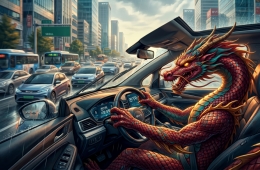
[Beijing Diary] Another Peaceful Day with China's 'Bokbulbok Taxi'
If you study abroad or work as an expatriate in China without your own car, there is probably a daily routine you repeat. That is calling a shared taxi. It is easily accessible through various apps, and thanks to its lower price compared to Korea, it is an indispensable 'foot' for foreigners. In major cities like Beijing or Shanghai, public transportation such as buses and subways is well established, but in less developed provincial cities, people rely on taxis.
If you have a local phone number and a bank account, using the service is simple. After linking the app with your account and activating automatic payment, you set the departure and destination points and call a car. You can use dozens of taxi operators through specialized vehicle-hailing apps or map apps, and you can also set your preferred price range. Vehicles and service levels are categorized as Jingjixing (economic), Youxiangxing (premium), and Zhuanche (luxury), and vans that can accommodate six people are also available immediately.

Last October, shortly after I started living in China, I called a taxi and a Tesla vehicle arrived. Since then, high-end cars including Teslas have been frequently dispatched. The photo shows the Tesla taxi I rode at the time and the driver. (Photo by Kim Hyunjung)
View original imageAs in Korea, it is difficult to call a vehicle during severe weather such as heavy snow, heavy rain, cold waves, or heat waves. In such cases, prices may be continuously raised like an auction, or conversely, nearby drivers may propose a fare by saying, "I can be there in a few minutes, how much will you pay?" Reservations with specific departure times and locations are possible, and changes or additions to the destination during the ride can all be managed through a single app. In my case, unless there is a special situation like having large luggage, I call either the economic or premium option. Using it this way, the fare rarely exceeds 10,000 won within the main living area.
A small peculiarity in this taxi lifestyle is that even with the same settings, the vehicles and drivers’ service levels vary greatly. Sometimes a Tesla is dispatched when set to economic, and sometimes the vehicle condition or service is poor even when calling premium. The luxury option is similar to Korea’s model taxis, with clean sedans and drivers dressed formally, but it costs more than 40% higher than the economic option. Ultimately, it’s a game of chance between economic and premium.
One day, a vehicle of an age that makes you wonder how it still runs arrives with a dull noise, and another day, a Tesla or Hongqi that couldn’t find other passengers quietly glides up in front of me. Driver types vary widely?from chatty ones who endlessly talk about Korean and Chinese first ladies’ face evaluations and the problems in Korea-China relations, to silent types who say nothing and quietly take you to your destination. Some drivers hold cigarette butts in their mouths until the moment the passenger boards, creating a hazy and dreamy atmosphere, while others maintain a clean interior and perfectly control temperature, humidity, and scent inside the vehicle.
What is interesting is that the dizzying gap between the called taxis accurately reflects the current state of China. Calculating an average is actually meaningless, as the top 1% and bottom 1% are mixed chaotically, making it impossible to be sure if the China I am encountering is the true China. The level of goods and services lacks uniformity, and consumption takes the form of a game of chance. This ultimately leads to repeated cycles of hope and despair.
Another implication found in this taxi lifestyle is that one naturally internalizes Laozi’s philosophy of not being pessimistic and adapting regardless of which vehicle and driver are assigned. This becomes a key skill to avoid being overwhelmed by difficulties in life in China. During tough times, I hope that 'bok' (good fortune) visits the Korean residents living in China more often.
Hot Picks Today
!["Rather Than Endure a 1.5 Million KRW Stipend, I'd Rather Earn 500 Million in the U.S." Top Talent from SNU and KAIST Are Leaving [Scientists Are Disappearing] ①](https://cwcontent.asiae.co.kr/asiaresize/93/2026051914165468840_1779167814.png) "Rather Than Endure a 1.5 Million KRW Stipend, I'd Rather Earn 500 Million in the U.S." Top Talent from SNU and KAIST Are Leaving [Scientists Are Disappearing] ①
"Rather Than Endure a 1.5 Million KRW Stipend, I'd Rather Earn 500 Million in the U.S." Top Talent from SNU and KAIST Are Leaving [Scientists Are Disappearing] ①
- "No Cure Available, Spread Accelerates... Already 105 Dead, American Infected"
- "If That's the Case, Why Not Just Buy Stocks?" ETFs in Name Only, Now 'Semiconductor-Heavy' and a Playground for Short-Term Traders
- "Reporters Who First Revealed Jo Jinwoong's Juvenile Offense History Cleared of Juvenile Act Violation"
- Instead of a National Assembly Profile, Now a 'Carpenter'... Ryu Hojung Says "I Couldn't Do a Body Profile Shoot Twice"
© The Asia Business Daily(www.asiae.co.kr). All rights reserved.