In the End, Government Chooses 'Table'... Electricity Rates: Residential 'Frozen', Industrial Rates Up by 10.6 Won
Government Announces Electricity Rate Hike Plan
"Considering Burden on Low-Income, Residential and Small Business Rates Frozen... Future Rate Adjustments Under Review"
Industrial Power Users' Electricity Bills for Large Corporations to Increase by 250 Million to 300 Million KRW per Month
The government has decided to raise industrial electricity rates by 10.6 KRW per kilowatt-hour (kWh). However, considering the burden on the ordinary economy such as general households and self-employed individuals due to prolonged high inflation, high interest rates, and economic recession, residential and general electricity rates have been frozen.
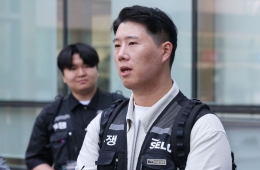
![Kang Kyung-sung, Vice Minister of the Ministry of Trade, Industry and Energy (right), and Kim Dong-chul, President of Korea Electric Power Corporation, are announcing a 'drastic self-help plan' to overcome the management crisis of Korea Electric Power Corporation on the afternoon of the 8th at the Ministry of Trade, Industry and Energy, Government Complex Sejong, Sejong City. <br>[Image source=Yonhap News]](http://www.asiae.co.kr/news/img_view.htm?img=2023110815194745450_1699424388.jpg)
Kang Kyung-sung, Vice Minister of the Ministry of Trade, Industry and Energy (right), and Kim Dong-chul, President of Korea Electric Power Corporation, are announcing a 'drastic self-help plan' to overcome the management crisis of Korea Electric Power Corporation on the afternoon of the 8th at the Ministry of Trade, Industry and Energy, Government Complex Sejong, Sejong City.
[Image source=Yonhap News]
On the 8th, Kang Kyung-sung, the 2nd Vice Minister of the Ministry of Trade, Industry and Energy, announced at the Government Complex Sejong, "It has been decided to increase the electricity consumption charge for large-volume customers in the industrial sector (Type B) by an average of 10.6 KRW per kWh starting from the 9th."
Vice Minister Kang explained, "Despite five previous electricity rate hikes, the rates still fall short of the cost, and without rate adjustments, it is difficult for Korea Electric Power Corporation (KEPCO) to maintain stable financial management. This adjustment plan was prepared after comprehensively reviewing KEPCO's financial conditions, the public's inflation burden, and international energy prices."
First, electricity rates for residential use and general use by small business owners have been frozen. Also, among industrial customers (approximately 440,000 accounts), the industrial Type A category, mainly used by small and medium-sized enterprises (about 400,000 accounts), will maintain current prices. On the other hand, for large-volume industrial customers (Type B), electricity consumption charges will increase by an average of 10.6 KRW per kWh starting from the 9th.
As of last year, industrial Type B customers numbered about 42,000, accounting for 0.2% of the total 24,866,000 accounts. However, their electricity consumption was 267,719 GWh, representing 48.9% of the total consumption of 547,933 GWh.
Hot Picks Today
!["Heading for 2 Million Won": The Company the Securities Industry Says Not to Doubt [Weekend Money]](https://cwcontent.asiae.co.kr/asiaresize/93/2025061015355092669_1749537351.jpg) "Heading for 2 Million Won": The Company the Securities Industry Says Not to Doubt [Weekend Money]
"Heading for 2 Million Won": The Company the Securities Industry Says Not to Doubt [Weekend Money]
- "Anyone Who Visited the Room Salon, Come Forward"… Gangnam Police Station Launches Full Staff Investigation After New Scandal
- "Envious of Korean Daily Life"...Foreign Tourists Line Up in Central Myeongdong from Early Morning [Reportage]
- "Can't Even Turn On a Fan? How Will They Endure the Heat?"... Massive Blackout Hits the Philippines Amid Scorching Heat
- Did Samsung and SK hynix Rise Too Much?... Foreign Assets Grow Despite Selling [Weekend Money]
For industrial Type B, the increase in rates varies by voltage level, considering the capacity to bear the cost depending on facility size. Accordingly, for industrial Type B High Voltage A (3,300 to 66,000 V or less), the rate will increase by 6.7 KRW, and for High Voltage B (154 kV) and High Voltage C (345 kV or higher), the electricity rate will increase by 13.5 KRW.
![Kim Dong-chul, President of Korea Electric Power Corporation, is announcing an "extraordinary self-help measure" to overcome the management crisis on the afternoon of the 8th at the Ministry of Trade, Industry and Energy in the Government Complex Sejong, Sejong City. <br>[Image source=Yonhap News]](http://www.asiae.co.kr/news/img_view.htm?img=2023110815203745454_1699424437.jpg)
Kim Dong-chul, President of Korea Electric Power Corporation, is announcing an "extraordinary self-help measure" to overcome the management crisis on the afternoon of the 8th at the Ministry of Trade, Industry and Energy in the Government Complex Sejong, Sejong City.
[Image source=Yonhap News]
A KEPCO official stated, "For High Voltage A, the average monthly electricity bill is expected to increase by about 2 million KRW, and for High Voltage B and C, by approximately 250 million KRW and 300 million KRW respectively. Overall, the average electricity bill for industrial Type B customers will increase by about 3.67 million KRW."
© The Asia Business Daily(www.asiae.co.kr). All rights reserved.