[Why&Next] Slight Exchange Rate Drop Following US Removal from Watchlist... Year-End Forecast at 1370 Won (Comprehensive)
Pause Ahead of US Consumer Price Index Release
Won Strengthens on News of Removal from Currency Watch List
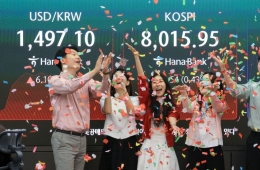
The won-dollar exchange rate, which had sharply declined in the short term due to the effect of the short-selling ban, slightly dropped on the 8th following a decline in U.S. Treasury yields and is fluctuating in the low 1300 won range. The exchange rate, which plunged after digesting the early-month U.S. Federal Open Market Committee (FOMC) event, reversed to an upward trend after four trading days the previous day but turned downward again on this day, probing its future direction. The won-dollar exchange rate is expected to enter a pause ahead of the U.S. consumer price index release on the 14th. The news that South Korea was removed from the U.S. currency watchlist acted as a partial strengthening factor for the won, while market experts forecast that the exchange rate may gradually recover from the excessive decline and raise its outlook to 1360-1370 won by the end of the year.
According to the Seoul foreign exchange market on the 8th, the won-dollar exchange rate was trading at 1305.4 won, down 2.5 won from the previous day as of 10:43 a.m. The exchange rate opened at 1306.0 won, down 1.9 won, and has been moving in the low to mid-1300 won range. This was influenced by a decline in U.S. Treasury yields overnight and a rise in the New York stock market, which revived risk appetite.
There is also an interpretation that South Korea's removal from the U.S. currency watchlist for the first time in over seven years since April 2016 acted as a partial strengthening factor for the won. Joo Won, head of the Economic Research Department at Hyundai Research Institute, explained, "Being removed from the currency watchlist can increase global market confidence in the won," adding, "This can somewhat help strengthen the won's value." The removal from the watchlist means South Korea is no longer under official surveillance by the U.S. Treasury Department, which could reduce burdens on the foreign exchange market.
However, since South Korea has not artificially appreciated the won, many analyses suggest that the removal from the U.S. currency watchlist alone will not have a significant impact on the won-dollar exchange rate. Although Korean foreign exchange authorities have recently intervened in the market to defend the exchange rate, this was a response to the won-dollar exchange rate rising too much and is the opposite of currency manipulation aimed at lowering the domestic currency value to boost exports.
Yoon Yeo-sam, a researcher at Meritz Securities, said, "The removal from the currency watchlist is a positive factor for the exchange rate, but since we have not artificially appreciated the won, the impact is expected to be limited," adding, "It has symbolic significance." Regarding the won's partial strengthening as the won-dollar exchange rate started lower on the day, he explained, "The news of removal from the currency watchlist may have had some effect, but the decline in U.S. Treasury yields yesterday seems to have had a bigger impact."
◆ Fluctuations around 1300 won... China’s economic recovery as a variable = Experts expect the exchange rate to fluctuate around 1300 won for the time being while probing its direction. Park Sang-hyun, a researcher at Hi Investment & Securities, said, "The expectation of the end of U.S. rate hikes revived risk appetite, and along with the government's full ban on short selling and foreign investors' net buying in the domestic stock market, this led to a recent sharp decline in the exchange rate," adding, "However, since the short-term decline in the won-dollar exchange rate was excessive, it remains to be seen whether it will lead to a sustained downward trend." He noted that since there is no strong momentum confirming that domestic economic fundamentals support won strength, the exchange rate is likely to fluctuate around 1300 won.
In particular, experts judged that it is still premature for the won-dollar exchange rate to shift to a sustained downward trend. Although the perception that the U.S. rate hike cycle ended with the November FOMC's consecutive rate hold decisions on the 1st (local time) is spreading, this may be an overly optimistic view. On this day, Neel Kashkari, president of the Minneapolis Federal Reserve Bank, warned that although recent inflation pressures have eased, it is still too early to declare victory over inflation. Kashkari said on the 6th (local time), "There have been hopeful indicators related to inflation over the past three months, but that alone is not enough," adding, "More data is needed to confirm whether the genie of inflation has been put back in the bottle." If the U.S. consumer price index released on the 14th exceeds market expectations, the possibility of further tightening cannot be ruled out, which could exert upward pressure on the won-dollar exchange rate.
The fact that the effect of the short-selling ban, which temporarily pulled down the won-dollar exchange rate, is not sustained may also affect the exchange rate going forward. Park Soo-yeon, a researcher at Meritz Securities, said, "The government's full ban on short selling lowered the exchange rate, but this may be a temporary factor," adding, "Considering that macro uncertainties have not been resolved and it is too early to predict the development of geopolitical conflicts, this is not the start of a full-fledged weak dollar trend." From a long-term perspective, the short-selling ban may negatively affect the domestic stock market and become a negative factor that raises the exchange rate.
Hot Picks Today
 Cerebras Soars 70% on IPO Debut: Is Nvidia's Reign Ending as a New AI Semiconductor Power Emerges?
- After Surpassing 8,000 Points, Is Profit-Taking Underway?... Why Is the KOSPI Plunging?
- "Gave in to the Momentary Temptation": Japanese Police Official Dismissed After Stealing 100 Million Won Next to Body
- "Mom, Isn't It Comfortable Living With Me?"... 'Unexpected Result' Shows Increased Drinking Out of Frustration
- "After Vowing to Become No. 1 Globally, Sudden Policy Brake Puts Companies’ Massive Investments at Risk"
Baek Seok-hyun, an economist at Shinhan Bank, said, "Since the exchange rate decline over the past few days was excessive, a rebound is expected," adding, "Short selling was only a temporary event, so its impact on the exchange rate is minimal." Baek added, "Although Chinese economic indicators have avoided the worst situation, concerns such as the real estate crisis remain, so the won is not strong enough to lead a strengthening trend," and "The Taiwan presidential election scheduled for January next year could also be a variable, with market impact expected around the candidate registration date on the 20th." Shinhan Bank predicted that the exchange rate could rise to 1360-1370 won by the end of the year, starting from the late 1290 won range the previous day.
![[Image source=Yonhap News]](http://www.asiae.co.kr/news/img_view.htm?img=2023110717041744161_1699344257.jpg)
© The Asia Business Daily(www.asiae.co.kr). All rights reserved.