Korea Financial Research Institute: "Next Year's Stock Prices Will Gradually Rebound If Interest Rate Cuts Begin"
2023 Financial Trends and 2024 Outlook Seminar
Bond Yields Expected to Decline Compared to This Year

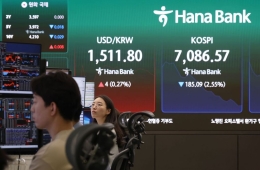
On the 21st, when the U.S. central bank Federal Reserve (Fed) held the base interest rate steady, employees were working in the dealing room at the Hana Bank headquarters in Jung-gu, Seoul. On that day, the KOSPI opened at 2544.81, down 4.93 points (0.58%) from the previous session, and the won-dollar exchange rate started at 1332.5 won, up 2.4 won from the previous trading day. Photo by Jo Yongjun jun21@
View original imageThe Korea Institute of Finance forecasted that "next year's domestic stock prices will fluctuate around the level of the second half of this year and then gradually rebound around the time when the economic recovery and the visibility of domestic and international monetary policy shifts become apparent."
On the 6th, the Institute held the '2023 Financial Trends and 2024 Outlook Seminar' and stated, "The prolonged high interest rate stance of the U.S. Federal Reserve, the rising trend of the U.S. 10-year Treasury yield, and the strength of oil prices and the dollar have expanded downside uncertainties in the external sector. Domestically, concerns about the accumulation of private debt and uncertainties about the timing of corporate business turnarounds also exist."
They added, "Volatility is expected to increase depending on whether uncertainties surrounding monetary policy are resolved and the impact of domestic and international political events. With strong expectations for operating profit improvements, the fundamental recovery of the financial market in 2024 will accelerate alongside confirmed improvements in the earnings of major industries."
This year, the domestic stock market showed an upward trend exceeding expectations in the first half but shifted to a downward trend in the second half, showing a 'high in the first half, low in the second half' pattern. The KOSPI recorded 2564.28 points as of the end of June this year, up 14.7% compared to the end of 2022, supported by a net inflow of foreign stock funds. However, in the second half, worsening external conditions due to the strengthening U.S. interest rate hike stance and a slowdown in foreign net investment led to a larger decline.
The PER (12-month forward earnings basis) fell below the long-term average (10.4) to 9.91 as of the 30th of last month due to the stock price decline in the second half. The PBR also dropped to around 0.8 (long-term average 0.94).
Next year, bond yields are expected to decline compared to this year due to the visibility of policy rate cuts by Korea and the U.S. It is anticipated that it will take considerable time to resolve the spread gap between credit market ratings. Since domestic forward rates do not yet reflect the possibility of policy rate cuts next year, if the U.S. Federal Reserve's September dot plot signals two rate cuts, the possibility of domestic policy rate cuts will also increase, acting as a factor for market rate declines.
Researcher Kim Nam-jong said, "Due to the nearing end of the rate hike cycle and the spillover effect of the rise in the U.S. term premium, the domestic term premium is likely to increase, causing the yield curve to steepen somewhat."
Hot Picks Today
 "Stocks Are Not Taxed, but Annual Crypto Gains Over 2.5 Million Won to Be Taxed Next Year... Investors Push Back"
- "Not Jealous of Winning the Lottery"... Entire Village Stunned as 200 Million Won Jackpot of Wild Ginseng Cluster Discovered at Jirisan
- Bull Market End Signal? Securities Firm Warns: "Sell SK hynix 'At This Moment'"
- "How Did an Employee Who Loved Samsung End Up Like This?"... Past Video of Samsung Electronics Union Chairman Resurfaces
- "Even With a 90 Million Won Salary and Bonuses, It Doesn’t Feel Like Much"... A Latecomer Rookie Who Beat 70 to 1 Odds [Scientists Are Disappearing] ③
He continued, "Bond supply and demand are not expected to worsen due to reduced government bond issuance and insurance companies' demand driven by rising long-term interest rates. However, if Korea Electric Power Corporation (KEPCO) continues to run deficits, the potential expansion of KEPCO bond issuance could pose a supply-demand burden. The real estate project financing (PF) issue is a factor that causes investment sentiment to shrink across vulnerable sectors and lower ratings, and it is expected to take time for a fundamental resolution."
© The Asia Business Daily(www.asiae.co.kr). All rights reserved.