[AI Hanip News] Sales Increased 50 Times in One Year... Will Cold Winds Blow Next Year?
OpenAI's Revenue Soars 50-Fold

Sam Altman, CEO of OpenAI, is having a conversation at the 'K-Startups meet OpenAI' event hosted by the Ministry of SMEs and Startups on the 9th at 63 Square, Yeouido, Seoul. Photo by Jinhyung Kang aymsdream@
View original imageOpenAI, the developer of ChatGPT, is expected to record annual revenue of $1.3 billion (approximately 1.75 trillion KRW) this year. Sam Altman, CEO of OpenAI, shared this information with the company's employees. Compared to last year's revenue of $28 million (approximately 378 billion KRW), this represents nearly a 50-fold rapid growth. Until the first half of this year, it was expected to achieve annual revenue of around $1 billion, but the forecast has increased by 30% since then. Currently, OpenAI generates revenue through paid subscriptions to ChatGPT and by providing application programming interfaces (APIs) for large language models (LLMs). OpenAI is driving monetization by strengthening its business-to-business (B2B) operations. At the developer conference scheduled for November, it plans to unveil technology that allows AI models to be used more affordably, targeting corporate clients. The company also plans to expand its business scope to AI that processes various types of information including text, images, audio, and video.
"Generative AI Bubble to Burst Next Year"
There is a forecast that the generative AI technology boom seen this year will face a turning point next year. Market research firm CSS Insights released this analysis in its annual report. There are two main reasons. One is the increasing cost burden required to operate generative AI. For example, ChatGPT is known to incur operating costs of about 900 million KRW per day. The other reason is that regulations surrounding generative AI technology are being actively introduced in various countries. Starting with the European Union (EU), many countries are moving to implement AI technology regulations.
"Google Bard is an Energy Hog"
![Photo by Pixabay [Image source=Pixabay]](http://www.asiae.co.kr/news/img_view.htm?img=2023101310373314324_1697161053.jpg)
A study has found that if Google integrates AI into all its search services, it would consume as much electricity annually as a whole country. A paper published in the scientific journal Joule projected that if Google offers its entire search service as an AI chatbot, energy consumption would increase more than tenfold. A typical Google search consumes 0.3 watt-hours (Wh) of electricity per search. In contrast, AI-powered generative search requires 3 Wh per search. Calculated on an annual basis, this amounts to electricity consumption comparable to Ireland's yearly usage. High electricity consumption means increased carbon emissions. This adds another concern for big tech companies racing to dominate the generative AI market.
AI Controls Traffic Lights to Reduce Emissions
![Photo by Pixabay [Image source=Pixabay]](http://www.asiae.co.kr/news/img_view.htm?img=2023101310355814322_1697160959.jpg)
Meanwhile, Google is using AI in a project aimed at reducing emissions called 'Project Green Light.' This project optimizes traffic signal systems using AI to reduce exhaust emissions. The method is as follows: AI learns from Google Maps data to calculate congestion levels and average waiting times of stopped vehicles at traffic lights. Based on this, it optimizes signal timing to reduce vehicle waiting times and the number of braking and acceleration events. Google first tested this project in Israel in 2021, reporting a 10-20% reduction in fuel consumption and signal waiting times. The company plans to expand the project to more cities in 2024, aiming to reduce carbon emissions by 1 gigaton (Gt) by 2030.
Hot Picks Today
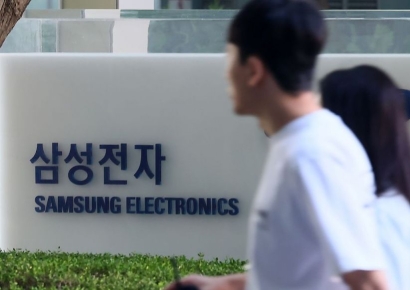 "Samsung Electronics Employee with 100 Million Won Salary Receiving 600 Million Won Bonus... Estimated Tax Revealed"
- Shaving His Head in Front of His 90-Year-Old Mother... Park Minshik Vows to End Han Donghoon's Predatory and Parasitic Politics
- Lived as Family for Over 30 Years... Daughter-in-Law Cast Aside After Husband's Death
- Despite ‘Tank Day’ Controversy, Gwangju Schools Purchased Starbucks Gift Certificates
- Appearing in a Leather Jacket, Jensen Huang Hastily Eats $6 Noodles on the Street... Shop Instantly Becomes a Hotspot
AMD Acquires AI Startup... Can It Stop Nvidia's Dominance?
![[Image source=Reuters Yonhap News]](http://www.asiae.co.kr/news/img_view.htm?img=2023072114372915620_1689917849.jpg)
US semiconductor company AMD announced it will acquire AI startup 'Node.AI.' Node.AI is a startup developing AI software based on open-source technology, with particular expertise in AI model optimization. AMD's acquisition of Node.AI is a strategic move to catch up with Nvidia in the AI semiconductor market. Currently, Nvidia holds over 80% market share in AI semiconductors such as graphics processing units (GPUs). Attention is focused on whether AMD can halt Nvidia's dominance.
© The Asia Business Daily(www.asiae.co.kr). All rights reserved.







