[Evaluation of Yoon Administration's Economic Policy] Comprehensive Support in Taxation, Fiscal, and Financial Sectors... Active Response to External Adversities
Strengthening Investment Momentum Despite Fiscal Deficit
Fostering Advanced Industry Global Clusters
Focusing on Risk Response and Monitoring
The government is signaling a comprehensive strengthening of measures to boost economic vitality in the second half of the year. Despite tax revenue shortfalls, it has unveiled a large-scale budget plan to invigorate corporate investment, which is being evaluated as playing a catalyst role for private-led economic growth.
![[Evaluation of Yoon Administration's Economic Policy] Comprehensive Support in Taxation, Fiscal, and Financial Sectors... Active Response to External Adversities](http://www.asiae.co.kr/news/img_view.htm?img=2023092013483882904_1695185318.png)
According to government departments on the 20th, one of the key projects the government is promoting is the "Advanced Industry Global Cluster Development" initiative. On the 18th, Deputy Prime Minister and Minister of Economy and Finance Choo Kyung-ho announced that 2.2 trillion won will be invested by 2028 to establish world-class infrastructure and support research and development. The cash support budget for attracting foreign-invested companies has also been significantly increased, rising fourfold from 50 billion won this year to 200 billion won next year. Previously, the government decided to support 50% of the investment costs for domestic return (U-turn) companies in advanced strategic industries such as semiconductors and batteries. Additionally, plans are underway to extend income tax reduction benefits for foreigners working at foreign-invested companies.
The Ministry of Economy and Finance and others are also strengthening their ability to respond to unforeseen adverse factors. Since mid-October last year, when financial market instability spread, the Deputy Prime Minister for Economy, the Governor of the Bank of Korea, the Chairman of the Financial Services Commission, and the Governor of the Financial Supervisory Service have been meeting every weekend to review the financial market situation and discuss major issues. A Ministry of Economy and Finance official explained, "Through the so-called 'F(Finance) 4' meetings, the heads of economic and financial authorities prepare response measures by monitoring the market weekly."
They are also carefully considering focused inspections of the economic situation and preparation of countermeasures. At the Emergency Economic Ministers' Meeting cum Export Investment Measures Meeting chaired by the Deputy Prime Minister for Economy, export measures are continuously announced, and the 'Emergency Economic Response TF' chaired by the First Vice Minister of Economy and Finance, which is a preparatory meeting for the Emergency Economic Ministers' Meeting agenda, operates twice a week to monitor exports and other matters. A government official said, "It cannot be said that such countermeasures did not exist before, but compared to the past, we are responding more promptly and actively."
Related Articles
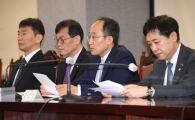 Choo Kyung-ho: "Real Estate PF Troubled Projects... Inducing Normalization Through Lenders' Agreement"
![[Image source=Yonhap News]](http://www.asiae.co.kr/news/img_view.htm?img=2023061509241664504_1686788656.jpg)
In particular, they are focusing on monitoring to avoid missing changes in the situation. The Macroeconomic Financial Meeting is a representative example. A meeting that was occasionally held at the vice minister level in the past has been elevated to the ministerial level and is now held every Sunday. Even when discussing confidential matters, discussions last about three hours, continuously checking various issues from the general current account situation to exports and financial market inspections to respond to risks. Along with this, officials have maintained this meeting body continuously for over a year since the second half of last year after the Legoland incident, ensuring vigilance over the financial market tension under the chairmanship of the Deputy Minister.
© The Asia Business Daily(www.asiae.co.kr). All rights reserved.







