Police Stirred by Organizational Restructuring... "Personnel Structure Reform Must Also Be Carried Out"
After the police organization restructuring plan, which includes reducing and consolidating internal departments and increasing patrol personnel by 9,000, was announced on the 18th, opinions within the police force were divided. While some argued that personnel at district police stations and local police boxes who respond to the field should be increased first, concerns were also raised about the reduction of certain functions such as intelligence. Experts suggested that a fundamental restructuring of the police personnel system is necessary for this organizational reform to be effective.
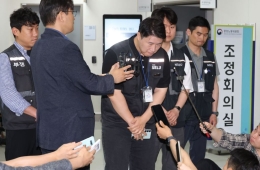
![A man who caused a disturbance by attacking passengers on Seoul Subway Line 2 on the 19th of last month is being arrested. <br>[Image source=Yonhap News]](http://www.asiae.co.kr/news/img_view.htm?img=2023082012213045217_1692501689.jpg)
A man who caused a disturbance by attacking passengers on Seoul Subway Line 2 on the 19th of last month is being arrested.
[Image source=Yonhap News]
◆Restless frontline police officers= This reorganization follows President Yoon Seok-yeol's order at the Cabinet meeting on the 29th of last month to "thoroughly restructure the police organization to focus on public safety." Reactions within the police were mixed. Internal staff at police stations expressed anxiety about possible personnel transfers. Lieutenant A from a police station in Seoul said, "Many internal staff are anxious, fearing they might be the ones reassigned." Lieutenant B from the administrative department of another police station confessed, "Even if transferred to field duty, we cannot expect incentives for field work, nor can we express dissatisfaction."
There is also considerable dissatisfaction among intelligence officers, who are directly affected by this reorganization. Out of 259 police stations nationwide, 197 intelligence divisions will be abolished and integrated into the provincial police agencies. Officer C from the Intelligence and Foreign Affairs Division of a police station in Gyeonggi Province said, "I have only handled intelligence since joining the police, and I worry whether I can properly manage other duties." He added, "While the plan aims to strengthen field security, I question whether reducing intelligence and foreign affairs functions is the right approach in terms of crime prevention and managing crimes involving foreigners." Lieutenant D from a police station in Seoul said, "The intelligence function not only manages assemblies but also plays a role in preemptively identifying threats to local security. I am unsure if such activities can be effectively conducted at the provincial level."
Meanwhile, frontline personnel at district police stations and local police boxes agreed with the intent to strengthen field operations but emphasized the need for additional personnel support. Lieutenant E, working at a police box in Busan, argued, "We should first allocate personnel to district police stations and police boxes to meet their staffing requirements, then use any surplus personnel to establish mobile patrol units." Officer F from a police box in Gyeonggi Province welcomed the plan, saying, "Local police need at least one more officer to respond together when incidents occur. Reinforcing personnel by even one officer each at district police stations and police boxes will speed up field dispatch."

◆"An expected step... urgent need for personnel structure reform"= Amid the divided responses to the police organization restructuring plan, experts agree that changes focusing on the field are essential. However, they commonly emphasize that it should not be limited to simply increasing numbers but should involve restructuring the personnel system for efficient task allocation. Since police duties require different expertise, merely converting internal staff to field patrol personnel does not necessarily strengthen public safety. Professor Lee Woong-hyuk of the Department of Police Science at Konkuk University said, "If it ends with just turning internal staff into field patrol personnel, it will be ineffective. Specific response plans for crimes that cause public anxiety, such as stalking, violent crimes, and domestic violence, must be established, along with corresponding personnel restructuring." Professor Kwak Dae-kyung of the Department of Police Administration at Dongguk University also suggested, "Each district police station, police station, and provincial police agency has different security situations and demands. It is necessary to gather opinions from frontline personnel who know the field best and improve work efficiency by allocating personnel according to actual conditions."
Hot Picks Today
 "Stocks Are Not Taxed, but Annual Crypto Gains Over 2.5 Million Won to Be Taxed Next Year... Investors Push Back"
- Second Round of Post-Adjustment Talks at Samsung Electronics Ultimately Fails... Central Labor Relations Commission: "Labor Accepted, Management Reserved Decision"
- "Not Jealous of Winning the Lottery"... Entire Village Stunned as 200 Million Won Jackpot of Wild Ginseng Cluster Discovered at Jirisan
- Bull Market End Signal? Securities Firm Warns: "Sell SK hynix 'At This Moment'"
- "Even With a 90 Million Won Salary and Bonuses, It Doesn’t Feel Like Much"... A Latecomer Rookie Who Beat 70 to 1 Odds [Scientists Are Disappearing] ③
There is also a call to reform the current 'jar-shaped' police personnel structure, which has many mid-level officers. The plan is to reduce personnel in downsized roles and increase those responsible for field security. As of July, the number of operational personnel such as patrol officers (17,020), corporals (23,604), and sergeants (22,682) totals 63,306, which is less than the 65,821 mid-level officers including lieutenants (40,915) and captains (24,906). Professor Lee Yun-ho, emeritus professor at Dongguk University's Department of Police Administration, said, "Considering the perception that police must catch criminals, the overall direction of this reorganization plan is correct. However, more field personnel should be deployed than now so that citizens can tangibly feel improvements in public safety." He added, "In the long term, the police personnel structure should be improved into a 'pyramid shape,' where patrol officers, corporals, and sergeants who actively work in the field constitute the majority of the force." This police organization restructuring plan is expected to be implemented as early as next month after consultations with the Ministry of the Interior and Safety and the Cabinet meeting. The National Police Agency plans to soon carry out personnel changes for senior officers at the rank of commissioner general and above in line with the reorganization.
© The Asia Business Daily(www.asiae.co.kr). All rights reserved.