'Breaking China's Mineral Monopoly'... US and Saudi Arabia Join Forces for Rare Earth Development
The United States is teaming up with Saudi Arabia to jointly develop critical minerals such as rare earth elements. This move aims to reduce dependence on China, which dominates the global supply chain of rare earths?key raw materials used in advanced industries like electric vehicle batteries, semiconductors, and military equipment.

On the 10th (local time), The Wall Street Journal (WSJ) reported, citing sources, that a Saudi state-owned company is acquiring stakes in mines in African countries such as Congo, Guinea, and Namibia, while U.S. companies would gain rights to purchase some of the minerals produced by the Saudi company. Saudi Arabia is reportedly planning to invest $15 billion (about 20 trillion won) in overseas mine development.
Sources said that the U.S. has proposed joint mineral development to other countries besides Saudi Arabia, but Saudi Arabia showed the most proactive response. For a long time, Saudi Arabia has been extending its reach beyond oil production revenues into investments in eco-friendly energy and the establishment of critical mineral facilities. The Saudi Public Investment Fund (PIF) is currently discussing a joint venture worth $3 billion with Congo. Congo accounts for 70% of the world's cobalt supply.
WSJ stated, "Whatever form the agreement takes, this negotiation will further strengthen the U.S. effort to reduce dependence on China for essential materials such as rare earth elements."
![[Image source=AFP Yonhap News]](http://www.asiae.co.kr/news/img_view.htm?img=2023091113474170899_1694407662.jpeg)
China has entered nearly all key mineral markets it can access in Africa and South America, controlling the entire supply chain from mining to refining and processing of battery-critical minerals such as lithium, cobalt, and nickel. Most cobalt mines in Congo, Africa, are owned by the Chinese government or Chinese companies. China's market share in manganese refining reaches 95%, and it dominates markets for cobalt (73%), graphite (70%), lithium (67%), and nickel (63%).
The U.S. also lags significantly behind China in mineral processing technologies essential for securing critical minerals. It is estimated that building related facilities (refineries) and training skilled technicians will take 2 to 5 years or more. Developing new mines and starting extraction reportedly takes at least 20 years.
Related Articles
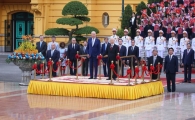 US Elevates Vietnam to 'Comprehensive Strategic Partner'... "Move to Contain China"
The U.S. government plans to achieve independence from China?which threatens export restrictions?by domesticating the entire production and processing of rare earth elements, critical raw materials used in semiconductors, electric vehicle batteries, fighter jets, missiles, and renewable energy. As part of this effort, private companies have also directly entered African countries to pursue 'mineral localization,' but progress has been hindered by various issues such as local government corruption.
© The Asia Business Daily(www.asiae.co.kr). All rights reserved.