[Yeouido Renaissance] 20 Years of Promoting a Northeast Asia Financial Hub, Remaining Challenges
It has been 20 years since the announcement of the 'Northeast Asia Financial Hub Promotion Strategy' in 2003. Since the first financial hub strategy, basic plans for financial centers have been announced every three years to advance policies. However, it is still difficult to say that it has risen as an international financial center. Of course, this does not mean there have been no achievements. In the 'Global Financial Centres Index (GFCI),' which measures and evaluates the financial competitiveness of major cities worldwide, Seoul ranked 10th out of 133 cities globally. This is a higher ranking than Beijing, China (13th), and Tokyo, Japan (21st).
The current government also shares the dream of becoming a Northeast Asia financial hub. This is because enhancing competitiveness in the financial sector can secure future growth engines. Based on the Global Financial Centres Index, cities ahead of Seoul include Singapore (3rd), Hong Kong (4th), and Shanghai (7th). The attractiveness of Hong Kong and Shanghai is likely to decline compared to before due to ongoing U.S. containment of China. This is why voices are emerging that this is a crucial time to leap forward as a financial hub.
In May, the government announced the '6th Basic Plan for the Creation and Development of Financial Centers.' It contains the vision and direction of financial center policies to be pursued over the next three years. Considering the rapidly changing global financial environment, four major tasks were selected to respond swiftly while utilizing competitive financial industry sectors. The government plans to continue financial regulatory innovation and strengthen support for fintech companies. Related infrastructure will be expanded to leverage changes in financial trends such as digital finance and sustainable finance. There is also a plan to boldly reform regulations and systems to enable foreign investors to expand their investments in the domestic capital market. Through the newly established 'Financial Internationalization Response Team' at the Financial Services Commission, active support will be provided for domestic financial companies' overseas expansion.
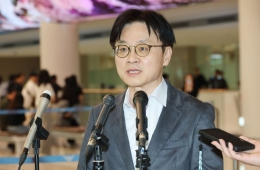
Kim Ju-hyun, Chairman of the Financial Services Commission, said, "Since the government announced the 'Northeast Asia Financial Hub Roadmap' in 2003, our financial industry has developed significantly in both quantity and quality over the past 20 years," adding, "We will boldly reform regulations and systems so that global investors can expand their investments in the domestic capital market and the Korean discount can be resolved."
Although the government's will toward becoming a financial hub is strong, competing with Singapore, which exempts various financial capital-related taxes, is not easy. Experts say that it is difficult to become a financial center with traditional financial industries alone and suggest promoting a digital financial center based on competitive ICT and fintech industries. Lee Byung-yoon, Senior Research Fellow at the Korea Institute of Finance, explained, "To leap forward as a digital financial center, it is necessary first to establish a global fintech hub," adding, "The government should proactively designate a specific area as a global fintech hub and create a complex where related companies and public institutions gather."
The financial authorities are showing an active stance in improving laws and systems related to digital finance. As the government has focused on fostering fintech, the number of domestic fintech companies increased about fivefold from 131 in 2014 to 637 in 2020. Seoul City also plans to invest a total of 59.4 billion KRW over five years until 2027 to support the establishment of a digital finance support center, fintech development, and the activation of financial education. Specifically, it will promote ▲ expansion and concentration of the Yeouido financial cluster through the creation of a digital finance center and financial specialized complex ▲ creation of a global business hub environment ▲ fostering promising fintech companies and training global financial professionals.
Domestic financial companies are also focusing on strengthening competitiveness by expanding their scale to stand shoulder to shoulder with global investment banks (IBs). This year, 10 years after the government implemented the comprehensive financial investment business operator system in May 2013, nine securities companies received comprehensive financial investment business operator licenses. The equity capital of these nine securities companies increased by 148%, from 22.1 trillion KRW to 54.8 trillion KRW. During the same period, total assets grew by 222%, from 141 trillion KRW to 455 trillion KRW.
Lee Hyo-seop, Director of the Financial Industry Office at the Capital Market Research Institute, explained, "Considering that the equity capital growth rates of global IBs such as JP Morgan, Goldman Sachs, Morgan Stanley, and Nomura Group over the past 10 years have been around 0 to 50%, the equity capital growth rate of domestic comprehensive financial investment companies is very high," adding, "From the perspective of scaling up, domestic comprehensive financial investment companies have achieved excellent quantitative results."
Hot Picks Today
 No Bacteria Detected in Arisu After 24 Hours of Repeated Drinking from a Tumbler
- "We Can't Just Let Them Be Damaged Inside"... Samsung Electronics Removes 360,000 Wafers in Preparation for Strike
- "Up to 100 Trillion Won in Losses Feared, It's Not About Second Place but Catastrophe"... Industry Minister: 'Emergency Mediation Unavoidable If Samsung Strike Occurs'
- Wife in $6.7 Million Debt Took Out $3 Million in Husband's Life Insurance, Poisoned Him... US Court: "She Can Never Be Released"
- "He's Handsome, It's Such a Pity?"... Lawyer Responds to Bizarre 'Appearance Evaluation' of High School Girl Murder Suspect
However, diversification of profitability and strengthening of expertise remain challenges to be addressed. There are calls to strengthen the supply of venture capital to innovative startups and to expand roles in the corporate restructuring market.
© The Asia Business Daily(www.asiae.co.kr). All rights reserved.