"Extend the Application of the Serious Accidents Punishment Act to Companies with Fewer Than 50 Employees"…Appeal from Small and Medium Enterprise Owners
From January 27 Next Year, the Serious Accident Punishment Act Applies to Workplaces with Fewer Than 50 Employees
Small SMEs Say "Not Ready Yet... Extension of Law Application Grace Period Needed"

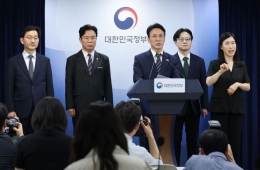
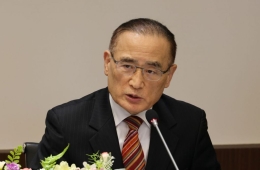
Representatives of small and medium-sized enterprise organizations, including the Korea Federation of SMEs and the Korea Specialty Contractors Association, held a press briefing on the 31st at the Korea Federation of SMEs to urge the extension of the grace period for the application of the Serious Accidents Punishment Act to workplaces with fewer than 50 employees. Jung Yun-mo, Vice Chairman of the Korea Federation of SMEs, is reading the statement. Photo by Younghan Heo younghan@
View original image"LPG filling stations are managed and supervised under the Liquefied Petroleum Gas Act, so applying the Serious Accidents Punishment Act as well constitutes overlapping regulation and is excessive." (Kim Sang-beom, Chairman of the Korea LPG Industry Association)
"Instead of blindly imposing penalties, the enforcement of the law should be postponed to allow small-scale businesses to prepare properly." (Kim Soon-hee, CEO of Shindong Textile)
On the morning of the 31st, small and medium-sized business owners operating small-scale workplaces held a press conference at the Korea Federation of SMEs in Yeouido, Seoul, appealing for an extension of the postponement of the Serious Accidents Punishment Act (SAP Act) for workplaces with fewer than 50 employees. The SAP Act stipulates that if a serious accident such as a worker's death occurs, the business owner or management responsible for failing to fulfill accident prevention duties can be sentenced to imprisonment for more than one year or fined up to 1 billion KRW. Although the law was enacted in January last year, workplaces with 5 to fewer than 50 regular employees were granted a two-year postponement of the law’s application. Starting January 27 next year, about five months from now, the SAP Act will apply to these companies as well. They argued, "In the reality of small and medium enterprises where the business owner handles multiple roles including sales, technology development, and business management, it is difficult to comply with the SAP Act without external assistance," and appealed, "An additional postponement period should be granted, and government support must back it up during that time."
Kim Dong-bok, CEO of Shingi Industry Co., Ltd., which operates in the chemical, energy, and environmental sectors in Cheongyeong-gun, Chungnam, said, "Most small companies like ours are unaware of the law itself," and lamented, "Even if an accident occurs unintentionally, the CEO can face criminal punishment, which is a huge burden." Lee Deok-gyu, CEO of Duseong Geonyeong, a construction company in Gangdong-gu, Seoul, said, "Postponing the application of the SAP Act to workplaces with fewer than 50 employees is essential," and added, "We need to explore practical support measures according to company size and industry characteristics."
A survey conducted by the Korea Federation of SMEs from the 23rd to the 25th targeting 892 small businesses with fewer than 50 employees showed that 80% answered they were not prepared for the enforcement of the SAP Act. Companies commonly cited a lack of professional personnel and budget, ambiguity in the law, and insufficient guidelines as difficulties. One businessperson said, "Since the SAP Act enforcement, many certification and safety management companies have contacted us, but there are no guidelines or prescribed forms, so we have no choice but to apply for consulting from these companies," and added, "The introduction costs are expensive, and we cannot afford to maintain it. Ultimately, only the consulting companies’ profits increase, and it is unrealistic." If the postponement period is not extended, 57.8% responded that they have "no proper countermeasures." 18.7% said they would "consider reducing employment and automating facilities," and 16.5% said they would "consider downsizing or closing the business."
Hot Picks Today
 "Now Our Salaries Are 10 Million Won a Month" Record High... Semiconductor Boom Drives Performance Bonuses at Major Electronic Component Firms
- Living the Homebody Dream? "I Was Shocked by My Spending" How to Cut Costs to 5,000 Won for Essentials [The Principles of Benefits]
- Is It Really Like an Illness? "I Can't Wait to Go Again"—Over 1 Million Visited in Q1, Now 'Busanbyeong' Takes Hold [K-Holic]
- "Asset Management Firm Deposits Soar by 99.6 Trillion Won in April amid Stock Market Boom, Marking All-Time High"
- Experts Already Watching Closely..."Target Price Set at 970,000 Won" Only Upward Momentum Remains [Weekend Money]
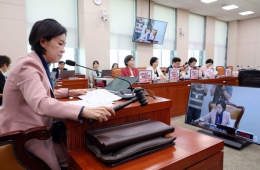
The SME sector has also taken steps to prepare countermeasures. Kim Ki-moon, Chairman of the Korea Federation of SMEs, Bae Jo-ung, Senior Vice Chairman, and Lee Myung-ro, Director of the Human Resources Policy Headquarters, visited the office of Kim Do-eup, Chairman of the National Assembly Legislation and Judiciary Committee, on the morning of the same day to urge an extension of the postponement period for at least two years. Chairman Kim appealed, "Many small and medium enterprises are suffering from management difficulties due to high inflation and high interest rates," and said, "There are even complaints that it is better to close the business than to endure additional judicial risks from the SAP Act." The Korea Federation of SMEs plans to persuade both ruling and opposition parties to pass the ‘SAP Act Amendment Bill’ containing the extension of the postponement for workplaces with fewer than 50 employees at the regular National Assembly session in September.
© The Asia Business Daily(www.asiae.co.kr). All rights reserved.