Judges Say "Candidate Lee Gyunyong Must Win Hearts to 'Reform'"
'Challenges Courts Must Address' According to Judges
Emphasizing 'Communication' Alongside Changes in Chief Judge Candidate Recommendation System
Since the nomination of Lee Gyunyong as the next Chief Justice candidate (age 60, Judicial Research and Training Institute class 16), voices within the judiciary have grown louder, calling for improvements to the issues and systems that were controversial during Kim Myungsoo's court in order to restore public trust in the judiciary. We listened to judges about the challenges that the candidate must address.
Judges emphasized the need to change controversial systems such as the court chief candidate recommendation system and stressed the necessity of increasing personnel. However, since judges with diverse opinions coexist within the judiciary, many believe that the most important thing to smoothly implement changes is to "win the hearts of the judges." The advice is to pursue "reform" while also valuing communication with the members.

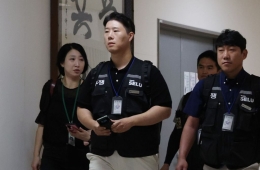
Lee Gyun-yong, Chief Judge of the Seoul High Court, who has been nominated as the new Chief Justice, is answering questions from the press in front of the Supreme Court in Seocho-gu, Seoul, on the morning of the 23rd. Photo by Joint Press Corps
View original image"The Court Chief Candidate Recommendation System Must Be Fixed First"
The biggest institutional changes in the judiciary over the past six years include ▲abolition of the High Court Chief Judge system ▲introduction of the court chief candidate recommendation system ▲establishment of the task allocation committee ▲reduction of the organization and functions of the Court Administration Office. Among these, many judges pointed to the court chief candidate recommendation system as the first system that needs to be fixed.
One mid-level judge who spoke on the phone on the 27th said, "The most urgent thing to fix is the court chief candidate recommendation system. Because court chiefs are recommended by vote, judicial administrative power has effectively been neutralized. Even though cases are backlogged, neither the court chief nor the senior deputy chief judge speaks up."
A chief judge gave a similar diagnosis: "In the past, court chiefs were recognized by everyone for their ability and character, but now even those lacking in these areas can become court chiefs through popularity votes. As a result, populism is flowing within the judiciary."
Another judge said, "There were cases where Chief Justice Kim Myungsoo appointed senior deputy chief judges in each court whom he had in mind as court chief candidates. Even after the two-year term of a senior deputy chief judge ended, some were deliberately not transferred to other courts and served an additional year, eventually becoming court chiefs." Since being appointed senior deputy chief judge increases contact with judges in the affiliated court, it inevitably becomes advantageous in the court chief candidate recommendation. Moreover, when the Chief Justice appoints senior deputy chief judges, judges think, 'He probably has a plan to appoint this person as the next court chief,' which ironically strengthens the Chief Justice's personnel authority.
There was also criticism that the judiciary must quickly escape from political bias controversies. One chief judge said, "How can the judiciary gain trust if judges are suspected of being ideologically biased in their rulings? The Chief Justice must take the lead and resolve these issues."
Abolition of High Court Chief Judges and 'Trial Delays' Caused by Work-Life Balance
The 'trial delay' issue, for which Kim Myungsoo's court has been most criticized, was greatly influenced by the abolition of the High Court Chief Judge system. Fundamentally, however, since the 'work-life balance (WLB)' culture has also taken root in the judiciary, many believe the solution lies in increasing judicial personnel.
One chief judge said, "In the past, chief judges about to be promoted to High Court Chief Judges worked excessively hard to the point of exhaustion. It is undeniable that the disappearance of the promotion system has clearly affected motivation to work hard." Another chief judge said, "There were reasons for abolishing the High Court Chief Judge system, and since reinstating it would require legal amendments, it won't be easy to bring it back. However, some alternative measures seem necessary."
A judge said, "In the past, I used to work until 4 a.m. the day before delivering a verdict and then take a taxi home after overtime pay ended. Now, expecting excessive overtime from associate judges is unreasonable. I even think the current situation might be normal." Another chief judge said, "Although trial delays are often an issue, and people think judges are not working and just playing around, that is not true. Many judges still work late into the night and come in on weekends."
There were also concerns that the capabilities of newly appointed judges might decline after changes in the judicial selection process. One mid-level judge said, "The law was amended to require over 10 years of legal experience for judicial appointments, but it is questionable whether someone who has settled well in a law firm or other jobs for 10 years would choose to become a judge. To conduct prompt and quality trials, increasing excellent judicial personnel is the best option. The appointment conditions need to be relaxed." Another judge said, "Nowadays, many quit law firms to become judges seeking work-life balance rather than higher salaries. In such circumstances, can we expect judges to work overtime and on weekends?"
"Winning the Hearts of Judges Is Important"
One chief judge expressed dissatisfaction, saying, "Because the task allocation committee assigns judges' positions based on pre-established internal regulations, judges often receive assignments different from their personal wishes." The task allocation committee, established in each court, consists of about two members recommended from meetings of chief judges, single judges, and associate judges, along with the senior deputy chief judge who participates ex officio. It decides the allocation of judges' tasks such as case assignments. A judge with experience working at the Court Administration Office said, "When I worked there, more than 30 judges handled trial support, policy research, and other tasks, but even then, we felt understaffed. Now, the number has been drastically reduced to about 10, making it realistically difficult to provide proper trial support."
It is known that candidate Lee refused to establish a task allocation committee during his tenure as the head of the Seoul Southern District Court, stating, "It is right for capable judges to take on difficult and challenging trials." He is also reported to have expressed a negative stance on the court chief candidate recommendation system to those around him. Regarding the functions of the Court Administration Office for the operation of the entire judiciary, he appears to hold views opposite to those of Chief Justice Kim. Therefore, there is speculation that if candidate Lee is appointed Chief Justice, he will attempt to restore or reform these systems.
Hot Picks Today
 "Samsung and Hynix Were Once for the Underachievers"... Hyundai Motor Employee's Lament
- "Was This Delicious Treat Enjoyed Only by Koreans?"... The K-Dessert Captivating Japan
- "Iran Considers Usage Fees From Surface to Seabed, Eyes $15 Billion Annual Revenue"
- Fair Trade Commission Fines "Big Five" Couriers Including Coupang and CJ 3 Billion Won for Shifting Safety Accident Liability to Agencies
- "That? It's Already Stashed" Nightlife Scene Crosses the Line [ChwiYak Nation] ③
One chief judge said, "Regardless of what the best overall direction might be, we cannot ignore practical realities. We must first consider the side effects of abolishing existing systems and how to embrace those who oppose it. If abolished without preparation, problems could worsen." He added, "I hope the new Chief Justice wins the hearts of the judges. That is the most important thing."
© The Asia Business Daily(www.asiae.co.kr). All rights reserved.