Suspicion of Favoritism in Election Commission's Hiring of Relatives... "Lack of External Control and Balance"
Professor Jang Young-su of Korea University KBS Radio Interview
"No explicit regulation on the National Election Commission's duty inspection, leading to interpretive conflicts"
Professor Jang Young-su of Korea University Law School pointed out that "the root of the lack of external control and internal checks and balances lies in the composition of the National Election Commission (NEC)" in relation to the controversy over preferential hiring of children of senior officials at the NEC.
Professor Jang appeared on KBS Radio's 'Choi Kyung-young's Strongest Current Affairs' on the 2nd and said, "This has become the root cause of issues such as bias and the violation of political neutrality of the NEC."
He went on to note that the issue of political neutrality at the NEC had arisen even before the allegations of preferential hiring of children. The professor said, "There were stories that banning 'Naeronambul' (double standards) banners was biased toward a specific political party. There is an analysis that such issues worsened as NEC commissioners, including the chairman, were appointed based on political alignment."
Professor Jang also pointed out that the composition issue affects internal administrative staff. He said, "The problem lies in the criteria and who selects internal staff. Since the NEC directly manages elections, a stronger political neutrality is required."
He added, "Nevertheless, like general national public officials, it would be sufficient if they have no party affiliation at the time of appointment. However, until recently, some who had been active in political parties or election campaigns only needed to stop such activities the moment they became election officials."
He continued, "There was also an issue with Standing Commissioner Cho Hae-joo in this regard. I understand that other staff members also have past party affiliations or election participation experience."

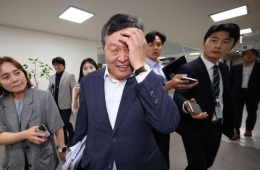
No Tae-ak, Chairman of the Central Election Commission, is presiding over an emergency committee meeting held on the afternoon of the 31st at the Gwacheon Central Election Commission to prepare measures related to preferential hiring of children of senior executives. Photo by Yonhap News
View original imageRegarding institutional ways to prevent political appointments, he said, "It is difficult under the current constitution. On the surface, three members are appointed each by the National Assembly, the President, and the Supreme Court, so it seems balanced. But in reality, besides the President's appointments, among the three appointed by the National Assembly, the ruling party's share and the Supreme Court Chief Justice, who is also appointed by the President, tend to share the same political alignment."
He added, "If the absolute majority of the nine commissioners share the same political stance, internal control becomes practically impossible."
On the NEC's refusal to undergo an audit by the Board of Audit and Inspection regarding the preferential hiring allegations, he said, "In fact, the Audit Act explicitly prohibits audits of the National Assembly, courts, and Constitutional Court. However, since there is no explicit provision regarding the NEC, there is a debate on whether the NEC, as a constitutional and independent institution, should be exempt or subject to audit due to the lack of explicit regulation."
He continued, "Emphasizing the NEC's independence, if the President were to pressure the NEC through the Board of Audit and Inspection under his control, it would be problematic. Therefore, some other form of external control should be introduced."
Hot Picks Today
!["Rather Than Endure a 1.5 Million KRW Stipend, I'd Rather Earn 500 Million in the U.S." Top Talent from SNU and KAIST Are Leaving [Scientists Are Disappearing] ①](https://cwcontent.asiae.co.kr/asiaresize/93/2026051914165468840_1779167814.png) "Rather Than Endure a 1.5 Million KRW Stipend, I'd Rather Earn 500 Million in the U.S." Top Talent from SNU and KAIST Are Leaving [Scientists Are Disappearing] ①
"Rather Than Endure a 1.5 Million KRW Stipend, I'd Rather Earn 500 Million in the U.S." Top Talent from SNU and KAIST Are Leaving [Scientists Are Disappearing] ①
- Given Grants, Then Says "No Launch" ... Innovative Korean Technology Ultimately Forced Overseas
- [Breaking] Chairman Park Sookeun: "Possibility of Agreement Instead of Samsung Electronics Labor-Management Mediation Proposal"
- "If That's the Case, Why Not Just Buy Stocks?" ETFs in Name Only, Now 'Semiconductor-Heavy' and a Playground for Short-Term Traders
- "No Cure Available, Spread Accelerates... Already 105 Dead, American Infected"
Furthermore, Professor Jang commented on the ruling and opposition parties' push for a parliamentary investigation, saying, "So far, parliamentary investigations have rarely been successful. They should be more neutral and objective, but political conflicts and confrontations between the ruling and opposition parties also surface during the investigation process. Without such conflicts, it could succeed, but there are significant concerns about whether it will succeed this time."
© The Asia Business Daily(www.asiae.co.kr). All rights reserved.
![Cheaper Than Candy, Yet Impossible to Find... Fears of a 'Pediatric Medical Crisis' as Pharmaceutical Companies Halt Production [Why&Next]](https://cwcontent.asiae.co.kr/asiaresize/307/2026051910065268365_1779152813.jpg)