Fear of R Continues in the New Year... Gold Prices Rise, Stock Market Falls as Money Flows into 'Safe Assets'
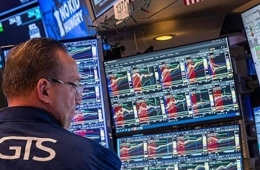
[Asia Economy New York=Special Correspondent Joselgina] The so-called ‘R (Recession) fear’ weighed down the global financial markets from the first trading day of the new year. Money poured into safe-haven assets such as gold, the dollar, and government bonds, pushing international gold prices to their highest level in over six months. There are even forecasts that gold prices could soon surge to an all-time high. On the other hand, the New York stock market, a representative risky asset, failed to smile on the first trading day of the year, with the market capitalization of Big Tech leader Apple falling below $2 trillion. International oil prices also recorded a 4% drop.
![[Image source=Reuters Yonhap News]](http://www.asiae.co.kr/news/img_view.htm?img=2023010410595373675_1672797594.jpg)
◇Soaring Gold Prices Due to Safe-Haven Asset Preference
On the 3rd (local time), in the global financial markets, investors’ preference for safe-haven assets was confirmed as concerns over high interest rates, high inflation, and recession, which weighed down the New York stock market last year, continued.
On that day, February delivery gold on the New York Commodity Exchange closed at $1,846.10 per ounce, up 1.1% ($19.90) from the previous trading day. This is the highest closing price in over six months since June 16 of last year. Gold prices began to rise from early November last year as recession concerns intensified and financial markets remained sluggish. Additionally, central banks around the world purchasing gold on an unprecedented scale as part of their ‘de-dollarization’ strategies supported the upward trend in gold prices.
Ole Hansen, Head of Commodity Strategy at Saxo Bank, analyzed this safe-haven asset preference, saying, "Recession, stock market valuation risks, weak dollar outlook, inflation concerns, and expectations that central banks’ interest rates will peak are all intertwined."

There are also predictions that gold prices will break all-time records as investors flee risky assets and flock to safe-haven assets. In particular, whether central banks, including the U.S. Federal Reserve (Fed), will pivot (change direction) is expected to have a significant impact on gold prices. Eric Strand, who manages the AuAg ESG Gold Mining Exchange-Traded Fund (ETF), predicted that gold prices could break the all-time high this year and surpass $2,100 per ounce, opening a "new long-term bull market."
Fear also pulled down bond yields. On that day, the benchmark 10-year U.S. Treasury yield in the New York bond market fell 14 basis points (1 bp = 0.01 percentage point) from the previous trading day to 3.74%. The 2-year yield, sensitive to monetary policy, also dropped 12 basis points to 4.39%. The decline in Treasury yields indicates that demand for safe-haven government bonds increased, pushing bond prices higher. In the foreign exchange market, despite rising gold prices, the dollar, another safe-haven asset, strengthened. The Dollar Index, which measures the value of the dollar against six major currencies, rose 1.13% from the previous close.
◇Stock Market Also Weak... Apple’s Market Cap Falls Below $2 Trillion
This preference for safe-haven assets appears to be the result of shrinking investor sentiment toward risky assets such as stocks, as recession warnings poured in from major advanced economies including the U.S., European Union (EU), and China since the new year.
Moreover, concerns over earnings for major Big Tech companies like Apple and Tesla added to the gloom. Their stocks dragged down major indices on the New York stock market on the first trading day of the year.

In particular, Apple fell 3.7% from the previous close, breaking the $2 trillion market capitalization mark. Based on the closing price that day, Apple’s market cap was $1.99 trillion. This is the first time Apple’s market cap has fallen below $2 trillion since March 2021. Economic media CNBC reported, "This is a stock price decline compared to a year ago when Apple became the first U.S. company to surpass a $3 trillion market capitalization."
Tesla, which plummeted 65% over the past year, also faced a gloomy first trading day of the new year. Tesla closed at $108.10, down 12.2% from the previous close. Disappointing electric vehicle delivery results last year raised concerns about weakening demand. As a result, at least four Wall Street investment firms reportedly lowered Tesla’s target price and future earnings estimates.
Hot Picks Today
!["Stock Set to Double: This Company Smiles Every Time a Data Center Is Built [Click e-Stock]"](https://cwcontent.asiae.co.kr/asiaresize/93/2026050416112750184_1777878687.jpg) "Stock Set to Double: This Company Smiles Every...
"Stock Set to Double: This Company Smiles Every...
- "Is Yours Just Gathering Dust at Home? Millennials & Gen Z Rediscover Digicams O...
- Chicago Fed President: "Rate Hikes Needed If Productivity Expectations Overheat"
- "High-Net-Worth Investors Managing 10 Trillion Won: 'Gangnam Wealthy Also Feel F...
- “She Shouted, ‘The Rope Isn’t Tied!’... Chinese Woman Falls from 168m Cliff ...
International oil prices plunged from the start of the new year due to recession concerns. On that day, February delivery West Texas Intermediate (WTI) crude oil on the New York Mercantile Exchange (NYMEX) closed at $76.93 per barrel, down 4.2% ($3.33). This is the lowest closing price since December 20 of last year. Brent crude for March delivery on the London ICE Futures Exchange also recorded a drop of over 4%.
© The Asia Business Daily(www.asiae.co.kr). All rights reserved.