Lee Ju-ho "Reform of the Entrance Exam System Should Be Approached Passively in This Administration"
Maintaining a 'Fine-Tuning' Stance on University Admission System Reform
"Reformed the system to wake up sleeping classrooms, but students and parents struggle"
"Felt devastated during the national debate over the ratio of early vs. regular admissions"
Emphasizing 'Class Innovation' and Highlighting Customized Education as a Core Task
Suggesting Expansion of Autonomous Evaluation: "Need to Establish an Early Admission Evaluation System"

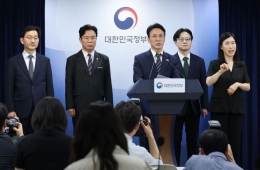
[Asia Economy Reporter Han Jinju] Lee Ju-ho, Deputy Prime Minister for Social Affairs and Minister of Education, emphasized educational innovation based on changes in teaching and said that the reform of the college entrance examination system should be "approached cautiously under this administration."
On the 7th, after his inauguration ceremony at the Government Complex Sejong, Deputy Prime Minister Lee met with reporters and said about the college entrance system reform plan, "The early admission system has expanded and then contracted, but the core is the change in classes, and there are parts where the entrance exam must be adjusted according to changes such as the high school credit system," adding, "If possible, the changes should not be felt significantly by parents, so it should be approached cautiously under this administration."
He said, "It seems difficult to discuss changing the entrance exam system now. In the past, there was talk of changing the entrance exam system to wake up sleeping classrooms, but parents and students found it difficult," emphasizing, "The fatigue from entrance exams has accumulated too much, and I understand that research on simplifying the entrance exam is underway. We will not change the field through the entrance exam but will change the field so that it is reflected in the entrance exam."
He added, "During the previous administration, when a national debate broke out over the ratio of early admission to regular admission, it was truly a disheartening experience. In fact, it was a debate without an answer," explaining, "The reason is that classes do not change in the field, and if classes change and we can see students' creativity and character, the fairness of early admission can also be improved."
Regarding the criticism that the reform of the entrance exam system must be accompanied for the high school credit system, which will be fully implemented in 2025, to settle, he said, "It is still difficult to give a confident answer about the high school credit system."
Emphasizing the "change in classes," Deputy Prime Minister Lee said he would support enhancing teachers' capabilities by utilizing Edutech as an auxiliary tool. He said, "When the classroom becomes revolutionary, customized education for all children will be possible," adding, "If classes are innovated, it will wake up sleeping classrooms and solve entrance exam problems in the long term."
He also suggested it as a means to evaluate students' academic abilities while avoiding controversy. He diagnosed, "We will introduce evaluation, but it will not be uniform; it will be customized evaluation," and added, "It is time to establish a system that allows evaluations to be conducted flexibly according to the convenience of the children."
Regarding the conflict of interest controversy with Edutech companies, Deputy Prime Minister Lee said, "I will report or inquire in advance according to the Conflict of Interest Prevention Act," and assured, "I will never represent the private interests of any specific group."
Amid concerns about the revival of nationwide tests as the Ministry of Education introduces 'customized academic achievement autonomous evaluation,' Deputy Prime Minister Lee expressed his intention to expand customized evaluation. He explained, "Parents often point out that there are too few evaluations and feel frustrated. Looking at the background of nationwide tests, there is strong opposition from schools, and if the focus is on written exams, the burden on teachers and students is significant," adding, "AI tutors are also based on adaptive evaluation, and looking to the future, customized evaluation methods have infinite potential for development."
Hot Picks Today
 "Now Our Salaries Are 10 Million Won a Month" Record High... Semiconductor Boom Drives Performance Bonuses at Major Electronic Component Firms
- Wallets Open Wide on Big News...300 Trillion Won Heads to the U.S., "Tax Breaks" Fail to Keep Funds at Home
- "Hope You Enjoy the 'Welfare' for Bereavement of Children"... Ridicule of Strike Non-Participants Intensifies Union Conflict at Samsung Electronics
- "Realizing How Fast Money Disappears: Should You Try Only the Essentials for 5,000 Won? [The Basics of Benefits]"
- Experts Already Watching Closely..."Target Price Set at 970,000 Won" Only Upward Momentum Remains [Weekend Money]
Regarding the plan to reform local education finance grants and establish a special account to support higher and lifelong education, he said, "There seems to be a clear part where elementary and secondary education finances are expected to have surpluses compared to university finances over the past few years. There is also a perspective that this is temporary, and we need to think about it carefully," but added, "I believe it cannot pass while all superintendents oppose it. From that perspective, I will continue to consider what the best consensus point could be and strive to reach an agreement."
© The Asia Business Daily(www.asiae.co.kr). All rights reserved.