Prosecutor's Investigation and Trial Both 'Self-Defense'... Nam Wook Shaking the Courtroom

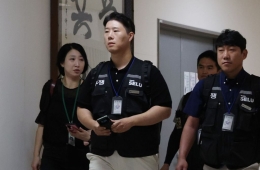
Nam Wook, a key figure in the preferential treatment allegations related to the Daejang-dong development, is attending the warrant hearing held at the Seoul Central District Court in Seocho-gu, Seoul on the 3rd. Photo by Jinhyung Kang aymsdream@
View original image[Asia Economy Reporter Kim Hyung-min] "Nam Wook's side. Please proceed."
On the 28th of last month, the 60th trial session regarding the 'Daejang-dong Urban Development Special Favoritism' suspicion case was held at the Seoul Central District Court. When the court ordered Nam Wook's lawyer to conduct witness examination of accountant Jung Young-hak, Nam's lawyer took the microphone. For a moment, silence fell. The atmosphere in the courtroom was filled with tension. It was a unique scene where those identified as 'accomplices' involved in the case exchanged questions and answers with each other. From accountant Jung's perspective, it seemed very difficult to lie in front of lawyer Nam, who deeply knows the inside story of the case.
Such scenes have occasionally appeared in the Daejang-dong trial so far. According to the legal community on the 2nd, Nam Wook appointed a lawyer to represent him and appeared in court together, but when necessary, he took the microphone himself. The same applies to the prosecution investigation. According to sources inside and outside the prosecution, Nam mostly appeared alone for the necessary investigations. This is so-called 'self-defense.'
While this is sometimes seen in cases where those holding lawyer licenses become suspects, especially in this Daejang-dong case, many people are involved in an organized manner, so Nam's 'self-defense' is drawing attention in the legal community. It is highly likely that Nam is comparing and analyzing the prosecution and trial situations while defending himself. Through this, he can discern the prosecution's investigation status and the necessary statements in court. Then, the strategy he should take also becomes clearer. There is even analysis that he holds the key to deciding the investigation and trial.
At times, his words can be powerful enough to shake the entire situation. Recently, by changing his stance and beginning to expose the inside story of the Daejang-dong case, he has been exerting considerable influence. During the trial on the 28th of last month, while questioning accountant Jung, he revealed that he heard that a portion of the Daejang-dong project shares belonged to Lee Jae-myung, leader of the Democratic Party of Korea, drawing attention. Nam asked Jung, "Do you remember that around February to April 2015, Kim Man-bae told Nam Wook, 'Just take 25% of the (stocks) and step back. I only have 12.5% shares, and the rest belong to Mayor Lee's side,' and Nam Wook initially resisted but eventually accepted the 25%?" Jung replied, "I don't remember." The Daejang-dong investigation team, including the Anti-Corruption Investigation Division 1 (Chief Prosecutor Eom Hee-jun) and Division 3 (Chief Prosecutor Kang Baek-shin) of the Seoul Central District Prosecutors' Office, is verifying whether this statement is true. It is also known that recently both Nam and Jung were summoned for a confrontation investigation.
Public attention is expected to continue focusing on Nam's statements. He will appear in court consecutively on that day and the 4th. On the 22nd, his detention period will expire, and he will be released.
Meanwhile, Kim Yong, deputy director of the Minjoo Research Institute, who was detained on charges of receiving illegal political funds amounting to around 800 million won, is reportedly continuing to exercise his right to remain silent during prosecution investigations. The prosecution is initially aiming to indict former deputy director Kim for violating the Political Funds Act and is also considering handling the case as a comprehensive single crime (one crime composed of multiple acts) due to the statute of limitations issue regarding past bribery suspicions.
Hot Picks Today
 "Samsung and Hynix Were Once for the Underachievers"... Hyundai Motor Employee's Lament
- "Was This Delicious Treat Enjoyed Only by Koreans?"... The K-Dessert Captivating Japan
- Despite Captivating the Nation for Over a Month... "Timmy" the Whale Ultimately Found Dead
- KOSPI Plunges Early Then Rebounds to Close Above 7,500
- "That? It's Already Stashed" Nightlife Scene Crosses the Line [ChwiYak Nation] ③
© The Asia Business Daily(www.asiae.co.kr). All rights reserved.