Increase of Interim Payment Loan Guarantee from 900 Million KRW to 1.2 Billion KRW... Considering Additional Deregulation of Restricted Areas

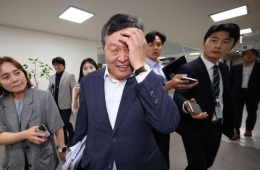
President Yoon Suk-yeol is speaking at the 11th Emergency Economic and Livelihood Meeting held at the Yongsan Presidential Office Building in Seoul on the afternoon of the 27th.
As the real estate market downturn deepens, the government is easing regulations on apartment interim payment loans and considering additional removals of speculative overheating zones and adjustment target areas.
On the 27th, Won Hee-ryong, Minister of Land, Infrastructure and Transport, announced measures to ease real estate regulations, including expanding interim payment loan guarantees, at the 11th Emergency Economic and Livelihood Meeting presided over by President Yoon Suk-yeol.
Interim payment loans will be allowed for apartments with a sale price of 1.2 billion won or less to reduce the financial burden on actual homebuyers.
Since August 2016, to cool down the overheated pre-sale market, the government has restricted interim payment loan guarantees from the Housing and Urban Guarantee Corporation (HUG) and Korea Housing Finance Corporation (HF) for homes priced over 900 million won. For homes priced above 900 million won, buyers had to cover the contract deposit and interim payments, which account for about 70% of the sale price, without loans.
However, over the six years since the introduction of the '900 million won regulation,' rising home prices have led to the average pre-sale price of private apartments in Seoul increasing by 40%, from 20 million won to 28 million won per 3.3㎡, raising concerns that the loan regulations are excessive.
Accordingly, the government has decided to expand interim payment loan guarantees to homes priced up to 1.2 billion won.
Minister Won said at the meeting, "The interim payment loan limit has been too low compared to the recent rise in home prices, so we will raise it to 1.2 billion won."
In addition, the government plans to lift the designation of 39 speculative overheating zones and 60 adjustment target areas by next month.
Earlier in September, 41 out of 101 adjustment target areas and 4 out of 43 speculative overheating zones were lifted, and now additional removals are being considered just a month later.
As a result, there is speculation that some parts of Gyeonggi Province, which were excluded from the previous removal despite recent sharp declines in home prices, will be released from regulations such as adjustment target areas and speculative overheating zones.
Currently, there are 15 speculative areas in Seoul, 39 speculative overheating zones in Seoul and Gyeonggi, and 60 adjustment target areas remaining.
The deadline for disposing of existing homes by successful applicants in speculative overheating zones will be extended to two years.
Currently, one-homeowners who win a subscription with the condition of disposing of their existing home must sell their house within six months after the move-in date. However, there have been many criticisms that it is difficult to sell homes within a short period due to the extremely sluggish housing transaction market.
Minister Won stated, "The mandatory period to sell the old home after winning a new home subscription is too short," adding, "We will strive to ensure that demand for moving or relocation is not suppressed due to transaction interruptions."
Hot Picks Today
!["Rather Than Endure a 1.5 Million KRW Stipend, I'd Rather Earn 500 Million in the U.S." Top Talent from SNU and KAIST Are Leaving [Scientists Are Disappearing] ①](https://cwcontent.asiae.co.kr/asiaresize/93/2026051914165468840_1779167814.png) "Rather Than Endure a 1.5 Million KRW Stipend, I'd Rather Earn 500 Million in the U.S." Top Talent from SNU and KAIST Are Leaving [Scientists Are Disappearing] ①
"Rather Than Endure a 1.5 Million KRW Stipend, I'd Rather Earn 500 Million in the U.S." Top Talent from SNU and KAIST Are Leaving [Scientists Are Disappearing] ①
- Brilliant Korean Technology Flows Overseas... Subsidies Granted, but "No Product Launch Allowed"
- "If That's the Case, Why Not Just Buy Stocks?" ETFs in Name Only, Now 'Semiconductor-Heavy' and a Playground for Short-Term Traders
- Singer Kim Minjong Responds to MC Mong's Gambling Allegations: "Clearly False... Legal Action to Follow"
- "No Cure Available, Spread Accelerates... Already 105 Dead, American Infected"
© The Asia Business Daily(www.asiae.co.kr). All rights reserved.
![Cheaper Than Candy, Yet Impossible to Find... Fears of a 'Pediatric Medical Crisis' as Pharmaceutical Companies Halt Production [Why&Next]](https://cwcontent.asiae.co.kr/asiaresize/307/2026051910065268365_1779152813.jpg)