Gyeongnam Office of Education: "Punishing School Violence Perpetrators Is Not the Solution, Restoring Relationships Is the Answer"

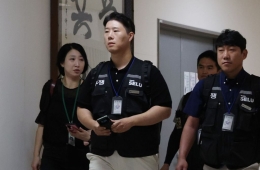
Song Ho-chan, Director of the Democratic Citizenship Education Division at the Gyeongnam Office of Education, is discussing the achievements and expectations of the School Violence Relationship Recovery Support Group. / Photo by Ryeong Lee ryeong@
View original image[Asia Economy Yeongnam Reporting Headquarters Reporter Lee Seryeong] The Gyeongnam Office of Education is operating a School Violence Relationship Recovery Support Group to help restore relationships between students in response to changes in the types of school violence.
According to the provincial Office of Education on the 20th, the support group consists of 254 members within the province, including current and retired teachers, school administrators and professionals, village teachers, professional counselors, current and former police officers, university professors, and restorative justice experts.
There are at least 8 and up to 20 members in the main office with 33 members and in 18 city and county education support offices, appointed on a one-year basis.
After completing integrated training and capacity-building training provided by the Office of Education, they visit schools to support the restoration of relationships between both students and their parents.
Starting with 250 members in May, the support group has handled a total of 100 school violence cases over the past five months: 15 cases in elementary schools, 34 in middle schools, and 21 in high schools.
There were 123 victim students and 193 perpetrator students. Among the 100 cases submitted to the School Violence Countermeasure Deliberation Committee, 62 were resolved by the school principal independently, and 9 cases were processed by the committee with disciplinary action against the perpetrators followed by relationship recovery support.
The remaining 30 cases are currently under investigation and restorative support by the committee and the support group.
According to the support group, recent patterns of school violence more frequently involve verbal abuse, cyberbullying, and group ostracism occurring among students who already have established relationships, rather than physical or bodily violence.
Kang Hyungcheon, Superintendent of Democratic Citizenship Education, explained, “This pattern, called relational violence or relational bullying, causes emotional and psychological aftereffects for the victim students and sometimes creates significant difficulties in forming interpersonal relationships during their growth process.”
He added that this issue is not unrelated to the characteristics of Korean culture, which is relationship-oriented and strongly collectivist, so it cannot be resolved by punishing only the perpetrator students.
He continued, “The support group operates in units of 2 to 3 people and conducts pre-meetings, main meetings, and post-meetings with the involved parties. Both parties must agree to proceed, and if either side refuses restorative support during the process, it is stopped.”
“Even after relationship recovery is achieved, the initially assigned support group monitors the situation for at least one month to confirm whether the students’ relationship has been fully restored,” he added.
The support group emphasized, “The current procedures for handling school violence cases cannot fundamentally solve the problem of school violence. Support for relationship recovery is needed throughout the entire process, from the occurrence of the school violence incident to after the committee’s disciplinary decision.”
“There are mixed situations where a student can be both a perpetrator and a victim, and incidents sometimes arise from misunderstandings because the students are still immature,” they said.
They also stated, “The purpose of the support group is not only to heal the hearts of children who have experienced school violence and restore relationships but also to help students grow into individuals who reflect on their own words and actions, take responsibility for them, and empathize with others, rather than relying solely on their parents.”
Hot Picks Today
 "Samsung and Hynix Were Once for the Underachievers"... Hyundai Motor Employee's Lament
- "Was This Delicious Treat Enjoyed Only by Koreans?"... The K-Dessert Captivating Japan
- "Iran Considers Usage Fees From Surface to Seabed, Eyes $15 Billion Annual Revenue"
- Former Google CEO: "AI Is Unavoidable"... U.S. Graduates Boo
- "That? It's Already Stashed" Nightlife Scene Crosses the Line [ChwiYak Nation] ③
Song Hochan, Director of Democratic Citizenship Education, said, “As many cases of school violence relationship recovery support accumulate and excellent cases are shared, it will be possible to educationally supplement the legal limitations that only punish the perpetrator students. We expect that through the voluntary responsibility of the perpetrators and the genuine recovery of the victims, the recovery and growth of all students can be supported.”
© The Asia Business Daily(www.asiae.co.kr). All rights reserved.