From "Nuclear Armament" to Mandatory "Women's Military Training"... Ruling Party Leadership Candidates Take a Hardline Stance
Hardline Security Remarks Advocating 'Tactical Nuclear Redeployment'
Calls for Mandatory 'Women’s Military Education' Also Emerge
US Ambassador Denies Responsibility Saying "Tactical Nuclear Talk Irresponsible"

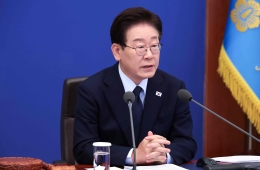
Jin Jeong-seok, Emergency Response Committee Chairman of the People Power Party. / Photo by Dongju Yoon doso7@
View original image[Asia Economy Reporter Kang Juhee] Ruling party presidential candidates have been making tough statements on security issues day after day. There have been claims that tactical nuclear redeployment, nuclear sharing, and even independent nuclear development should be pursued. The necessity of mandatory 'women's basic military education' was also raised. Amid ongoing military provocations by North Korea, it seems that a fierce competition for clarity targeting the conservative support base sensitive to security issues is intensifying.
The ruling People Power Party presidential candidates have recently all taken a hardline stance regarding North Korea's successive provocations. Jeong Jin-seok, a member of the Emergency Response Committee and a presidential candidate, posted on Facebook on the 18th, "If the Guam Air Force Base, U.S. territory, is attacked by North Korea's tactical nuclear weapons, no one would doubt that the U.S. would retaliate with nuclear strikes on Pyongyang. But if North Korea destroys Busan Port with tactical nuclear weapons, would the U.S. really retaliate with nuclear strikes? Would the U.S. kindly open an umbrella for us even while it's drizzling?" he questioned.
He continued, "The people's anxiety starts right here. The response to North Korean nuclear weapons must be comprehensively reconsidered. The extended deterrence promised by the U.S. must be concretized to a level where the people can feel safe," emphasizing the necessity of redeploying tactical nuclear weapons.
There were also claims that independent nuclear development should be pursued. Lawmaker Cho Kyung-tae stated on Facebook, quoting former President Park Chung-hee, "A mad dog is best dealt with a club," and argued, "At this point, we must push forward with nuclear development to protect freedom and peace." Recently, Cho also declared on a broadcast that he would deploy tactical nuclear weapons in his constituency, Saha District, Busan.
Lawmaker Kim Ki-hyun announced plans to make women's basic military education mandatory. He said, "The obligation and promotion of women's basic military education is not a matter of political strife but a matter of survival to protect myself and my family," adding, "While various debates on women's conscription are ongoing, we must first focus on urgent and feasible tasks."
As a specific implementation plan, he mentioned, "The existing reserve forces and civil defense training, which mainly target men who have completed military service, should be expanded to include women who have reached a certain age, and basic survival training should be conducted through commuting methods or 2-night, 3-day admission training covering basic first aid, chemical, biological, radiological, and nuclear (CBRN) response methods, firearm management, and countermeasures during bombardment to prepare for emergencies."

On the other hand, some within the People Power Party hold skeptical views about the hardline stance toward North Korea. Lawmaker Yoon Sang-hyun said in an interview with KBS Radio's 'Choi Kyung-young's Strong Current Affairs' that he believes South Korea's independent nuclear armament would "never be tolerated by the U.S." He added, "If we develop nuclear weapons, we would have to withdraw from the NPT (Non-Proliferation Treaty), and (if that happens) our international credibility would decline, and we would inevitably be diplomatically and economically isolated."
Regarding the redeployment of tactical nuclear weapons, Lawmaker Yoon also expressed skepticism, saying, "Would the U.S. government really do that? I am somewhat doubtful," pointing out, "The U.S. would have to consider the reactions of China and Russia, and the national consensus on the Korean Peninsula would be divided."
Hot Picks Today
 "Samsung and Hynix Were Once for the Underachievers"... Hyundai Motor Employee's Lament
- "Plunged During the War, Now Surging Again"... The Real Reason Behind the 6% One-Day Silver Market Rally [Weekend Money]
- After Losing Her Only Daughter, a Mother in China Gave Birth to Twins at 60... Reinventing Life at 76
- "We Will Return to the EU" ... Brexit Reignited in UK Prime Ministerial Race
- "That? It's Already Stashed" Nightlife Scene Crosses the Line [ChwiYak Nation] ③
Above all, many view the feasibility of redeploying tactical nuclear weapons, as advocated by the ruling party, as low. The U.S. side has shown a negative stance toward deploying tactical nuclear weapons on the Korean Peninsula. Philip Goldberg, U.S. Ambassador to South Korea, said at a Kwanhun Club discussion held at the Seoul Press Center on the 18th, "Whether the talk about tactical nuclear weapons started from Putin or Kim Jong-un, it is irresponsible and dangerous. It does not help reduce tensions," adding, "We need to focus on eliminating nuclear weapons to reduce tensions, not on nuclear weapons that increase threats."
© The Asia Business Daily(www.asiae.co.kr). All rights reserved.