[2022 National Audit] Kang Do-tae "Deep Apology for Employee Embezzlement... Will Establish Fundamental Measures"
National Assembly Audit of the National Health Insurance Service on the 13th
![[Image source=Yonhap News]](http://www.asiae.co.kr/news/img_view.htm?img=2022101311300867396_1665628208.jpg)
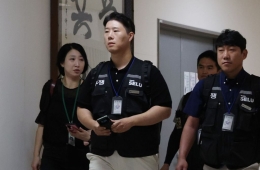
[Asia Economy Reporter Kim Young-won] Kang Do-tae, President of the National Health Insurance Service (NHIS), apologized for the recent embezzlement incident involving 4.6 billion KRW by an employee and stated that fundamental countermeasures will be established.
At the National Assembly Health and Welfare Committee’s audit held on the 13th at the NHIS headquarters in Wonju, Gangwon Province, President Kang said before the business report, "I sincerely apologize for the recent employee embezzlement incident. We will minimize the damage caused by this incident and conduct a comprehensive and thorough review of all operations to establish fundamental measures to prevent recurrence."
Earlier, on the 22nd, during a work inspection, NHIS confirmed that Choi (44), an employee in charge of receivables, embezzled approximately 4.6 billion KRW and referred the case to the police for investigation. Subsequently, the NHIS formed an emergency response team internally and took measures to freeze the embezzling employee’s accounts.
The NHIS’s business report also included measures to prevent recurrence of embezzlement incidents. Since the 25th of last month, to prevent recurrence, the authority of payment decision-makers has been decentralized, and the approval authority has been elevated from team leaders to department heads. The automatic account verification information saving function of the Korea Financial Telecommunications & Clearings Institute was supplemented, and procedures were improved by separating the departments responsible for the cause of expenditure and the expenditure execution departments. President Kang explained, "We are reviewing all cash payment operations to establish an effective management system," adding, "Based on the results of the Ministry of Health and Welfare’s special audit and internal inspections, we will prepare fundamental measures to prevent recurrence."
Regarding major business status, NHIS announced plans to alleviate medical expenses burdens and expand support for vulnerable groups. First, to strengthen essential medical coverage, the government’s public policy fee schedule will be introduced, and support will be provided for training public regional medical personnel, while also promoting the rapid listing of high-cost drugs. To strengthen management of non-reimbursable medical services, NHIS is identifying the current status and developing monitoring indicators. President Kang stated, "We are working to establish the foundation for introducing a non-reimbursable reporting system and to strengthen cooperation among public medical insurance systems."
To alleviate the burden of high-cost and severe medical expenses, the out-of-pocket maximum payment system and special calculation exceptions will be expanded, and the pilot project for sickness benefits will continue. The out-of-pocket maximum payment system refunds the excess amount to the insured if the total annual out-of-pocket expenses exceed the standard limit classified by income level. Additionally, to expand medical support for persons with disabilities, support for assistive devices and home treatment will be strengthened.
NHIS is promoting a two-step reform to establish a fair insurance contribution system and is pursuing deductions for housing finance debt. The system for foreign dependents will also be improved. To strengthen a stable financial foundation, efforts are being made to improve expenditure efficiency, secure national treasury funds, and diversify fund management to increase revenue. Furthermore, NHIS plans to prevent financial leakage by blocking illegal institution entry and strengthening detection, collaborating with related organizations to detect fraudulent claims, and enhancing systems to prevent and detect identity theft.
Additionally, NHIS plans to entrust student health checkups to the NHIS. Currently, student checkups are separately managed by the Ministry of Education. President Kang said, "We will promote entrusting student checkups to NHIS to establish a foundation for a lifelong health management system, improve checkup quality through evaluation, and strengthen follow-up management," adding, "For chronic disease management, we will expand comprehensive management centered on local clinics and linked services."
Measures to prepare for the "100-year life" in an aging society were also presented. NHIS is developing an integrated home care model and preparing integrated services reflecting medical, nursing, and care needs. Medical services within nursing facilities are being strengthened, and integrated nursing and caregiving services are being expanded. To improve the quality of long-term care services, mandatory continuing education for care workers will be implemented, and standardized designation review criteria will be expanded nationwide to enhance the substance of the long-term care institution designation renewal system.
Hot Picks Today
 "Samsung and Hynix Were Once for the Underachievers"... Hyundai Motor Employee's Lament
- "Was This Delicious Treat Enjoyed Only by Koreans?"... The K-Dessert Captivating Japan
- "Iran Considers Usage Fees From Surface to Seabed, Eyes $15 Billion Annual Revenue"
- U.S. Treasury Yields Surge Amid Iran War Uncertainty... Warning Signs for AI Tech Stock Rally
- "That? It's Already Stashed" Nightlife Scene Crosses the Line [ChwiYak Nation] ③
Regarding COVID-19, NHIS plans to continue supporting responses using big data, including monitoring adverse reactions to vaccinations.
© The Asia Business Daily(www.asiae.co.kr). All rights reserved.