Gyeongnam Province Connects Water Purification Plants to Create 'Emergency Water Supply Network'... Suspends Operation of Affected Plants During Larvae Outbreak
Announcement of Comprehensive Measures to Strengthen Management in the Water Supply Sector

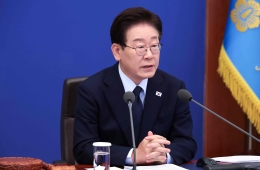
Jeong Seok-won, Director of the Climate, Environment, and Forestry Bureau of Gyeongnam Province, announcing comprehensive measures to strengthen management in the water supply sector. / Photo by Ryeong Lee
View original image[Asia Economy Yeongnam Reporting Headquarters Reporter Lee Se-ryeong] Gyeongsangnam-do recently established a comprehensive plan for the water supply sector on the 27th to prevent recurrence of incidents such as the larvae outbreak at Seokdong Water Purification Plant in Jinhae-gu, Changwon City.
This plan consists of a total of 15 tasks across four areas: ▲strengthening water quality monitoring ▲enhancing water purification plant operation and management and accident response ▲improving water supply pipelines ▲and strengthening services for residents.
Gyeongnam Province decided to shorten the monitoring measurement intervals for key surveillance items related to larvae or algal blooms from raw water intake to water purification.
For 51 water purification plants in the province, larvae monitoring, which was previously conducted once a week for raw water and once daily for purified water, will now be performed once daily for all pre-purification processes.
For the four cities operating the algae warning system?Changwon, Jinju, Gimhae, and Yangsan?the microcystin-LR test for algal toxins, previously conducted once every six months at intake and purification plants, will be strengthened to once a month.
Monitoring of odor substances such as geosmin and 2-MIB will also have its frequency shortened from once a month to once a week at 20 intake and purification plants.
The hygiene management and inspection of 51 water purification plants, jointly conducted annually by the province and the Nakdong River Basin Environmental Office, will increase from once to twice a year, with additional special inspections conducted as needed during summer.
They will check ▲cleaning status of intake points ▲removal of larvae habitats ▲daily monitoring implementation for each water purification process ▲on-site investigation of larvae presence before purification processes ▲and proper management of inflow prevention facilities such as insect screens, air curtains, and insect traps, followed by facility improvements and requests for inspection by the National Institute of Biological Resources.
The province plans to collaborate continuously with specialized organizations such as the Korea Water Resources Corporation and the Korea Water and Wastewater Works Association to support facility improvements and operation management plans tailored to the circumstances of cities and counties.
If larvae or small organisms are found in the water, immediate reporting to the province and environmental office will be required, and the manual for accident response will be improved to speed up notifications to residents according to the duties of related agencies.
The province will create a separate specialized education course for preventing tap water accidents, which had been conducted once every three years by the Korea Water Resources Corporation, Korea Water and Wastewater Works Association, and the National Institute of Environmental Human Resources Development. This course will be held annually at the Gyeongnam Human Resources Development Institute for those responsible for operating and managing water supply facilities in cities and counties.
Simulated training and discussions on responses to major tap water quality incidents such as algae or larvae accidents will increase from once a year to twice a year for operation and management personnel.
A research project will also be pursued to establish optimal water purification process operations and technologies to respond to larvae incidents.
A provincial official explained, “Currently, even when incidents of rust-colored water or larvae occur, the drinking water quality standard tests at purification plants all pass without violations, which does not meet residents’ expectations and increases distrust.”
Accordingly, the province plans to propose to the Ministry of Environment to add items such as larvae and rust-colored water as foreign substances to the existing 61 drinking water quality standard items.
Gyeongnam Province is also promoting projects for repairing aging water supply networks and establishing emergency supply networks.
The water supply network repair project has been underway since 2017 and will continue until 2026 with an investment of 537 billion KRW, while the emergency supply network construction project is being promoted from 2018 to 2026 with a budget of 117.8 billion KRW.
The emergency supply network project connects emergency pipelines between nearby water purification plants so that if a problem such as larvae occurs at one plant, its operation can be stopped and water can be supplied from another connected plant to households.
According to the province, the project is currently in progress, with connections established among Chilseo, Daesan, Jinju 1st and 2nd water purification plants.
A provincial official stated, “We are discussing advancing the project planned by Changwon City for 2030 to be implemented earlier in cooperation with the province.”
The province will also disclose tap water quality information, which was previously accessible via the National Waterworks Information System operated by the Ministry of Environment or city and county water supply department bulletin boards, on the official websites of cities and counties.
Starting in 2023, the free tap water quality testing service, ‘Our Home Tap Water Safety Confirmation System,’ will be expanded to all cities and counties.
Additionally, a budget of 3.3 billion KRW will be allocated to the ‘Visiting Our Home Tap Water Safety Confirmation Support Project,’ where responsible public officials visit areas prone to complaints to provide water quality testing directly.
Hot Picks Today
 "Samsung and Hynix Were Once for the Underachievers"... Hyundai Motor Employee's Lament
- After Topping 8,000 Instead of Hitting 10,000... KOSPI Plunges—When Will It Rebound?
- "They Said It's Impossible to Get—Already Selling for Triple the Price: Crowds Worldwide Line Up for $600 Luxury Watch"
- "Children Should Be Cared for at Home by Their Mother"...Opinion Reversed for the First Time in 18 Years
- "That? It's Already Stashed" Nightlife Scene Crosses the Line [ChwiYak Nation] ③
Jung Seok-won, Director of the Climate, Environment, and Forestry Bureau, said, “We will faithfully implement the comprehensive plan to strengthen management in the water supply sector together with cities, counties, and related agencies. We will do our best to alleviate residents’ concerns and supply water that can be safely consumed at any time.”
© The Asia Business Daily(www.asiae.co.kr). All rights reserved.