Rapid Exchange Rate Surge is a Double-Edged Sword... 'Restless' Small and Medium Enterprises
"Secured Inventory Anticipating Exchange Rate Rise... But Endurance Has Limits"
Companies Engaged in Both Export and Import Face a "Double-Edged Sword"... "Frustrated by Daily Ups and Downs"

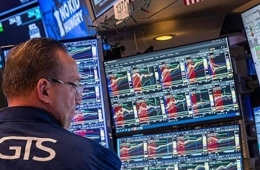
The won-dollar exchange rate surpassed 1,300 won during the trading session. On the 23rd, the exchange rate started at 1,299 won, 1.7 won higher than the previous day, and soared to 1,300.5 won by 9:15 a.m. It is the first time in about 13 years since July 14, 2009 (1,303 won) that the intraday exchange rate exceeded 1,300 won. The photo shows the Hana Bank dealing room in Jung-gu, Seoul, on that day. Photo by Kim Hyun-min kimhyun81@
View original image[Asia Economy Reporters Kim Jong-hwa, Choi Dong-hyun] The won-dollar exchange rate fluctuating around 1,300 won per dollar is dealing a blow to our economy. Our small and medium-sized enterprises, structurally vulnerable to external shocks, are restless. Although the situations vary by industry, the current rising uncertainty is not entirely welcome.
The paint industry wears a gloomy expression. Due to its high import and domestic demand ratios, it is sensitive to fluctuations in oil prices and exchange rates. In March, major paint companies such as KCC, Noroo Paint, Samhwa Paint, and Gangnam Jevisco raised product prices by up to 30%. This followed two price hikes in the first and second halves of last year due to increases in raw material and logistics costs.
"The limit of enduring with inventory will soon be reached"
Although they anticipated the exchange rate rise and secured some raw material inventory, raw material prices continue to climb, and it is expected that they will soon reach a breaking point, severely deteriorating profitability. A paint industry official said, "We predicted the exchange rate increase to some extent and have secured some inventory, so we are still okay, but the continuously rising raw material prices are problematic. Since product prices have already been raised significantly, it is difficult to reflect further increases in prices, so we are contemplating strategies for the second half of the year. If this situation persists, no matter how good the plan is, it will be useless," expressing concern.
The cement industry, recently struggling with soaring thermal coal prices, is also grim. For exports, payments are received in dollars, which is somewhat advantageous, but the purchase price of thermal coal, which is entirely imported, is so high that the exchange rate effect is hard to expect. Inland cement companies that rely solely on domestic sales without exports are facing the worst situation.
Thermal coal accounts for about 40% of cement production costs. As of June, the average thermal coal price is $395 per ton, about eight times higher than the $52 per ton average in June 2020, and three times higher than last year's average of $127 per ton. A cement industry official said, "If the won depreciates, coastal companies can offset some profits through exports, but inland companies will suffer serious damage. If thermal coal prices do not fall, profitability is hard to expect. At the company level, we are only monitoring exchange rate fluctuations; there is no clear countermeasure to control them," he revealed.
Companies engaged in both exports and imports face a 'double-edged sword'
The paper industry is equally frustrated. Raw materials are imported, but the produced products must be exported. While exports bring payments in dollars, potentially improving profits to some extent, the recent surge in raw materials like pulp, which are imported, inevitably raises costs. A paper industry official said, "For companies like us that have to manage both exports and imports, the exchange rate entering the 1,300 won range is a 'double-edged sword.' It is frustrating to be subject to daily ups and downs," he lamented.
All industries worry about the prolonged situation. The furniture industry, which has almost no exports and imports materials to manufacture furniture, is striving to diversify its client base. A Hanssem official said, "We are affected by the exchange rate when importing raw materials. We will use sufficient inventory in the short term, but if the situation prolongs, we may face unpredictable circumstances. We are diversifying our clients from dollar-based transactions to euros, yuan, and others. We are also looking for products that can hedge exchange rate risks," he explained.
Companies not relying on luck, exchange rate fluctuations 'no problem' draws attention
At least some companies are offsetting losses through currency hedging. SFA, a display equipment and smart factory solutions company, earns 70% of its sales from overseas orders and has a low proportion of imported materials, so it is hardly affected by exchange rate fluctuations. An SFA official explained, "When overseas orders are secured, SFA immediately hedges the entire amount through forward contracts and futures, so exchange rate fluctuations practically do not significantly affect profitability. For example, when the exchange rate rises, sales converted to won increase, boosting operating profit, but losses from hedging in non-operating sections offset this, so pre-tax profit is not greatly affected." Their honest business approach without relying on luck draws attention.
Hot Picks Today
!["Stock Set to Double: This Company Smiles Every Time a Data Center Is Built [Click e-Stock]"](https://cwcontent.asiae.co.kr/asiaresize/93/2026050416112750184_1777878687.jpg) "Stock Set to Double: This Company Smiles Every...
"Stock Set to Double: This Company Smiles Every...
- "Is Yours Just Gathering Dust at Home? Millennials & Gen Z Rediscover Digicams O...
- "I Take Full Responsibility"... Seongjae Ahn Issues Direct Apology for 'Wine Swi...
- "Continuous Groundwater Pumping Causes Mexico City to Sink 24cm Annually... 'Gia...
- “She Shouted, ‘The Rope Isn’t Tied!’... Chinese Woman Falls from 168m Cliff ...
© The Asia Business Daily(www.asiae.co.kr). All rights reserved.