[Good Morning Stock Market] Mixed Trends Expected Amid Rebound Attempts... FOMC Caution Caps the Upside
![[Image source=Yonhap News]](http://www.asiae.co.kr/news/img_view.htm?img=2022061507003813490_1655244037.jpg)
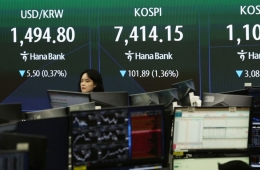
[Asia Economy Reporter Lee Seon-ae] The domestic stock market, which narrowed its losses the previous day, is expected to start with a slight decline but show mixed trends. Although it will attempt a rebound due to the easing of the plunge in the U.S. stock market, caution ahead of the June Federal Open Market Committee (FOMC) meeting is expected to limit the upper range of the index. Concerns about stagflation persist, so differentiation among individual stocks is also expected to continue.
On the eve of the Federal Reserve's (Fed) June FOMC regular meeting announcement, the New York stock market showed mixed trends. On the 14th (local time) at the New York Stock Exchange (NYSE), the Dow Jones Industrial Average closed at 30,364.83, down 151.91 points (0.50%) from the previous session. The Standard & Poor's (S&P) 500 index fell 14.15 points (0.38%) to 3,735.48, while the tech-heavy Nasdaq index rebounded 19.12 points (0.18%) to close at 10,828.35.
The May Consumer Price Index (CPI) significantly exceeded expectations, rapidly raising forecasts that the Fed will implement a giant step rate hike (a 0.75 percentage point increase), larger than previously anticipated. Various U.S. media outlets, including Bloomberg and The Wall Street Journal (WSJ), reported that the Fed is likely to raise rates by 0.75 percentage points at the FOMC meeting held on the 14th-15th. According to CME FedWatch, the interest rate futures market reflects a 94% probability that the Fed will raise rates by 0.75 percentage points at this meeting.
If the giant step is taken as the market expects, it will be the first 0.75 percentage point hike since November 1994 during former Chairman Alan Greenspan's tenure. Wall Street economists predict that the Fed will raise rates by 0.75 percentage points in both June and July, 0.5 percentage points in September, and 0.25 percentage points in November and December. Accordingly, the year-end benchmark interest rate is expected to rise to 3.25%-3.5%. Currently, the U.S. benchmark interest rate is 0.75%-1.00%.
New York stock market experts said the giant step could be negative for the stock market. Michael Rankin, senior market strategist at the NYSE, said, "There was a mild rebound at the opening, but with the Fed's decision looming, the market shows almost no aggressive enthusiasm."
Seo Sang-young, Head of Media Content, Mirae Asset Securities
The Korean stock market started lower the previous day as the U.S. market showed further sharp declines amid recession concerns. In particular, supply-demand instability caused by active selling from foreigners was also a factor in the decline. However, as a rebound buying wave entered due to recent declines, the losses narrowed. China's active stimulus measures are estimated to have had a positive effect on improving some investor sentiment. As a result, the KOSPI fell 0.46%, and the KOSDAQ dropped 0.63%.
Meanwhile, the inflow of intraday rebound buying centered on tech stocks, which had recently declined ahead of the FOMC in the U.S. market, is positive for the Korean stock market. However, concerns related to recession persist, and with the FOMC approaching, the Korean stock market is expected to see differentiation centered on stocks that had large declines.
On the other hand, despite the sharp rise in U.S. Treasury yields following the near certainty of a 75 basis point rate hike by the Fed through CME FedWatch, the resilience of tech stocks suggests that related issues have already been partially priced into the stock market. Therefore, the Korean stock market is expected to start lower but mainly undergo a process of digesting selling pressure.
In particular, the widening decline in the U.S. market in the late session is also influenced by changes in tax policy, so its impact on the Korean stock market is expected to be limited. Meanwhile, the sharp rise of Chinese companies listed on the U.S. market amid expectations of policy direction and earnings improvement is positive. This is expected to lead to strength in the Hong Kong stock market, which will likely have a favorable effect on investor sentiment. Considering this, the Korean stock market is expected to start with a decline of around 0.3% and then proceed with a stock-specific market.
Han Ji-young, Researcher, Kiwoom Securities
The U.S. stock market excessively perceived the consecutive plunges over the past two trading days. It rebounded early in the session on positive news such as Oracle's (+10.4%) good performance, but amid growing caution ahead of the June FOMC and rising 10-year Treasury yields, volatility increased during the session, closing mixed (Dow -0.5%, S&P 500 -0.38%, Nasdaq +0.18%). The May U.S. Producer Price Index (10.8%) slightly declined compared to April (10.9%), supporting expectations of a second-quarter inflation peak (core PPI 8.3%, April 8.6%).
However, as evidenced by the 10-year Treasury yield surging to just below 3.5% during the session, market participants appear to be pricing in aggressive Fed rate hikes to address prolonged high inflation, regardless of whether inflation has peaked.
Although Chairman Powell mentioned at the May FOMC that a 75 basis point hike was not being considered, after the consumer price shock on the 10th, the market is pricing in a 90%+ probability of a 75 basis point hike in June and an 88% probability in July.
This means the giant step is a fait accompli for the June and July FOMC meetings, and if the Fed fails to restore market confidence through forward guidance and policy path changes at the June FOMC, volatility could frequently appear until the July FOMC.
Since the second-quarter earnings season will begin in earnest only in late July, the stock market is expected to remain highly sensitive to macroeconomic factors for some time after the June FOMC.
The domestic stock market, which succeeded in narrowing losses the previous day due to positive news from LG Energy Solution, is expected to find rebound factors in the easing of the U.S. stock market plunge and technical buying inflows today, but caution ahead of the June FOMC is expected to limit the index's upper range.
During the session, the market is also expected to be influenced by May real economy indicators from China, such as retail sales (expected -7.1%, previous -11.1%) and industrial production (-1.0%, previous -2.9%), which are beginning to reflect the effects of lifting lockdown measures.
Hot Picks Today
!["Rather Than Endure a 1.5 Million KRW Stipend, I'd Rather Earn 500 Million in the U.S." Top Talent from SNU and KAIST Are Leaving [Scientists Are Disappearing] ①](https://cwcontent.asiae.co.kr/asiaresize/93/2026051914165468840_1779167814.png) "Rather Than Endure a 1.5 Million KRW Stipend, I'd Rather Earn 500 Million in the U.S." Top Talent from SNU and KAIST Are Leaving [Scientists Are Disappearing] ①
"Rather Than Endure a 1.5 Million KRW Stipend, I'd Rather Earn 500 Million in the U.S." Top Talent from SNU and KAIST Are Leaving [Scientists Are Disappearing] ①
- "No Cure Available, Spread Accelerates... Already 105 Dead, American Infected"
- "If That's the Case, Why Not Just Buy Stocks?" ETFs in Name Only, Now 'Semiconductor-Heavy' and a Playground for Short-Term Traders
- "Reporters Who First Revealed Jo Jinwoong's Juvenile Offense History Cleared of Juvenile Act Violation"
- Instead of a National Assembly Profile, Now a 'Carpenter'... Ryu Hojung Says "I Couldn't Do a Body Profile Shoot Twice"
Meanwhile, as confirmed by the unstable overall index immediately after the market opened due to a surge in limit-down stocks during the pre-market simultaneous bidding session the previous day, the consecutive stock market declines are increasing the risk of forced liquidation of leveraged bets (such as margin credit) on specific stocks. However, considering that price declines caused by such forced selling are unrelated to fundamentals, this is seen as a short-lived negative factor and should be viewed as a buying opportunity.
© The Asia Business Daily(www.asiae.co.kr). All rights reserved.