‘Conquering Cancer!’ … UNIST and Seoul National University Hospital Sign Research Agreement on ‘Smart Radiation Medical Science’

[Asia Economy Yeongnam Reporting Headquarters Reporter Hwang Duyul] UNIST and Seoul National University Hospital have decided to jointly advance the field of radiation medical science, including 'heavy ion therapy,' which is gaining attention as a cancer conquering technology.
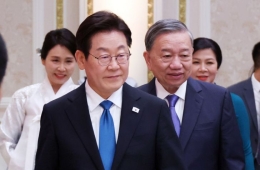
On the 3rd at 11 a.m., UNIST and Seoul National University Hospital signed a Memorandum of Understanding (MOU) in the large conference room on the 6th floor of the UNIST University Headquarters.
According to the agreement, the two institutions will work together to promote the development of smart radiation medical science centered on heavy ion therapy and secure competitiveness in medical industry technology based on smart healthcare.
Heavy ion therapy is a cutting-edge radiation treatment that utilizes the physical properties that appear when heavy particles such as carbon (C) or helium (He), accelerated by a heavy ion accelerator, are irradiated onto the human body.
It is known to have higher cancer cell killing power than conventional X-ray therapy or proton therapy while minimizing damage to normal tissues.
The heavy ion accelerator, an essential element of heavy ion therapy, is so rare that there are only 13 units in 5 countries worldwide.
In South Korea, heavy ion accelerators are scheduled to be installed in Seoul and Busan, and one of them will be housed in the Gijang Cancer Center of Seoul National University Hospital, which is scheduled to open in 2026.
UNIST and Seoul National University Hospital plan to conduct convergent research in the field of smart radiation medical science using heavy ion accelerators and also promote related human resource development.
UNIST already has an advanced research infrastructure in ICT technologies such as artificial intelligence (AI) and big data, radiation utilization technology, and the biohealth field, making cooperation between the two institutions expected to proceed smoothly.
Kim Yeonsu, Director of Seoul National University Hospital, said, “There is a global shortage of specialized personnel to advance research using heavy ion accelerators. Joint research and human resource development through cooperation between the two institutions will greatly help secure national competitiveness in the field of smart radiation medical science.”
Lee Yonghun, President of UNIST, expressed his expectation, saying, “When the Gijang Cancer Center of Seoul National University Hospital opens in 2026 and personnel exchange and joint research expand, a world-class research group leading the radiation medical science field in the southeastern region will be born.”
Hot Picks Today
 "Over 20 Times More Than Overseas": 104.5 Milli...
- "Only the Top 1% Winning Big in Stocks Smile... '300 Million Won Splurges' or '1...
- Applied Just for Skin Soothing...Study Finds It Suppresses Antibiotic Resistance
- "If an Accident Happens, Teachers Go to Jail"... The Real Reason Behind Fewer Sc...
- "Please Launch It in Korea!" After All the Hype... This Coffee Finally Arrives i...
Attendees at the signing ceremony included UNIST President Lee Yonghun, Department Head Jung Ungkyu of Biomedical Engineering, Department Head Bang Incheol of Nuclear Engineering, Professor Cho Hyeongjun of Biomedical Engineering, Professor Lee Jimin of Nuclear Engineering, Professor Myung Kyungjae of Biomedical Engineering, Professor Yoon Euisung of Nuclear Engineering, Seoul National University Hospital Director Kim Yeonsu, Heavy Ion Accelerator Project Group Leader Woo Honggyun, Heavy Ion Accelerator Project Group Professor Kim Kyungsu, Heavy Ion Accelerator Project Group Professor Jung Seongmun, and Heavy Ion Accelerator Project Administrative Team Member Noh Jaebung.
© The Asia Business Daily(www.asiae.co.kr). All rights reserved.