Democratic Party Unafraid of Tactical Defections, "Will Pass Complete Prosecution Reform in April National Assembly"
Park Hong-geun Requests Agenda Adjustment Committee Review on 21st and Plenary Session on 22nd
People Power Party, Asked for 2 Names, Submits 3 Members for Agenda Adjustment Committee
Concerns Emerge Within Democratic Party as Well

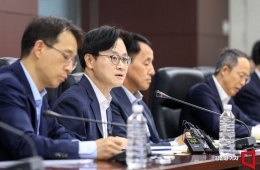
Park Hong-geun, floor leader of the Democratic Party of Korea, is attending the policy coordination meeting held at the National Assembly on the 21st and delivering opening remarks. Photo by Yoon Dong-joo doso7@
View original image[Asia Economy reporters Naju-seok, Oh Juhyun, Kwon Hyunji] The Democratic Party of Korea clearly stated on the 22nd that it will hold a plenary session to pass the "Complete Removal of Prosecutorial Investigation Rights" (검수완박, Geomsu Wanbak) law during the April extraordinary session. The People Power Party plans to block it through the Legislation and Judiciary Committee's agenda adjustment subcommittee, but it is insufficient to stop the Democratic Party's forceful passage, even at the cost of a 'disguised withdrawal' from the party. Depending on the decision of National Assembly Speaker Park Byeong-seok, the Geomsu Wanbak law may be submitted to the plenary session.
On the 21st, Park Hong-geun, floor leader of the Democratic Party, stated at the party policy coordination meeting, "We will pass the normalization of the prosecution through the separation of investigation and prosecution rights in the April National Assembly." He added, "I urge the Legislation and Judiciary Committee's agenda adjustment subcommittee to conduct a thorough review overnight today," and "I request the Speaker of the National Assembly to convene a plenary session on the 22nd." This is interpreted as a step to complete the agenda adjustment subcommittee's review within the day and to force the bill through the plenary session.
Park said, "The separation of investigation and prosecution rights has been a long-standing promise to the public since the Participatory Government." However, he added, "We will continue dialogue and compromise," and "If the fundamental principle of separating investigation and prosecution rights is firmly guaranteed and a Korean-style FBI-like investigative agency is established, we will listen broadly to opinions from civil society and other sectors and seek social consensus." This means the bill will be submitted, but some amendments remain possible.
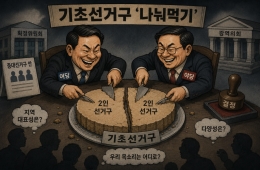
The People Power Party submitted lawmakers Yoo Sang-beom, Jeon Ju-hye, and Cho Su-jin to the agenda adjustment subcommittee, which is composed equally of three members from each party. Previously, Park Kwang-on, chairman of the Legislation and Judiciary Committee from the Democratic Party, requested the People Power Party to submit two names for the agenda adjustment subcommittee. Yoo explained, "The agenda adjustment subcommittee is a system designed to reflect the minority party's opinion that the majority party should not unilaterally process controversial bills, preserving the spirit of cooperative compromise," and "The Democratic Party's move to damage this spirit by forcing lawmaker Min Hyung-bae to withdraw from the party and become an independent undermines the purpose of the agenda adjustment subcommittee, so we submitted three names." Although the opposition's quota in the agenda adjustment subcommittee can be allocated to independents or non-negotiating groups, due to the Democratic Party's trickery, the People Power Party also plans to submit three members. Regarding the convening of the agenda adjustment subcommittee, Yoo said, "Since the Speaker is preparing a mediation plan, meetings should not be held today or tomorrow so that the mediation plan can be addressed in the agenda adjustment subcommittee."

Yoo Sang-beom, the People Power Party's secretary of the National Assembly's Legislation and Judiciary Committee, is holding up a document in front of the Legislation and Judiciary Committee chairman's office on the 21st, indicating the recommendation of three members?Yoo Sang-beom, Jeon Ju-hye, and Jo Su-jin?for the agenda adjustment committee./Photo by Yoon Dong-joo doso7@
View original imageHowever, if Chairman Park forms the agenda adjustment subcommittee according to the Democratic Party's plan by including lawmaker Min as part of the opposition quota, effectively making it four members from the Democratic Party and two from the People Power Party, the agenda adjustment subcommittee can pass the bill to the full Legislation and Judiciary Committee with a two-thirds majority. In this case, the Democratic Party plans to proceed with the approval process in the Legislation and Judiciary Committee and go straight to the plenary session. If Speaker Park agrees to convene the plenary session, the People Power Party plans to oppose the bill's passage through unlimited debate (filibuster) and other means.
Hot Picks Today
 "After Vowing to Become No. 1 Globally, Sudden Policy Brake Puts Companies’ Massive Investments at Risk"
- "Mom, Isn't It Comfortable Living With Me?"... 'Unexpected Result' Shows Increased Drinking Out of Frustration
- "Available Only in Korea": Pokémon Card Prices Surge 2,532% Due to Rarity, Becoming Investment Assets
- Tenant Steals 80 Million Won from Landlord's Bedroom... "Used for Debt Repayment, Burned 70 Million?"
- Even the Wealthy Ask, "Is It Okay to Enter Now?"... Flocking In With Cash Bundles [Wealth Investment Strategies] ⑨
However, concerns are growing within the Democratic Party. Lawmakers Park Yong-jin, Lee Sang-min, Lee So-young, and Cho Eung-cheon, who voice rational opinions within the party, expressed worries about the bill's passage through Min's disguised withdrawal. They argue that lacking procedural legitimacy also undermines the legitimacy of the purpose.
© The Asia Business Daily(www.asiae.co.kr). All rights reserved.