The Ministry of Justice Pledges Active Cooperation with Yoon's Promises... Will Conditional Parole Including 'Protective Custody' Be Realized?

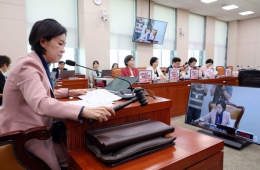
Joo Young-hwan, Director General of the Ministry of Justice Policy Office (fourth from the left), and other Ministry of Justice staff are waiting to report on their work at the transition team office in Samcheong-dong, Seoul, on the 29th. Photo by Transition Team Press Corps
View original image[Asia Economy Reporter Kim Hyung-min] The Ministry of Justice expressed its intention to actively cooperate with the campaign promises of President-elect Yoon Seok-yeol during the presidential transition committee's work report on the 29th, drawing attention to whether these promises will be realized.
According to the legal and political circles on the 30th, the Ministry of Justice stated in the previous day's work report that it would review campaign promises such as the introduction of conditional parole for protective custody, lowering the age criteria for juvenile offenders, and the establishment of a headquarters for Crime Prevention Through Environmental Design (CPTED).
'Conditional parole for protective custody' is a system where parolees under protective supervision engage in daytime employment and enter designated facilities at night or on weekends to complete correctional programs such as vocational training and counseling therapy.
The Ministry of Justice had also announced in September last year that it would consider introducing this system following the 'Kang Yoon-sung case.' President-elect Yoon proposed expanding the scope of this system to include offenders with a high risk of recidivism as part of his campaign promises.
The Ministry of Justice also expressed its position to actively participate in legislative discussions in the National Assembly regarding President-elect Yoon's promise to lower the age of 'juvenile offenders' from the current 14 years to 12 years.
Juvenile offenders are children and adolescents aged 10 or older but under 14 who commit crimes but are not subject to criminal punishment. Instead of criminal penalties, they receive protective measures under the Juvenile Act, so no criminal record is left.
The Ministry of Justice also proposed that related laws be amended so that probation officers can intervene immediately when juvenile cases are sent to family courts, and that family court investigators support the parties and related persons involved in the trial.
They also reported to the transition committee a plan to enact the 'Crime Prevention Environment Improvement Act' (tentative name) and establish a headquarters for Crime Prevention Through Environmental Design (CPTED). CPTED involves creating urban environments necessary for crime prevention, such as improving high-crime areas and installing closed-circuit television (CCTV) and lighting.
Hot Picks Today
 "Now Our Salaries Are 10 Million Won a Month" Record High... Semiconductor Boom Drives Performance Bonuses at Major Electronic Component Firms
- Living the Homebody Dream? "I Was Shocked by My Spending" How to Cut Costs to 5,000 Won for Essentials [The Principles of Benefits]
- Is It Really Like an Illness? "I Can't Wait to Go Again"—Over 1 Million Visited in Q1, Now 'Busanbyeong' Takes Hold [K-Holic]
- "Heading for 2 Million Won": The Company the Securities Industry Says Not to Doubt [Weekend Money]
- Experts Already Watching Closely..."Target Price Set at 970,000 Won" Only Upward Momentum Remains [Weekend Money]
On the other hand, the Ministry of Justice holds a cautious stance on campaign promises such as abolishing intoxication mitigation and tracking the location of stalking perpetrators before a final verdict, which were proposed by President-elect Yoon. It is also reported that the work report included plans to promote supplementary legislation allowing video-recorded statements of minor sexual assault victims to be used in court.
© The Asia Business Daily(www.asiae.co.kr). All rights reserved.