[Good Morning Stock Market] KOSPI Collapses on Putin's Remark... Will It Turn Blue Again Today?
US Stock Market Reflects Concerns Over Ukraine War
Nasdaq -1.23%, Dow -1.42%
KOSPI Expected to Fall Below 2500 if Full-Scale War Erupts
Rising Commodity Prices to Increase Corporate Burdens
![[Image source=Yonhap News]](http://www.asiae.co.kr/news/img_view.htm?img=2022022218105054381_1645521050.jpg)
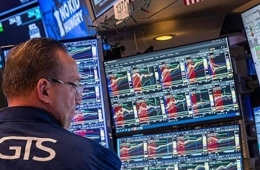
[Asia Economy Reporter Minji Lee] As the risk of armed conflict between Ukraine and Russia escalates, global stock markets are experiencing increased declines. On the 22nd, the U.S. stock market reflected Ukraine-related issues with a one-day delay, showing a decline of over 1%. The Dow Jones Industrial Average fell by 1.42%, while the Nasdaq and S&P 500 indices dropped by 1.23% and 1.01%, respectively. Typically, the domestic stock market is influenced by the U.S. market trends, but since the KOSPI had already significantly factored in Ukraine-related uncertainties a day earlier, it is expected to show limited movement.
Han Ji-young, Kiwoom Securities Researcher: “In line with expected Western sanctions... KOSPI movement will be limited.”
![[Good Morning Stock Market] KOSPI Collapses on Putin's Remark... Will It Turn Blue Again Today?](http://www.asiae.co.kr/news/img_view.htm?img=2022022308040854721_1645571048.png)
Russia has approved the independence of pro-Russian rebel areas within Ukraine's Donbas region and deployed troops, prompting Western countries such as the U.S. and Europe to impose sanctions on Russia. President Biden announced sanctions targeting Russian banks and politicians, stating that “Western countries will be prevented from using financial services,” and Germany declared it would halt approval of the Nord Stream 2 natural gas pipeline.
However, these sanctions are in line with prior expectations and are unlikely to cause significant market shocks. Additionally, President Biden’s remark that “there is still a diplomatic solution and time remains to avoid the worst” should be taken into account. Considering this, the likelihood of full-scale war involving Western countries in the Donbas region remains low for now.
Accordingly, the domestic stock market is expected to show limited price movement today. Although the uncertainty of armed conflict persists, the domestic market has already been continuously reflecting the issue of Russia’s control over the Donbas region. Since the conflict is occurring among commodity-exporting countries, concerns remain that rising prices of crude oil, grains, and other commodities could negatively impact corporate earnings. However, unless a situation worse than armed conflict unfolds, it is predicted that the inflationary environment will not deteriorate further than it currently is.
Jang Hyun-chul, Korea Investment & Securities Researcher: “Short-term uncertainty in domestic stocks is increasing; defensive measures are necessary.”
![[Good Morning Stock Market] KOSPI Collapses on Putin's Remark... Will It Turn Blue Again Today?](http://www.asiae.co.kr/news/img_view.htm?img=2022022308033554719_1645571015.png)
The conflict between Russia and Ukraine is lasting longer than expected. Although the U.S. is attempting negotiations with Russia, the situation is deteriorating. The prolonged issue recalls the 2018 U.S.-China trade dispute. In such circumstances, investors are expected to develop investment strategies for each scenario to protect returns.
In the worst-case scenario of full-scale war, the KOSPI might fail to hold the 2500 level. Domestic companies are burdened by rising costs and economic uncertainties. Additionally, South Korea has become Russia’s fifth-largest import partner, so if Western sanctions on Russia intensify, export companies could immediately see revenue declines. Based on last year’s cumulative export figures, the automobile, machinery, and chemical industries are expected to face uncertainty. During this period, investors are likely to increasingly seek refuge in sectors such as telecommunications and utilities to defend returns.
![[Good Morning Stock Market] KOSPI Collapses on Putin's Remark... Will It Turn Blue Again Today?](http://www.asiae.co.kr/news/img_view.htm?img=2022022308035054720_1645571030.png)
Even if localized fighting continues in eastern Ukraine, extreme volatility is not expected to occur. Since war-related issues have not had a significant direct impact on the stock market so far, the KOSPI is expected to show gradual recovery. However, as there are no major positive factors expected at the index level in the first half of the year, the market is likely to be sector- and stock-specific. Also, due to internal market anxiety, large-cap stocks are expected to show relatively stable performance compared to small- and mid-cap stocks. Specifically, investor sentiment is expected to expand toward sectors with low market sensitivity and favorable earnings outlooks such as semiconductors, transportation, distribution, and food and beverages.
In the best-case scenario, if a peace agreement is reached between Western countries and Russia, geopolitical risks would be resolved, and the KOSPI would likely rebound quickly. The easing of supply concerns for energy and agricultural commodities could also reduce inflationary pressures. Consequently, small- and mid-cap stocks, which have been under significant downward pressure, may recover even more than large-cap stocks. From an investment strategy perspective, rapid rebounds are expected in growth stocks with strong value propositions such as batteries, internet, and gaming. Although the likelihood is lowest, if diplomatic compromise is achieved, the index level is expected to rise to a higher tier.
Hot Picks Today
!["Stock Set to Double: This Company Smiles Every Time a Data Center Is Built [Click e-Stock]"](https://cwcontent.asiae.co.kr/asiaresize/93/2026050416112750184_1777878687.jpg) "Stock Set to Double: This Company Smiles Every...
"Stock Set to Double: This Company Smiles Every...
- "Is Yours Just Gathering Dust at Home? Millennials & Gen Z Rediscover Digicams O...
- [New York Stock Market] Deal Nears... S&P 500, Nasdaq Hit New Highs Again
- "Continuous Groundwater Pumping Causes Mexico City to Sink 24cm Annually... 'Gia...
- “She Shouted, ‘The Rope Isn’t Tied!’... Chinese Woman Falls from 168m Cliff ...
© The Asia Business Daily(www.asiae.co.kr). All rights reserved.