Minister Meeting Was Useless... Frequency Reallocation Returned to Square One
"Further Review Needed"
Ministry of Science and ICT's Hollow Conclusion
Telecom 3 Companies Face More Complex Calculations

At the CEO meeting of the three telecommunications companies held on the 17th at Post Tower in Jung-gu, Seoul, Minister Lim Hye-sook of the Ministry of Science and ICT and the CEOs of the three telecommunications companies are taking a commemorative photo. From the left, KT CEO Koo Hyun-mo, Minister Lim, SK Telecom CEO Yoo Young-sang, LG Uplus CEO Hwang Hyun-sik. Photo by Kang Jin-hyung aymsdream@
View original image[Asia Economy Reporter Cha Min-young] Minister Lim Hye-sook of the Ministry of Science and ICT (hereinafter referred to as the Ministry of Science and ICT) met twice with the CEOs of the three major telecommunications companies and held 17 meetings and public forums over seven months, but the issue of additional 5G frequency allocation has ultimately returned to square one. The telecommunications industry is also expressing frustration over the Ministry of Science and ICT's hollow conclusion of "further review is needed," which neither confirms nor denies the allocation.
Engine Stalled After 7 Months of Idling

Standard: Since LG Uplus requested additional 5G frequency allocation in July 2021
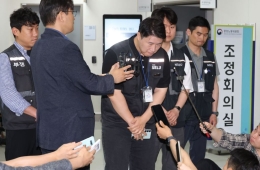
View original imageOn the morning of the 17th, Minister Lim held a meeting at Seoul Central Post Office with the CEOs of the three major telecommunications companies?Yu Sang-young, President of SK Telecom, Koo Hyun-mo, President of KT, and Hwang Hyun-sik, President of LG Uplus?to discuss the allocation of 5G frequencies.
After hearing the opinions of the three companies, Minister Lim stated, "The principle that improving the quality of 5G services and promoting investment should be the top priority in frequency allocation remains unchanged," but added, "A comprehensive review must be conducted regarding the issues continuously raised by the telecom companies last year and this year." Instead of reaching a conclusion on the additional 5G frequency allocation, the matter was reverted to square one.
The Ministry of Science and ICT had initially insisted on proceeding with the frequency auction schedule by February at the latest. Choi Woo-hyuk, Director of the Radio Policy Bureau at the Ministry, said, "A comprehensive review stage is necessary, so a February announcement is unlikely," and added, "Based on the results of today's CEO meeting, we plan to proceed next month." However, whether this will be upheld remains uncertain. Although the 'comprehensive review' period is not expected to be long, it is likely to take place after the presidential election.
17 Discussions Over 7 Months, Yet Back to Square One
The frequency conflict among the three telecom companies, which began last July with LG Uplus's demand for additional 5G frequency allocation, was anticipated from the start. SK Telecom and KT opposed LG Uplus's request for additional frequencies exclusive to them, arguing that it did not meet auction requirements. Despite the opposition from the two companies, the Ministry of Science and ICT consistently maintained a lukewarm stance, insisting on pushing forward with the February auction rather than mediating the opinions of the three telecom companies.
The situation changed when SK Telecom requested an early allocation of additional frequencies originally scheduled for auction next year. Citing fairness, SK Telecom argued that the three 5G frequency bands planned for allocation next year should be auctioned. In this process, SK Telecom also claimed adjacent frequency bands, complicating the situation for KT. Currently, the 5G frequencies are allocated in the order of LG Uplus, KT, and SK Telecom, with LG Uplus using an 80 MHz bandwidth and KT and SK Telecom each using 100 MHz. LG Uplus requested adjacent lower bands to their current frequencies, SK Telecom requested adjacent upper bands, but KT has no adjacent bands available to request.
Calculations Complicated for the Three Telecom Companies

The Ministry of Science and ICT's stance on a 'comprehensive review' has made the calculations of the three telecom companies even more complicated. If the Ministry considers fairness and auctions the frequencies SK Telecom requested for additional allocation, SK Telecom would become the only company among the three to use a connected 200 MHz bandwidth of 5G frequencies. This is most advantageous in terms of facility investment and significantly reduces development costs. Consequently, there are criticisms that the controversy over LG Uplus's additional 5G frequency allocation has shifted to SK Telecom's additional allocation issue.
After the meeting, Hwang Hyun-sik, CEO of LG Uplus, told reporters, "No definite conclusion was reached today," and added, "Decisions should be made promptly from the perspective of public convenience and customers, but delays continue due to other arguments, which is regrettable." He emphasized, "The additional 20 MHz bandwidth we requested was announced in 2018 and was available in 2019. The other frequency bands raised belatedly by SK Telecom were planned for discussion in 2023. It is not desirable to discuss frequencies that went through a research task force and public hearings first together with those raised later." Koo Hyun-mo, CEO of KT, also said, "KT will carefully review the demand for the bands requested by SK Telecom and provide opinions to the government."
Hot Picks Today
 "Stocks Are Not Taxed, but Annual Crypto Gains Over 2.5 Million Won to Be Taxed Next Year... Investors Push Back"
- [Breaking] Samsung Labor-Management 'Performance Bonus Negotiations' Fail in Third Mediation... Union Says "General Strike to Proceed as Planned Tomorrow"
- "Not Jealous of Winning the Lottery"... Entire Village Stunned as 200 Million Won Jackpot of Wild Ginseng Cluster Discovered at Jirisan
- Bull Market End Signal? Securities Firm Warns: "Sell SK hynix 'At This Moment'"
- "Even With a 90 Million Won Salary and Bonuses, It Doesn’t Feel Like Much"... A Latecomer Rookie Who Beat 70 to 1 Odds [Scientists Are Disappearing] ③
Meanwhile, the three CEOs conveyed to the government their intention to continue investing in 5G, including the construction of 5G 28 GHz networks in subways. CEO Koo said, "Despite various difficulties, we agreed to faithfully implement the plan so that the public can use faster Wi-Fi in subways through the 28 GHz band." Yu Sang-young, CEO of SK Telecom, stated, "We will maximize investment to expand coverage quality that the public desires."
© The Asia Business Daily(www.asiae.co.kr). All rights reserved.