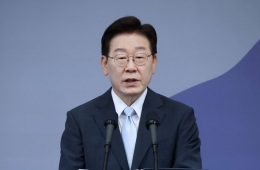
Ahn Cheol-soo, Lee Jae-myung, and Yoon Seok-youl: Any Chance of a Dramatic Unification?... Reviewing Past Cases
Unification Debate from the 13th to the 20th Presidential Election
13th Election, Yang-Geum Unification Fails... Leading to Yang-Geum's Determined Efforts
Over 30 Years of Unification Debate... Citizens Experience Fatigue
Overcoming Two-Party Political Structure... Runoff Voting System and Proportional Representation May Be Solutions

On the 15th, when the official campaign for the 20th presidential election began, banners of Lee Jae-myung (in numerical order), the Democratic Party presidential candidate, and Yoon Seok-youl, the People Power Party presidential candidate, were hung near Dongnimmun in Jongno-gu, Seoul.
View original image[Asia Economy Intern Reporter Kang Wooseok] Whether it is Lee Jae-myung and Ahn Cheol-soo or Yoon Seok-youl and Ahn Cheol-soo, with the presidential election just 13 days away as of the 24th, fierce debates over the unification of opposition and ruling parties surrounding Ahn Cheol-soo, the presidential candidate of the People’s Party, continue. Lee Jun-seok, leader of the People Power Party, is engaged in sharp exchanges, even facing criticism that he is mocking candidate Ahn. Earlier, on the 20th, Ahn held an emergency press conference declaring the breakdown of unification talks with Yoon Seok-youl, the People Power Party candidate, saying, “I will put an end to any more meaningless processes and time.” However, some interpret that politics is a living organism, suggesting there might still be room for unification.
In politics, unification is an unavoidable kind of fate. Through unification, one can overwhelm the opposing camp, but failure to unify can lead to defeat in the election. Moreover, unprincipled unification, so-called “blind unification” just to win the election, can even threaten one’s political life. As a result, from the 13th presidential election, the first after democratization, to the current 20th presidential election, the issue of unification has always heated up the presidential election landscape.

On January 22, 1987, Yang Kim (Kim) is shaking hands before a meeting to unify the presidential candidate. Photo by Yonhap News
View original imageIn 1987, ahead of the 13th presidential election, the two Kims (Kim Young-sam of the Unification Democratic Party and Kim Dae-jung of the Peace Democratic Party, hereafter honorifics omitted) were in conflict. As the first direct presidential election after democratization, both had strong ambitions for power. At that time, the ruling party candidate, Roh Tae-woo of the Democratic Justice Party, had secured solid support through the 'June 29 Declaration' including the constitutional amendment for direct presidential elections and the slogan “ordinary people.”
To defeat candidate Roh, unification of the opposition by the two Kims was desperately needed, but they ultimately failed to narrow their differences and each ran separately. The result was Roh’s election. The vote shares were Roh Tae-woo (36%), Kim Young-sam (28%), and Kim Dae-jung (27%), so despite the opposition gaining more than half the votes, they failed to achieve a regime change.

The 14th and 15th presidential elections were marked by the two Kims’ bitter determination. Ahead of the 14th election, candidate Kim Young-sam formed the Democratic Liberal Party through the so-called 'three-party merger' with President Roh Tae-woo’s Democratic Justice Party and Kim Jong-pil’s New Democratic Republican Party. This was a result of aligned interests: President Roh aimed to overcome the minority ruling situation, Kim Jong-pil sought greater influence in central politics, and Kim Young-sam aimed for an overwhelming victory in the election. Kim Young-sam, now the ruling party candidate, won the presidency with 41%, defeating Kim Dae-jung, who again failed to unify the opposition and received 33%.
In the 15th presidential election, Kim Dae-jung formed the DJP coalition (Kim Dae-jung + Kim Jong-pil). This unification was achieved when Kim Dae-jung promised Kim Jong-pil a parliamentary system amendment and the appointment of the prime minister, effectively a joint government. Kim Dae-jung (40%) narrowly defeated Lee Hoi-chang of the Grand National Party (38%), who failed to unify with Lee In-je of the People’s New Party, by a 2% margin and entered the Blue House.

Roh Moo-hyun, the Saechunmyun Democratic Party candidate, and Chung Mong-joon, the Gukmintonghap 21 candidate, are embracing each other. Photo by Yonhap News
View original imageIn the 16th presidential election, the first-ever 'poll-based unification' took place in Korean political history. Roh Moo-hyun of the Millennium Democratic Party and Chung Mong-joon of the National Unity 21 Party decided on Roh as the final unified candidate through a public opinion poll. Roh then defeated Lee Hoi-chang, who ran again.
At that time, Roh and Chung fiercely debated unification until the early hours of November 16, 33 days before the December 19 election. They then dramatically agreed on a poll-based method. However, Chung’s side raised issues about the media leak of the poll method two days later, sending negotiations back to square one. Eventually, unification was dramatically finalized, and Roh was confirmed as the unified candidate in the early hours of November 25.
Yet, Chung withdrew his support for Roh just one day before the election, prolonging tense negotiations until the last moment. This is why unification is called a politician’s fate and a fierce strategic battle between camps during elections. Paradoxically, the unification situation Roh faced helped consolidate his support base, effectively becoming a driving force for his victory.
In the 17th and 19th presidential elections, unification talks occurred but did not reach agreement. In the 17th election, candidates Chung Dong-young of the Grand Unified Democratic New Party and Lee In-je of the Democratic Party sought unification against Lee Myung-bak of the Grand National Party but failed. On the conservative side, debates over unification between Lee Myung-bak and independent candidate Lee Hoi-chang flared but ultimately no unification occurred.
As a result, Lee Myung-bak won the presidency with nearly 48% of the vote, beating second-place Chung Dong-young (26%) by more than 20%.
In the 19th election, unification among Hong Joon-pyo of the Liberty Korea Party, Ahn Cheol-soo of the People’s Party, and Yoo Seung-min of the Bareun Party against Moon Jae-in was a hot topic. However, due to the special circumstances of the impeachment crisis, unification was not easily achieved. Ultimately, Moon Jae-in of the Democratic Party, who held the highest level of support at the time, won the presidency with 41% of the vote.

Candidate Ahn Cheol-soo and candidate Moon Jae-in met at the funeral hall. Photo by Yonhap News
View original imageThe 18th presidential election was the first case where successful unification did not lead to victory. At that time, independent candidate Ahn Cheol-soo hinted at running in September 2012 and continued behind-the-scenes talks for opposition unification with Moon Jae-in of the Democratic United Party but failed to reach a proper agreement.
Eventually, about a month before the election, Ahn withdrew and supported Moon, achieving unification. However, Park Geun-hye of the Saenuri Party won with over 51% of the vote, defeating Moon (48%).
![Ahn Cheol-soo, the presidential candidate of the People’s Party, officially proposed unifying opposition candidates to Yoon Seok-youl, the presidential candidate of the People Power Party, during a special press conference live-streamed on YouTube on the 13th. <br>[Image source=Yonhap News]](http://www.asiae.co.kr/news/img_view.htm?img=2022021312064141963_1644721600.jpg)
Ahn Cheol-soo, the presidential candidate of the People’s Party, officially proposed unifying opposition candidates to Yoon Seok-youl, the presidential candidate of the People Power Party, during a special press conference live-streamed on YouTube on the 13th.
[Image source=Yonhap News]
In the current 20th presidential election, unification debates continue. On the 13th, Ahn Cheol-soo of the People’s Party held a special press conference proposing opposition unification to Yoon Seok-youl of the People Power Party.
The method proposed was a public opinion poll-based national primary. Yoon responded, “I evaluate it positively,” but also said, “There are some regrets.” Kwon Young-se, head of the People Power Party’s election campaign headquarters, expressed concerns about the poll-based primary, saying, “What is needed now is a bold unification.” He advocated for a negotiation-based unification rather than a poll-based one, setting up a confrontation. Ultimately, on the 20th, Ahn declared the breakdown of opposition unification, effectively ending the unification effort.
Although not as intense as the opposition, the ruling party also continues unification debates. Lee Jae-myung of the Democratic Party has floated the idea of a 'unified government,' leaving open the possibility of unification with Kim Dong-yeon of the New Wave Party, Sim Sang-jung of the Justice Party, and even Ahn Cheol-soo. However, all three candidates have expressed their intention to complete the election, and especially Ahn and Sim have continued to criticize Lee, making actual unification uncertain.
Some citizens express fatigue over the unification debates that have lasted over 30 years. Jeong, a 55-year-old taxi driver in Seoul, sighed, “It’s all just the same. They are fighting for power and don’t care about people’s livelihoods. Our people are struggling and losing interest in politics.”
Voices also raise issues about the 'two-party political' structure that inevitably leads to unification debates during presidential elections. Jiin Jun, a 25-year-old university student, lamented, “It’s unfortunate that the candidate I personally want to vote for is not a major party’s front-runner. I feel a lot of skepticism and fatigue toward two-party politics.”
Experts point out problems with the current political system itself. Professor Ahn Byung-jin of Kyung Hee University’s Future Civilization Institute explained, “Because Korea does not have a runoff voting system, minority parties inevitably have to form coalitions, and the first and second candidates face a dilemma of needing to form coalitions to surpass the majority. Unless the two-party centered system is reformed, unification debates will continue.”
Professor Ahn suggested introducing a runoff voting system and strengthening proportional representation to overcome the two-party centered structure. He said, “First, runoff voting can provide minority parties with incentives to politically unite even if the two parties dominate elections. Also, strengthening proportional representation can encourage competition among various parties.”
Hot Picks Today
 "Stocks Are Not Taxed, but Annual Crypto Gains Over 2.5 Million Won to Be Taxed Next Year... Investors Push Back"
- "Groups of 5 or More Now Restricted"... Unrelenting Running Craze Leaves Citizens and Police Exhausted
- Despite Warnings of "Do Not Enter, You May Not Make It Out Alive"... Foreign Tourist Stranded After Unauthorized Climb on Jeju Sanbangsan
- AI Bubble or Real Growth? All Eyes on NVIDIA's Q1 Earnings
- "Even With a 90 Million Won Salary and Bonuses, It Doesn’t Feel Like Much"... A Latecomer Rookie Who Beat 70 to 1 Odds [Scientists Are Disappearing] ③
Meanwhile, candidate Ahn, who declared the breakdown of unification, repeatedly dismissed the possibility of unification with candidate Yoon. After a People’s Party Central Election Committee meeting at the National Assembly on the 24th, Ahn told reporters, when asked if unification was possible if the People Power Party underwent a poll-based primary, “The time has passed. That’s why I declared the breakdown.” When asked if it meant there would be no further meetings with candidate Yoon, he briefly replied, “I have not received any contact.”
© The Asia Business Daily(www.asiae.co.kr). All rights reserved.