Why Did the Minister of Science and Technology and Research Institute Heads All Gather at Samsung Electronics at Year-End?
"Determination to Mobilize National Capabilities to Maintain Semiconductor Technology Superiority" Demonstrated Domestically and Internationally

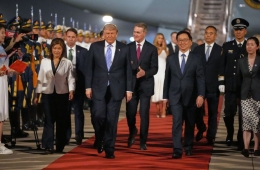
[Asia Economy Reporter Kim Bong-su] Minister Lim Hye-sook of the Ministry of Science and ICT visited Samsung Electronics' Hwaseong Campus, the forefront of the year-end global semiconductor technology war, accompanied by a large number of heads of national research institutes, promising a "full mobilization of national capabilities" to maintain semiconductor technology superiority.
Minister Lim visited Samsung Electronics' Hwaseong Campus on the morning of the 28th, one day before the Lunar New Year holiday began. Along with the Ministry of Science and ICT's responsible officials, the heads of national research institutes in charge of basic and applied semiconductor technology research and development, including Kim Myung-joon, President of the Electronics and Telecommunications Research Institute (ETRI), Noh Do-young, President of the Institute for Basic Science (IBS), and Yang Eun-kyung, Vice President of the Korea Institute of Science and Technology (KIST), were fully mobilized. This was an unprecedented event qualitatively different from other site visits where Minister Lim usually accompanied only one or two officials.
The visit was interpreted as a gesture to clearly demonstrate the Korean government's will to support the domestic semiconductor industry in the global semiconductor technology hegemony war. It signified the intention to fully mobilize national capabilities to maintain the technological superiority of the Korean semiconductor industry, including Samsung Electronics, amid the increasingly fierce global semiconductor technology competition.
At the event, Minister Lim stated, "Semiconductors are our country's number one industry, contributing remarkably to national economic growth, and recently they hold very important value in terms of international security and politics. In the era of the 4th Industrial Revolution, we will not leave all the burden to the companies that have performed well in the global technology hegemony competition surrounding semiconductors, whose importance will further increase in the future."
She continued, "At the national level, we plan to proactively invest in R&D for future promising semiconductor technologies and cultivate talented personnel with excellent capabilities to actively enhance the country's technological capabilities in the semiconductor field. In mobilizing national capabilities to maintain semiconductor technology superiority, we must make every effort to ensure organic and close cooperation among industry, academia, research institutes, and government in the semiconductor sector."
The Ministry of Science and ICT also explained, "This visit was to listen to the future technology directions from domestic companies performing well in the global market in memory semiconductors, foundry, and some system semiconductors, and to refer to the mid- to long-term government semiconductor R&D promotion needed at the corporate sites. It was a visit to explore ways to achieve even closer cooperation among industry, academia, research institutes, and government in the domestic semiconductor R&D ecosystem."
Currently, the global environment surrounding semiconductors presents both opportunities and crises for Korean semiconductor companies, showing complex and radical characteristics. Japan imposed export restrictions on materials, parts, and equipment (SoBuJang) in 2019, and in 2021, a shortage of automotive semiconductors shocked the world. As semiconductor supply chain instability continues, major countries such as the United States are intensifying technology hegemony competition by attracting factories with exceptional support incentives for semiconductor companies. The U.S. has chosen semiconductors as a major battleground for technology hegemony against China, conducting an all-out effort in economics, security, and politics to secure semiconductor technological competitiveness through technology bloc formation, export restrictions, and semiconductor supply chain establishment.
Despite this situation, the domestic semiconductor industry is performing well by maintaining the global number one position in memory semiconductors and making advances in the foundry sector and expanding investments in system semiconductors. In fact, in the memory semiconductor market ($128.1 billion), Korea held a 56.9% market share as of 2020, ranking first.
Hot Picks Today
 "Why Is the Korean Stock Market Surging?"... Even Italy Is Astonished by the KOSPI Rally
- "Invested 95% in Hynix and Reached 10 Billion Won"... Japanese Investor's Proof Post Goes Viral
- "South Korea Shows Similar Trend to Developed Nations"...Obesity Analysis of 232 Million People Worldwide [Reading Science]
- "That Thing Wakes Up Every Night" ... Suspicious Object Covers Rural Village
- "My Wife Is Missing"... Woman in Her 50s Still Unaccounted for Nearly a Month After Climbing Bukhansan Mountain
Meanwhile, Samsung Electronics promised Minister Lim support and cooperation for the government's PIM (Processing In Memory) development project. The government plans to develop PIM, which performs computation and storage functions simultaneously, to transform the paradigm of the future semiconductor industry.
© The Asia Business Daily(www.asiae.co.kr). All rights reserved.