Mergers and Divisions Also Subject to the '3% Rule'...Business Community and Experts Warn of High Risk of Unconstitutionality
Business circles: "An unprecedented bill worldwide"
Concerns raised over property rights infringement and unconstitutionality
Also points to excessive influence of the National Pension Service

[Asia Economy Reporters Kiho Sung and Chaeseok Moon] "When the ‘3% rule’ limiting major shareholders' voting rights was introduced, no one could explain why the 3% threshold was set. Introducing an unfounded ‘3%’ standard even to physical and material divisions is tantamount to telling companies not to operate."
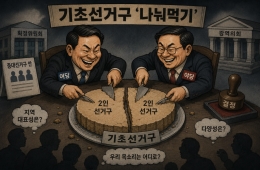
The ruling party has proposed an amendment to the Commercial Act that fundamentally blocks physical and material divisions ahead of the presidential election. The business community is strongly opposing it, calling it a ‘strangling bill’ that excessively infringes on management rights. Experts have also expressed concerns that if systems limiting major shareholders' authority continue to be introduced, constitutional controversies will arise, and the influence of the National Pension Service will become excessive, potentially leading to ‘pension socialism.’
Controversial ‘3%’ Rule... Virtually Blocking Physical and Material Divisions
According to political circles on the 28th, recently, Park Jumin, a member of the Democratic Party of Korea, proposed a ‘Partial Amendment to the Commercial Act’ containing such provisions. The bill's core is that when a listed company makes important decisions such as mergers, divisions, or business transfers involving affiliates defined under the Monopoly Regulation and Fair Trade Act (Fair Trade Act) through a shareholders' meeting, the voting rights of major shareholders, including related parties, are limited to 3%. If the bill passes, physical and material divisions would be virtually blocked if minority shareholders oppose them. For example, in the recent division and listing of LG Energy Solution, minority shareholders opposed it citing damage to the parent company's share value, but LG, the major shareholder of LG Chem, proceeded by meeting the voting requirements using its 34.17% stake. However, if the amendment is applied, LG's voting rights would be limited to 3%, making division and listing practically impossible.
The business community reacted strongly, saying the bill would strip away all remaining voting rights of major shareholders. An executive from a large corporation criticized, "The ‘3% rule’ itself is unprecedented worldwide. Corporate divisions and mergers are core management matters, and excluding major shareholders is effectively telling them to give up management."
Previously, in 2020, the National Assembly passed an amendment to the Commercial Act limiting the voting rights of major shareholders and related parties to a maximum of 3% when appointing auditors and audit committee members. At that time, the business community opposed the ‘3% rule,’ arguing it would hinder governance structures and could be exploited by foreign speculative forces to attack management rights, but the political circles pushed it through.
An official from an economic organization pointed out, "When divisions and mergers occur, restructuring is also carried out, which could harm shareholder value through this process. Since it infringes on property rights, there is a high possibility of unconstitutionality."
Experts Warn of ‘Pension Socialism’
Market participants and experts also expressed negative views on the ruling party's bill. In particular, they pointed out that the ‘3%’ standard introduced with the 2020 amendment to the Commercial Act is being excessively expanded and applied. A securities firm official criticized, "When the 2020 amendment was passed, no one could provide clear grounds for the ‘3%’ standard. Once a wrong standard was set, the unfounded ‘3%’ application that reduces major shareholders' authority has been excessively used."
Experts expressed concerns that along with constitutional controversies, weakening major shareholders' control could cause private companies to be swayed by the National Pension Service's influence.
Professor Samhyun Jeon of Soongsil University’s Department of Law said, "Passing the law is practically equivalent to eliminating major shareholders, so except for entities like the National Pension Service, there is no proper subject to exercise voting rights. This could lead private companies to become ‘pension socialism’ public enterprises."
He added, "After the amendment, not only physical division activities but also the establishment of joint-stock companies and capital market activities could shrink. If the ‘3% rule’ is applied, major shareholders will find it difficult to file lawsuits to cancel shareholders' meeting resolutions as stipulated by the Commercial Act, significantly weakening their voting rights."
Professor Myunghun Cho of Korea University’s Department of Business Administration argued, "The ‘3% rule’ itself contradicts the basic spirit of the Commercial Act, which is ‘one share, one vote.’ The ruling party opposes introducing dual-class voting rights by citing ‘one share, one vote,’ yet advocates expanding the ‘3% rule’ that violates ‘one share, one vote,’ which is logically inconsistent."
Hot Picks Today
 No Bacteria Detected in Arisu After 24 Hours of Repeated Drinking from a Tumbler
- "I Feel Uncomfortable Being Filmed"... Cheerleaders Distressed by Commercial Fan Cam Practices
- "Available Only in Korea": Pokémon Card Prices Surge 2,532% Due to Rarity, Becoming Investment Assets
- High-Net-Worth Investors Increase Stock Holdings: "Samsung and SK hynix Are Basic, Now Searching for the Next Opportunity" [Investment Strategies of the Wealthy] ⑧
- Police Officer Cycling on Day Off Rescues Woman Attempting to Jump from Hangju Bridge
Professor Cho pointed out, "If the goal is to protect minority shareholders, it is much more important to devise other methods than expanding the ‘3% rule.’ There are much more market-friendly systems like the Minority Opinion Mechanism (MOM), which requires minority shareholders' consent for management decisions to prevent major shareholders and controlling families from misconduct. The ‘3% rule’ limiting management rights is a system unique to South Korea."
© The Asia Business Daily(www.asiae.co.kr). All rights reserved.