Despite Export Growth... Trade Deficit Widens Due to Soaring Energy Prices Including Crude Oil and Gas
KCS Reports Export-Import Status from January 1 to 20
Exports Up 22.0% · Imports Up 38.4%
Trade Deficit of $5.631 Billion
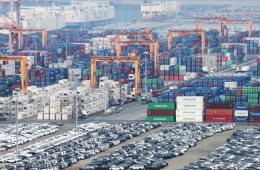
![(Photo) [Image source=Yonhap News]](http://www.asiae.co.kr/news/img_view.htm?img=2021122911055079884_1640743550.jpg)
[Sejong=Asia Economy Reporter Joo Sang-don] Although export value from January 1 to 20 this month increased by more than 20% compared to a year ago, the import value rose more sharply, expanding the trade deficit. This is interpreted as a result of increased energy imports due to rising demand amid soaring energy prices such as crude oil and gas, economic recovery, and the winter season.
According to the Korea Customs Service on the 21st, the trade deficit from January 1 to 20 was $5.631 billion, an increase of $4.897 billion compared to the same period last year (-$734 million). Compared to the previous January 1 to 10 period (-$4.945 billion), the deficit grew by $686 million.
The expansion of the deficit was due to the import value increasing at a faster pace than exports this month. Export value from January 1 to 20 was $34.4 billion, up 22.0% ($6.22 billion) from the same period last year. By item, exports increased compared to the previous year in semiconductors (29.5%), passenger cars (22.8%), petroleum products (84.0%), and home appliances (105.4%). Conversely, exports of wireless communication devices (-40.4%) and ships (-61.1%) decreased.
During the same period, the import value increase was even greater. Imports reached $40.1 billion, up 38.4% ($11.11 billion) from the same period last year. Among major items, crude oil (96.0%), semiconductors (27.1%), gas (228.7%), and petroleum products (85.7%) increased compared to the previous year, while imports of machinery (-0.6%) decreased.
An official from the Ministry of Trade, Industry and Energy explained, "The main cause of the increase in import value is the rise in energy imports such as crude oil and gas," adding, "This is due to the overlap of soaring energy prices during the winter season when energy demand is relatively high." According to the Ministry’s raw material price information, Dubai crude oil was priced at $86.35 per barrel as of the 20th, up 22.38% ($15.79) from a month ago. Liquefied natural gas (LNG) was priced at $892.03 per ton as of December last year, up 10.75% ($86.59) from the previous month. Notably, the price of coal for power generation was $217.71 per ton (as of the 14th), soaring 169.51% ($136.93) from the previous month.
Hot Picks Today
 No Bacteria Detected in Arisu After 24 Hours of Repeated Drinking from a Tumbler
- "Available Only in Korea": Pokémon Card Prices Surge 2,532% Due to Rarity, Becoming Investment Assets
- Despite Posting Surprise Earnings of 23 Trillion Won, Cisco Tells 4,000 Employees to Leave... What Happened?
- "Claimed He Was Trying to Catch Flies": Man in His 60s Adds Pesticide to Village Residents' Food
- "Egg Prices Are Strange" Proven True... Collusive Margin Hike of 46% Without Basis Leads to 594 Million Won Fine
The official added, "Increased energy demand due to economic recovery exerts upward pressure on prices, compounded by conflicts between Russia and the European Union (EU) over the Ukraine situation, instability in the Middle East, and Indonesia’s coal export ban, causing abnormal surges in energy prices." He continued, "As a result, energy import value has sharply increased, expanding the trade deficit. We are monitoring the situation closely, but currently, it is not considered a situation to worry about a structural or annual deficit."
© The Asia Business Daily(www.asiae.co.kr). All rights reserved.