Last Year's Export and Import Prices Soar to Highest Increase in 13 Years... Interest Rate Hike Imminent (Comprehensive)
Export and Import Price Indices Rise 14.3% and 17.6% Respectively
Monitoring Oil Price Rebound
![[Image source=Yonhap News]](http://www.asiae.co.kr/news/img_view.htm?img=2021122911055079884_1640743550.jpg)
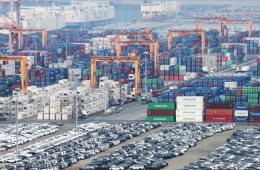
[Asia Economy Reporter Jang Sehee] Last year, the export and import price indices showed the highest rate of increase in 13 years since the financial crisis in 2008. The sharp rise in crude oil and raw material prices played a significant role. However, in December last year, export and import prices slightly declined compared to the previous month, marking the second consecutive month of decrease.
According to the '2021 Export and Import Price Index' statistics released by the Bank of Korea on the 13th, last year's export price index was 108.29, up 14.3% from a year earlier, and the import price index was 117.46, up 17.6%. This is the largest increase since 2008, when they rose 21.8% and 36.2%, respectively.
Choi Jinman, head of the Price Statistics Team at the Economic Statistics Bureau of the Bank of Korea, explained, "The base effect from the negative growth in export and import prices in 2020, along with the sharp rise in international oil prices and raw material prices, led to a large increase, especially in import prices." In 2020, import prices recorded -8.7% and export prices -5.2%.
However, the export and import price indices declined in December. The export price index was 114.64 (2015=100), down 1.0% from the previous month. By item, coal, petroleum, and chemical products fell, causing manufactured goods to decrease by 1.0% compared to the previous month.
Last month's import price index (127.11) also fell 1.9% from the previous month, marking a decline for the second consecutive month. This was influenced by the weakening of international oil prices and decreases in mining products, coal, and petroleum products. Dubai crude oil averaged $73.21 per barrel in December, down 8.8% from November ($80.30).
The monthly export and import price indices are expected to rebound as international oil prices have recently shown signs of rising again. This suggests that inflationary pressure may increase in the future. Team leader Choi said, "Looking at recent international oil prices, there is a slight upward trend," adding, "We need to monitor how international oil prices will move going forward."
Hot Picks Today
 No Bacteria Detected in Arisu After 24 Hours of Repeated Drinking from a Tumbler
- "Available Only in Korea": Pokémon Card Prices Surge 2,532% Due to Rarity, Becoming Investment Assets
- "Egg Prices Are Strange" Proven True... Collusive Margin Hike of 46% Without Basis Leads to 594 Million Won Fine
- Pungsan Denies Reports of Jack Nicklaus GC Acquisition Plans
- American Woman Who Poisoned Husband for $2 Million Insurance and Published Memorial Children's Book Sentenced to Life in Prison
Since the rise in import prices can also affect domestic consumer prices, the current trend of interest rate hikes is expected to continue. Professor Sung Taeyoon of Yonsei University's Department of Economics stated, "With ongoing inflationary pressure and the depreciation of the Korean won, an increase in the base interest rate seems inevitable."
© The Asia Business Daily(www.asiae.co.kr). All rights reserved.