Ministry of Environment Explores 'Nature-Based Solutions Expansion and Biodiversity Conservation Measures' with Domestic and International Experts
International Academic Conference Held in Collaboration with the International Union for Conservation of Nature (IUCN)

[Asia Economy Reporter Joo Sang-don] The Ministry of Environment and the National Institute of Ecology jointly held an international academic conference (seminar) on "Expanding Nature-Based Solutions and Biodiversity Conservation" on the 11th at the ENA Suite Hotel located in Jung-gu, Seoul, in collaboration with the International Union for Conservation of Nature (IUCN).
This event was organized for domestic and international experts to jointly explore the expansion of nature-based solutions to respond to the climate crisis and biodiversity conservation. It also aimed to gather opinions from experts at home and abroad to discuss the main policy directions of the "Nature and Ecology-Based Promotion Strategy for Climate Change Mitigation and Adaptation (draft)" to be established by the Ministry of Environment in the first half of this year, and the "5th National Biodiversity Strategy" scheduled for establishment in the second half of this year.
At this event, the expansion of nature-based solutions, which protect ecosystems and sustainably utilize, manage, and restore them to effectively and flexibly address social issues such as climate change, and biodiversity conservation, which will be a key agenda item at the 15th Meeting of the Conference of the Parties to the United Nations Convention on Biological Diversity to be held in Kunming, China, in April this year, were discussed as core topics.
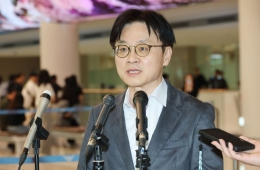
The seminar began with an opening address by Hong Jeong-gi, Vice Minister of the Ministry of Environment, and a congratulatory speech by Lee Seong-a, Deputy Director of IUCN, followed by keynote presentations and discussions by Kang Seong-gu, Director of the Natural Ecology Policy Division at the Ministry of Environment; Sengupta Sandip, IUCN Global Coordinator; Professor Park Hoon of Korea University; and Jeong Gil-sang, Director of the Climate Ecology Research Office at the National Institute of Ecology.
At the event, Sengupta Sandip, IUCN Global Coordinator, explained the necessity of nature-based solutions for climate change response and international trends, emphasizing the need to consider feasibility, governance, and the trade-offs between climate change response and biodiversity conservation.
Professor Park Hoon of Korea University described biodiversity conservation and ecosystem restoration as the final missing pieces to achieve carbon neutrality by 2050, explaining that nature-based solutions are sustainable and appropriate methods to achieve carbon neutrality.
Hot Picks Today
 No Bacteria Detected in Arisu After 24 Hours of Repeated Drinking from a Tumbler
- "We Can't Just Let Them Be Damaged Inside"... Samsung Electronics Removes 360,000 Wafers in Preparation for Strike
- "Up to 100 Trillion Won in Losses Feared, It's Not About Second Place but Catastrophe"... Industry Minister: 'Emergency Mediation Unavoidable If Samsung Strike Occurs'
- Wife in $6.7 Million Debt Took Out $3 Million in Husband's Life Insurance, Poisoned Him... US Court: "She Can Never Be Released"
- "He's Handsome, It's Such a Pity?"... Lawyer Responds to Bizarre 'Appearance Evaluation' of High School Girl Murder Suspect
Jeong Gil-sang, Director of the National Institute of Ecology, presented the impacts and risk factors of climate change on ecosystems such as soil, species, and sea levels, stating the need for continuous assessment of ecosystem risk levels to respond to the climate crisis, including the establishment of national-level ecological observatories and integrated management systems for climate change information.
© The Asia Business Daily(www.asiae.co.kr). All rights reserved.