Year-to-Date Returns by Buyer Type Show... Institutions 'Hit the Mark' on Sensitive Stocks
Top 10 Net Buyers' Returns Amid US Early Tightening Concerns Adjustment
Institutions Buy Cyclical Stocks for Gains While Individuals Suffer -11.6% from Growth Stocks

[Asia Economy Reporter Song Hwajeong] Amid ongoing market volatility since the beginning of the year due to early tightening concerns originating from the U.S., institutional investors who sold off more than 5 trillion won this year have achieved high returns by focusing on cyclical stocks. In contrast, individual investors, who mainly bought growth stocks, suffered negative returns as they bore the full brunt of concerns over U.S. interest rate hikes.
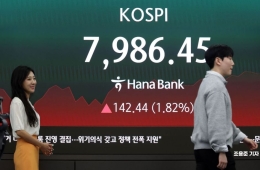
According to the Korea Exchange on the 11th, an analysis of the average returns of the top 10 net purchased stocks by major investor groups up to the previous day this year showed that institutions posted an average return of 9.07%. This significantly outperformed the KOSPI return of -1.71% during the same period. Foreign investors also recorded a solid return of 4.54%, surpassing the KOSPI. Meanwhile, individuals were the only group to record negative returns at -11.6%, falling well below the KOSPI performance.
All of the top 10 net purchased stocks by institutions showed favorable returns. Hyundai Heavy Industries led with a 17.12% gain this year, followed by S-Oil (13.07%), GS Construction (11.99%), POSCO (10.75%), and Samsung Fire & Marine Insurance (10.15%), with five stocks achieving double-digit returns.
Among foreign investors’ holdings, LG Chem, which had been weak at the end of last year, rebounded this year with a 15.45% increase, delivering the highest return. POSCO and Hyundai Glovis (8.04%) also posted strong returns. Additionally, bank stocks effectively defended their returns. Foreign investors bought shares in Hana Financial Group, KB Financial Group, and Shinhan Financial Group, which yielded solid returns of 7.97%, 5.09%, and 4.76%, respectively. Conversely, Samsung Electronics (-0.38%), SK Hynix (-4.96%), and LG Display (-3.25%) recorded negative returns.
Individual investors’ top 10 net purchased stocks all showed negative returns. Krafton fell the most sharply by 17.07%, followed by L&F (-16.28%), HYBE (-15.33%), Kakao (-14.13%), KakaoBank (-13.39%), LG Household & Health Care (-12.85%), and NAVER (-11.49%), with seven stocks experiencing double-digit declines.
While institutions’ strategy of focusing on cyclical stocks amid U.S. early tightening concerns paid off, individuals who concentrated on growth stocks such as secondary batteries, internet, and gaming were hit hard by fears of interest rate hikes. Growth stocks, which attract attention for future rather than current earnings, tend to be valued lower as interest rates rise because the discount rate applied to future earnings increases, making growth stocks more vulnerable to rate hikes. Lee Woongchan, a researcher at Hi Investment & Securities, said, "After a rally over the past year and a half, growth stock valuations have risen, and rapid monetary policy tightening is pushing up real interest rates, increasing the discount rate on growth stocks."
Hot Picks Today
 "If a Strike Happens, Damage Is Inevitable"...Samsung Electronics Takes Out 360,000 Wafers to Brace for Worst-Case Scenario
- No Bacteria Detected in Arisu After 24 Hours of Repeated Drinking from a Tumbler
- "Available Only in Korea": Pokémon Card Prices Surge 2,532% Due to Rarity, Becoming Investment Assets
- “He Did What Even Family Couldn’t”… Teacher Supports Student Who Lost Father for 7 Years
- "Addicted to Uncovering Hidden Value Investing Opportunities"... Korean Stock Fever Sweeps the US
Seo Jeonghoon, a researcher at Samsung Securities, advised, "If the absolute level of real interest rates rises higher than before as a signal of tightening by the U.S. Federal Reserve (Fed), growth stocks, which have relied on multiple expansions for price increases, could be hit. Therefore, premature attempts to buy these stocks at low prices should be avoided." Kim Younghwan, a researcher at NH Investment & Securities, also said, "To reduce risk in the early-year market, where domestic and international negative factors are concentrated, it is necessary to select sectors that can withstand discount rate pressures. The early-year stock market environment will favor large cyclical stocks over growth stocks."
© The Asia Business Daily(www.asiae.co.kr). All rights reserved.