Fear of Fed Quantitative Tightening and COVID-19 Risks... KOSPI Slips to 2910 Level
![[Image source=Yonhap News]](http://www.asiae.co.kr/news/img_view.htm?img=2022011011003393568_1641780033.jpg)
[Asia Economy Reporters Lee Seon-ae and Jang Se-hee] As the U.S. Federal Reserve (Fed) hinted at a more hawkish (tightening) response than the market had anticipated with 'quantitative tightening,' and COVID-19 cases surged globally, domestic financial market investor sentiment appears to be freezing up. Asian stock markets also started off weak.
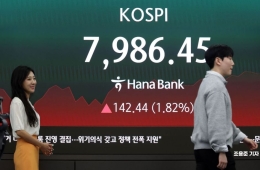
On the 10th, the KOSPI opened at 2,947.37, down 7.52 points (0.25%), and the KOSDAQ opened at 992.49, down 2.67 points (0.27%). The decline deepened, pushing the KOSPI down to the 2,910 level and the KOSDAQ to the 970 level. As of 10 a.m., the KOSPI was trading at 2,912.14, and the KOSDAQ at 976.56.
Quantitative tightening means that the Fed will reduce the size of its holdings by not reinvesting in financial assets such as U.S. Treasury bonds and mortgage-backed securities (MBS) as they mature. The reduction of liquidity in the market acts as a negative factor for the stock market.
The spread of COVID-19 is also a negative factor. The U.S. has seen an average of over 700,000 new COVID-19 cases per day, with cumulative cases approaching 60 million. The situation in China is also challenging. About 20 days before the Winter Olympics, 20 confirmed cases were reported in Tianjin, one of China's four direct-controlled municipalities located 140 km from Beijing. Currently, Chinese authorities have ordered COVID-19 testing for all 15 million residents of Tianjin.
Jo Byung-hyun, a researcher at Yuanta Securities, diagnosed, "There is a deepening concern over the Fed's more radical monetary policy and a tightening monetary policy stance beyond normalization levels."
Asian stock markets also started off weak. At the opening, the Shanghai Composite Index fell 0.49%, and the Hong Kong Hang Seng Index dropped 0.27%.
The won-dollar exchange rate continues to rise. As of 10 a.m. in the Seoul foreign exchange market, the won-dollar exchange rate was 1,199.1 won, down 2.4 won from the previous day's closing price. The rate opened at 1,198.8 won, down 2.7 won from the previous session, rose to 1,200 won in the early session, and then moved around the 1,199 won level.
Hot Picks Today
 No Bacteria Detected in Arisu After 24 Hours of Repeated Drinking from a Tumbler
- "We Can't Just Let Them Be Damaged Inside"... Samsung Electronics Removes 360,000 Wafers in Preparation for Strike
- "Up to 100 Trillion Won in Losses Feared, It's Not About Second Place but Catastrophe"... Industry Minister: 'Emergency Mediation Unavoidable If Samsung Strike Occurs'
- Wife in $6.7 Million Debt Took Out $3 Million in Husband's Life Insurance, Poisoned Him... US Court: "She Can Never Be Released"
- "He's Handsome, It's Such a Pity?"... Lawyer Responds to Bizarre 'Appearance Evaluation' of High School Girl Murder Suspect
There are also forecasts that the exchange rate could peak in the first quarter. Yoon Yeo-sam, a researcher at Meritz Securities, analyzed, "Due to the Fed's balance sheet reduction and other factors, U.S. interest rates are rising, maintaining the dollar's strength." Yoon added, "If the first-quarter peak is broken, it could reach 1,250 won. However, depending on the monetary policy trends of major countries such as the European Central Bank in the second half of the year, the one-sided dollar strength trend could ease."
© The Asia Business Daily(www.asiae.co.kr). All rights reserved.