"If Opposition Candidates Unite... Ahn Cheol-soo 42.3%, Lee Jae-myung 28.9%"

Yoon Seok-yeol (left), the presidential candidate of the People Power Party, and Ahn Cheol-soo, the presidential candidate of the People Party, are greeting each other at the '2022 New Year's Meeting of Small and Medium Business Owners' held on the 5th at the Korea Federation of SMEs in Yeouido, Seoul. Photo by Kim Hyun-min kimhyun81@
View original image[Asia Economy Reporter Dongwoo Lee] A poll released on the 9th showed that if Ahn Cheol-soo, the presidential candidate of the People’s Party, runs as a unified candidate with Yoon Seok-youl of the People Power Party, he leads Lee Jae-myung of the Democratic Party of Korea by a margin beyond the margin of error.
When Yoon runs as the unified opposition candidate, the race with Lee Jae-myung is within the margin of error.
According to a telephone interview survey (100% mobile, response rate 19.9%) conducted by Southern Post on behalf of CBS from the 7th to 8th among 1,002 men and women aged 18 and over nationwide, if Ahn becomes the unified opposition candidate, Ahn recorded a support rate of 42.3%, while Lee received 28.9%.
The gap between the two candidates was 13.4 percentage points, exceeding the margin of error. Justice Party candidate Sim Sang-jung received 4.3%, 'No preferred candidate' was 16.4%, and 'Don't know/No response' was 5.4%.
If the unification is made with Yoon as the candidate, Yoon received 34.4%, and Lee 33.6%, showing a close race within the margin of error. Sim received 4.7%, 'No preferred candidate' 18.2%, and 'Don't know/No response' 5.7%.
In a multi-candidate race where Ahn is the conservative opposition unified candidate, 69.3% of respondents who chose Yoon shifted their support to Ahn, and 11.6% of those who supported Lee also switched their support to Ahn.
In a multi-candidate race where Yoon is the unified candidate, only 30.6% of respondents who supported Ahn said they would support Yoon. Regarding support or opposition to the unification of conservative opposition candidates, 44.3% were in favor, 37.8% opposed, and 18.0% were unsure or did not respond.
In a multi-candidate race without assuming unification, Lee received 34.1%, Yoon 26.4%, with a gap of 7.7 percentage points, which is outside the margin of error.
In party support surveys, the People Power Party was highest at 35.3%, followed by the Democratic Party at 25.8%, a gap of 9.5 percentage points. The People’s Party had 6.4%, Justice Party 5.1%, and Open Democratic Party 3.5%.
Regarding President Moon Jae-in’s administration, positive evaluations were 40.5%, negative evaluations 56.4%. Compared to the previous survey, positive evaluations decreased by 2.6 percentage points from 43.1%, and negative evaluations increased by 2.9 percentage points from 53.5%.

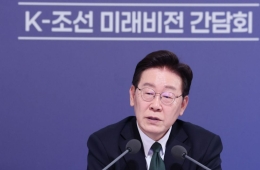
Lee Jae-myung, the Democratic Party presidential candidate, is exchanging fist bumps with Floor Leader Yoon Ho-jung during a meeting with small business owners from industries excluded from loss compensation at a small theater in Daehak-ro, Jongno-gu, Seoul, on the 9th. Photo by Yoon Dong-ju doso7@
View original imageA presidential candidate support rate survey conducted by the Korea Society Opinion Institute (KSOI) from the 7th to 8th nationwide among 1,000 people using a wireless automated response method (response rate 8.7%) also showed that Ahn’s support rate rose 5.9 percentage points from the previous week to 15.1%, reaching double digits. Ahn’s support rate also rose to 15% in the Gallup Korea survey released on the 7th.
According to election law, if a candidate’s vote share is 15% or higher, they can receive full reimbursement of election expenses. Lee received 37.6%, and Yoon 35.2%, both down 3.4 and 1.9 percentage points respectively from the previous week. The gap between the two candidates’ support rates narrowed by 1.5 percentage points from 3.9 to 2.4 percentage points.
When asked who is more suitable for the opposition candidate unification, 37.3% responded Ahn, and 35.5% pointed to Yoon, showing a close race. Regarding President Moon’s administration, positive evaluations fell 2.3 percentage points from the previous week to 41.7%, and negative evaluations rose 1.1 percentage points to 54.1%.
Party support rates were 33.1% for the People Power Party, 30.7% for the Democratic Party, 7.9% for the People’s Party, 5.9% for the Open Democratic Party, and 3.9% for the Justice Party. In the same survey, 54.5% supported the Democratic Party’s reform plan to limit the number of times a three-term incumbent can run in the same constituency, 31.4% opposed, and 14.2% were unsure.
Regarding the pledge to expand health insurance coverage for hair loss treatment, support and opposition were 43.1% and 43.8%, respectively. The margin of error for both polls is ±3.1 percentage points at a 95% confidence level.
Hot Picks Today
 Even with High Oil Price Relief Payment, Additional 300,000 Won Per Person to Be Provided... Applications Open from the 18th in This Region
- "Invested 95% in Hynix and Reached 10 Billion Won"... Japanese Investor's Proof Post Goes Viral
- "Why Is the Korean Stock Market Surging?"... Even Italy Is Astonished by the KOSPI Rally
- "You Don't Need to Go to the Gym": The Best Exercises for Lowering Hypertension
- "That Thing Wakes Up Every Night" ... Suspicious Object Covers Rural Village
For detailed survey information, please refer to the Central Election Poll Deliberation Commission website.
© The Asia Business Daily(www.asiae.co.kr). All rights reserved.