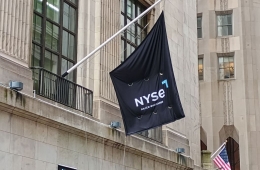
US to Start 'Quantitative Tightening' in June Following March Rate Hike... Impact on Stock Market?
[Asia Economy Reporter Ji Yeon-jin] As the U.S. central bank, the Federal Reserve (Fed), is expected to raise the benchmark interest rate in March this year, there are also forecasts that it will initiate 'quantitative tightening' to withdraw liquidity from the market within this year.

On the 9th, Shinhan Financial Investment predicted that if the Fed raises interest rates in March, quantitative tightening could begin as early as June. Ha Geon-young, a researcher at Shinhan Financial Investment, said, "The Fed is expected to absorb excess liquidity of mid-$1 trillion through asset reduction at an average of $80 billion per month over about 1 year and 9 months," adding, "If quantitative tightening accompanies this, the pace of interest rate hikes is expected to slow down."
As the reason for the Fed's pace adjustment in raising interest rates, Ha cited the need to maintain a low interest rate policy to stabilize prices through liquidity control and to support fiscal policy with monetary policy.
Researcher Ha said, "Excess liquidity, which has driven broad asset price increases, is expected to be absorbed through the Fed's quantitative tightening," but added, "However, until the first half of the year just before quantitative tightening begins, the absolute scale of liquidity will remain unchanged, and only the perspective on risk premiums will change, leading to a style rotation of funds."
After the financial crisis, the Fed's quantitative easing caused a rapid increase in the monetary base, but most of it was re-deposited with the Fed, limiting the initial expansion of private liquidity supply. In contrast, after COVID-19, the Fed's quantitative easing combined with aggressive expansionary fiscal policy by the government and the Fed's asset purchases led to an inflow of U.S. Treasury cash, which directly supplied liquidity to the market through fiscal spending.
Therefore, until the first half of the year before quantitative tightening begins, the absolute scale of liquidity is expected to remain unchanged despite policy rate hikes. However, asset prices, which surged due to COVID-19 liquidity inflows, may show a gradual decline, and risks that were previously undervalued due to uncertain future growth will increase, Ha predicted. Conversely, the evaluation weight on the safety of earnings, which had been given relatively low weight, may increase.
Hot Picks Today
 Even with High Oil Price Relief Payment, Additional 300,000 Won Per Person to Be Provided... Applications Open from the 18th in This Region
- "Invested 95% in Hynix and Reached 10 Billion Won"... Japanese Investor's Proof Post Goes Viral
- "Why Is the Korean Stock Market Surging?"... Even Italy Is Astonished by the KOSPI Rally
- "You Don't Need to Go to the Gym": The Best Exercises for Lowering Hypertension
- "That Thing Wakes Up Every Night" ... Suspicious Object Covers Rural Village
Lee Eun-taek, a researcher at KB Securities, also pointed out, "When interest rates rise, stock prices fall, which leads to economic slowdown and in turn limits further interest rate increases," adding, "The combination of economic slowdown and Fed tightening expands stock market uncertainty, but in the longer term, it is not entirely negative." He continued, "It is difficult to confirm whether the current short-term interest rate rise will turn into a trend, and I prefer value stocks that overlap with 'reopening' (such as alcoholic beverages, food ingredients, oil-related, travel and leisure) among value stocks."
© The Asia Business Daily(www.asiae.co.kr). All rights reserved.