KOSPI Starts New Year's First Trading Day with Over 1% Rise

This year, the KOSPI index made new history in the domestic stock market by surpassing the 3300 mark despite the shock of COVID-19. At the same time, the index experienced sharp declines due to tapering (asset purchase reduction), inflation, US-China conflicts, and concerns over variant viruses. In the new year of Im In, we hope that the Korean economy will leap forward more vigorously with the bravery of the tiger. On the 22nd, the year is coming to an end in the Yeouido financial district of Seoul. Photo by Moon Honam munonam@
View original image[Asia Economy Reporter Minji Lee] On the first trading day of the Year of the Black Tiger, the KOSPI opened higher and showed an upward trend. Despite the burden of weak export data announced on the 1st and concerns about foreign investor flows, the market is maintaining a favorable trend.
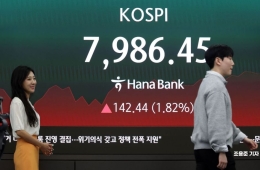
As of 10:17 a.m. on the 3rd, the KOSPI stood at 3006.66, up 0.97% (29 points) from the previous trading day. The KOSPI opened at 2998.32, up 0.69% (20.67 points) from the previous day, and continued its upward momentum.
Strong buying by foreign investors is driving the index higher. Although foreigners sold stocks worth 230 billion KRW on the last trading day of last year, they are currently purchasing stocks worth about 150 billion KRW. Individuals and institutions sold stocks worth 10.9 billion KRW and 131.5 billion KRW, respectively.
While the U.S. stock market experienced a slight decline on the last trading day of last year due to selling pressure mainly on large-cap stocks, the domestic market has continued its upward trend unaffected. Although the export data released on the 1st showed a lower-than-expected growth rate of 18.3% compared to the market forecast of 22%, raising concerns about corporate earnings slowdown, positive results from key sectors such as semiconductors (35%) and automobiles (17%), along with easing currency pressure, are believed to have offset these concerns.
Looking at the top market capitalization stocks, most showed gains: Samsung Electronics (0.89%), SK Hynix (0.38%), NAVER (0.13%), Samsung Biologics (0.44%), Kakao (1.78%), Samsung SDI (0.46%), Hyundai Motor (0.24%), and LG Chem (1.14%).
At the same time, the KOSDAQ index stood at 1038.96, up 0.48% (4.98 points) from the previous trading day. The index opened at 1038.97, up 0.48% (4.99 points) from the previous day.
Among the top market capitalization stocks, Celltrion Healthcare (0.37%), Pearl Abyss (1.66%), Kakao Games (3.52%), Wemade (2.36%), HLB (2.16%), and Seegene (0.16%) showed upward trends, while EcoPro BM (-0.04%), L&F (-2.02%), and Celltrion Pharm (-0.56%) declined.
Hot Picks Today
 No Bacteria Detected in Arisu After 24 Hours of Repeated Drinking from a Tumbler
- "Available Only in Korea": Pokémon Card Prices Surge 2,532% Due to Rarity, Becoming Investment Assets
- Staring at Stock Charts Causes 'Hwabyeong'... "What Have I Even Been Doing?" FOMO Spreads Amid Soaring KOSPI
- President Lee: "Agriculture Is a Core Strategic Industry Ensuring Food Sovereignty... Major Transformation of Rural Areas Needed"
- "Egg Prices Are Strange" Proven True... Collusive Margin Hike of 46% Without Basis Leads to 594 Million Won Fine
Meanwhile, the securities market opened one hour later than usual at 10 a.m. today, while the closing time remained the same at 3:30 p.m.
© The Asia Business Daily(www.asiae.co.kr). All rights reserved.