Due to strengthened quarantine measures, the Korean economy faces year-end setbacks... 'Return to normal' fades, with persistent domestic and external risks
Focus on Domestic Demand Contraction... Decline in Consumption Impact Slows Down

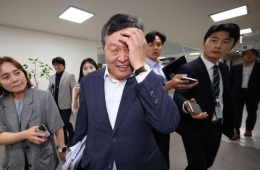
The spread of COVID-19 and the strengthening of quarantine measures have deepened the worries of self-employed business owners. On the 16th, a mask-wearing notice was posted at a restaurant in Jung-gu, Seoul. Photo by Mun Honam munonam@
View original image[Sejong=Asia Economy Reporter Moon Chaeseok] The government’s move to strengthen quarantine measures to curb the spread of COVID-19 is expected to inevitably shrink the year-end economy. Domestic demand, including consumption and employment, is bound to be hit, and the worries of small business owners who cannot fully enjoy the year-end peak season are expected to deepen. The "gradual recovery to daily life (With COVID-19)" policy is being criticized as a "boomerang" that is instead damaging the economy.
According to the government on the 19th, due to strengthened quarantine measures, from the 18th, the maximum number of private gatherings was reduced to four people in both the metropolitan area and non-metropolitan areas, and operating hours for restaurants and cafes were limited until 9 p.m., and movie theaters and PC rooms until 10 p.m. In effect, the country has returned to a high-intensity social distancing system before the implementation of With COVID-19. The domestic economy is expected to face another cold wave.
The Ministry of Economy and Finance diagnosed in the "Recent Economic Trends (Green Book December issue)" released on the 17th that "Recently, our economy has maintained solid export and employment growth, but concerns remain about the impact on domestic demand such as face-to-face service industries due to the increase in COVID-19 cases and strengthened quarantine measures." In last month’s Green Book, after the implementation of the With COVID-19 policy, there was optimism that "the transition of the quarantine system could gradually improve domestic conditions such as face-to-face service industries," but within a month, expectations have turned into concerns.
The indicators from mid to late November, when confirmed cases began to surge, and preliminary indicators provide some measure of the economic impact. The number of employed people last month increased by 553,000 compared to a year ago, but the increase was smaller than in October (652,000), and employment in the accommodation and food service sector, a representative sector hit by COVID-19, decreased by 86,000, returning to a decline after three months. Jung Dong-myung, Director of the Social Statistics Bureau at Statistics Korea, explained, "With the implementation of gradual recovery to daily life and relaxation of quarantine rules, the daily number of confirmed cases surged, leading to a significant decrease in employment mainly in restaurants and pubs." This means that as confirmed cases increased, customers at restaurants and bars decreased, causing employment to fall. Because of this, concerns are emerging that next month, with the added impact of strengthened quarantine measures, the decline in employment in face-to-face service sectors such as accommodation and food services will deepen.
Consumption showed a more noticeable recovery than employment, but the outlook remains uncertain. Last month, card approval amounts increased by 13.6% compared to a year ago, marking ten consecutive months of growth. However, consumption is likely to contract further after the strengthening of quarantine measures. In the accommodation and food service sector, decreases of 19.0% during the first wave (February 2020), 7.6% during the second wave (August 2020), and 27.6% during the third wave (December 2020) were recorded, but during the fourth wave (July 2021), the decline narrowed to 5.2%. However, since the impact of COVID-19 spread on consumption has been diminishing over time, the decrease may not be severe. Kim Young-hoon, head of the Economic Analysis Division at the Ministry of Economy and Finance, said at the Green Book briefing on the 17th, "The upward trend in consumption-related preliminary indicators stopped at the end of last month, and in December, it turned to a slight decline," adding, "The fourth wave of COVID-19 is ongoing after the first, second, and third waves, but the impact on consumption has gradually lessened over time."
Hot Picks Today
 Given Grants, Then Says "No Launch" ... Innovative Korean Technology Ultimately Forced Overseas
- "Rather Than Endure a 1.5 Million KRW Stipend, I'd Rather Earn 500 Million in the U.S." Top Talent from SNU and KAIST Are Leaving [Scientists Are Disappearing] ①
- [Breaking] Chairman Park Sookeun: "Possibility of Agreement Instead of Samsung Electronics Labor-Management Mediation Proposal"
- "If That's the Case, Why Not Just Buy Stocks?" ETFs in Name Only, Now 'Semiconductor-Heavy' and a Playground for Short-Term Traders
- "No Cure Available, Spread Accelerates... Already 105 Dead, American Infected"
External risks are also significant. Global inflation and concerns over supply chain disruptions continue, and uncertainties related to major countries’ monetary policy shifts remain high. Initially, when With COVID-19 was implemented, the government judged that the focus of risk management was shifting from the domestic sector to the external sector, but due to the increase in confirmed cases and strengthened quarantine measures, it will end the year bearing burdensome risks in both sectors.
© The Asia Business Daily(www.asiae.co.kr). All rights reserved.
![Cheaper Than Candy, Yet Impossible to Find... Fears of a 'Pediatric Medical Crisis' as Pharmaceutical Companies Halt Production [Why&Next]](https://cwcontent.asiae.co.kr/asiaresize/307/2026051910065268365_1779152813.jpg)