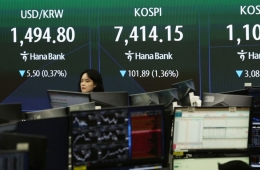
Foreigners Bought 1 Trillion Won of KOSPI This Month... Signal of a Shift in Net Buying Trend?
First Joint Net Buying in Asian Emerging Markets
Taiwan and Korea Buy Together "Preemptive Recognition, Shift in Price Attractiveness"
KOSPI PER from 15x to 10x, Possibility of Low-Price Buying

[Asia Economy Reporter Ji Yeon-jin] Foreign investors have turned to net buying in the KOSPI market this month, purchasing nearly 1 trillion won worth of stocks, marking a shift to net buying after a month. The scale of foreign net purchases in the KOSPI this month is the largest of the year, and foreigners are expanding their net buying not only in the domestic stock market but also across emerging markets in Asia.
According to the Korea Exchange on the 19th, foreign investors have net purchased 993.7 billion won worth of stocks in the KOSPI market up to the previous day this month. As of the 17th, the net purchase amount exceeded 1 trillion won, reaching 1.0492 trillion won. Monthly foreign net buying is the third this year following April and September, and the scale of net buying this month is the largest on a monthly basis.
The market is paying attention to the fact that although the KOSPI's returns have been slightly weak this month, continuing a five-month consecutive decline, large-cap stocks have shown relatively favorable returns. The fact that large-cap stock returns outperform the KOSPI returns is the first time in 10 months since January, interpreted as a signal that market style is changing along with the shift to foreign net buying.
In particular, the return of foreign net buying this month is noteworthy as it is a phenomenon appearing for the first time this year, reflecting changes not only in the domestic stock market but across emerging markets in Asia. Even in April and September, when foreign investors recorded net buying in the domestic market, they showed selling behavior in the Asian markets.
Moreover, the fact that foreign investors are simultaneously net buying in both the domestic market and Taiwan adds significance. Park Seok-hyun, a researcher at KTB Investment & Securities, said, "It is necessary to pay attention to the possibility that the trend of foreign investors in emerging Asia in November is not limited to some countries but may be the beginning of a fundamental change," adding, "The shift to net buying by foreigners in Korea and Taiwan implies a focus moving from concerns over profit outlooks to preemptive recognition and price attractiveness."
Global liquidity, inflation, and the normalization of U.S. monetary policy, which have been cited as reasons for avoiding emerging market stock markets, have already been factored in as negative factors. Additionally, the continuous downward trend of large-cap stocks in the KOSPI since January this year has highlighted price attractiveness. According to KTB Investment & Securities, foreign investors net sold $45.3 billion across eight Asian countries from January to October this year, concentrating net sales of $28.7 billion and $19.4 billion in Korea and Taiwan, respectively. Despite large profits mainly in IT this year, concerns over 'peak-out' (decline after economic peak) fueled foreign capital outflows.
There is also a view that this is more of a bargain hunting rather than a fundamental shift. Lee Jin-woo, a researcher at Meritz Securities, said, "It is difficult to conclude that this is a full-fledged shift to net buying by foreigners, but since the KOSPI price-to-earnings ratio (PER) has dropped from 15 times at the beginning of the year to 10 times now, there is price attractiveness, so it appears to be selective buying," adding, "Macro variables such as uncertainty in China and inflation are no longer worsening, which is also a factor for net buying."
Hot Picks Today
!["Rather Than Endure a 1.5 Million KRW Stipend, I'd Rather Earn 500 Million in the U.S." Top Talent from SNU and KAIST Are Leaving [Scientists Are Disappearing] ①](https://cwcontent.asiae.co.kr/asiaresize/93/2026051414165763158_1778735817.jpg) "Rather Than Endure a 1.5 Million KRW Stipend, I'd Rather Earn 500 Million in the U.S." Top Talent from SNU and KAIST Are Leaving [Scientists Are Disappearing] ①
"Rather Than Endure a 1.5 Million KRW Stipend, I'd Rather Earn 500 Million in the U.S." Top Talent from SNU and KAIST Are Leaving [Scientists Are Disappearing] ①
- Samsung Electronics Strike D-2... Park Sugun, Central Labor Relations Chairman: "Differences Narrowing... Possibility of Agreement"
- Is This the Peak? As Others Hesitate..."The Answer Is Clear for Surviving the KOSPI 10,000 Era"
- "If That's the Case, Why Not Just Buy Stocks?" ETFs in Name Only, Now 'Semiconductor-Heavy' and a Playground for Short-Term Traders
- "No Cure Available, Spread Accelerates... Already 105 Dead, American Infected"
The financial investment industry advises reflecting this in year-end portfolio strategies, as foreign net buying sectors are concentrated in cyclical growth stocks such as semiconductors, IT home appliances, displays, and the broader IT sector, as well as automobiles, cosmetics, apparel, and transportation.
© The Asia Business Daily(www.asiae.co.kr). All rights reserved.